
Economics
Hindu Rate Of Growth: A Tale of Prejudices And Fallacies
Samridh Joshi
Dec 08, 2025, 01:14 PM | Updated 01:14 PM IST
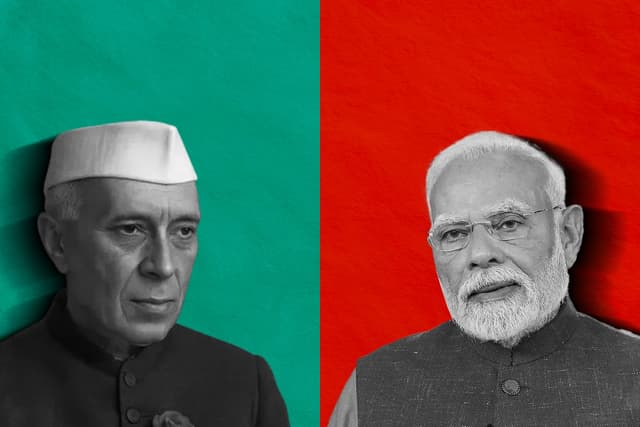
Avid readers of economics and finance, often come across one of the most abused terms of modern Indian economic history, the ‘Hindu Rate of Growth’.
The term evidently refers to poor economic fundamentals including sluggish growth, muted investment rate, poor public expenditure (both domestic and capital) and a lack of demand which in turn is held responsible for low production rate of goods and supply, fanning a vicious cycle that doesn’t let the economy flourish.
While oft used in academic culture and by prominent economists, on a closer inspection, one realises that the term is one borne out of academic prejudice, lack of economic rationality, as well as a subtle attempt to blanket the actual reasons behind the failure of Indian economic growth pre-liberalisation which were not rooted in Hindu culture but rather had their origins in socialist thought.
Reading the Hindu economic thought, one would further realise that the pre-liberalisation models of economic planning were rather antithetical to the very ideas ingrained in texts like the Arthashastra and Smritis.
Muted pre-liberalisation growth should rather be attributed to the model of post-independence economic planning, which was based on faulty premises of fabian socialism, clubbed with Nehruvian ideals. More so, Nehru was neither a practicing Hindu nor had any appreciation for Hindu economic philosophy and it is extremely unlikely that he was ever inspired by Hindu thoughts while devising his famed economic policies.
The era of subdued growth: Socialism and Nehruvian Thought
Since the 1930s, Jawaharlal Nehru as a young leader in the Indian National Congress had natural leanings towards the ideas of socialism and economic egalitarianism. These ideals were further bolstered by the rise of Soviet Russia that broke the shackles of imperialism and marched towards a semi-dictatorial socialist state, led by Vladimir Lenin and his successors. The Russian Revolution inspired many in the Congress as the new government renounced its claims on the colonial territories of the Czar (erstwhile rulers) and thus the Soviet model came to be seen as a natural economic model to ward off imperialism.
Nehru had turned into a radical socialist, almost bordering communist by the late 1930s. It is during the later deliberations of the National Planning Committee of Congress that he began shifting to a more moderate form of socialism, principally because of the pushback by the leading industrialists who were also members of the committee. Gandhi too was not in favour of a centralised economy. Nehru eventually moved to a stance of accommodation, a planned economy where private players would coexist.
With the independence of the nation, Nehru implemented the command economy model based on the Mahalanobis plan, and the country that once controlled 25 per cent of the world's GDP (c.1100CE) and was the heart of Asian trade and commerce, closed its doors to foreign trade and began on the path of a controlled economy with government being the sole arbitrator of the economic fundamentals.
The private sector eventually bowed to the Government and ‘babus’, begging for licenses and engaging in rampant corruption and lobbying instead of market efficiencies and fair competition.
Coining of the Infamous Term
Although Nehru’s model met its goals of capital asset generation for the nation, the general economy to some extent, private enterprise and human development along with its foreign exchange reserves, took a beating.
Indira Gandhi, continued similar policies (even more aggressively), leading to rapid economic collapse. The decades from 1950-1990 saw an average growth rate of GDP of barely 4 per cent while the per-capita GDP increased at an even slower 2 per cent rate, worse than Sub-Saharan Africa.
This can be contrasted with the East Asian tigers and China, which grew rapidly in the same period. China, which had roughly the same GDP as India in the 1970s, skyrocketed to a global economic superpower, led by liberalisation, globalisation and a rapid move away from Communist economic ideas.
This debacle is precisely what has been termed as ‘Hindu’ rate of growth.
The reasons have been stated to be manifold by economists, red-tapism and corruption in the license regime that created a parallel black economy, poor innovation and technological developments, stifling of MSME segment, lack of investible capital (due to ban on foreign investment) and foremost among them all, monopoly of PSUs in most critical sector that dampened any competition and growth prospects. In short, the 'laziness' or 'laid-back attitude' of economic growth drivers—which formed the basis of the 'Hindu Growth Rate' thesis—can be attributed to the lack of competition from a closed economic model and the innate 'Babu-like' attitude of managers in key industries.
The term was first coined by BPR Vithal, under a pseudonym ‘Najin Yanupi’ in February 1973. What is interesting is that BPR Vithal was not an economist by training and was rather a bureaucrat, an IAS officer of the 1950 batch. With no formal training either in Hindu Philosophy or Economics, Mr. Vithal proclaimed that “The actual achievement despite these targets has been 3.7 to 3.8 per cent in the past two decades, which would give a growth of per capita income of roughly 1 plus per cent during this period. Thus, we have a situation where the rate of growth of per capita income varies between an actual of 1 per cent and a target of about 3 per cent. This range is not fortuitous. This is the range within which alone the Hindu view of life will hold.”
In an era where academic publications and remarks are subjected to a high degree of scrutiny, the ones by Mr. Vital were never put to the test.
Later, the economist Raj Krishna took up the same concept and popularised it. And unfortunately for Raj Krishna, as Gautam Chikermane points out, this fallacious term remains his only legacy and a pretty bad one at that.
The term was then immediately lapped up by certain elements of academia and financial media alike and became common in liberal economic theory, continuing in use with the most recent case of its revival by the noted economist Raghuram Rajan, whose attempts at predicting Indian economic indicators have amusingly gone horribly wrong.
Modi Era: Rise of Hindu Consciousness and Economy
The post 2014 era can be said to define the rise of both Hindu civilizational and cultural consciousness across socio-political spheres. A renewed interest in Hindu thought and practice is evident across both social discourse and governance agendas. While Prime Minister Modi wears the Hindu identity on his sleeve and symbols of Hindu renaissance continue to rise including the Rama Temple at Ayodhya, a radical shift of interest towards Hindu cultural and philosophical values can be seen across the youth in popular and social media.
How does the economy fare when this consciousness is on the rise? Critics and proponents of the ‘Hindu Rate of Growth’ theory would expect the economy to slow down and enter the same territory as Vithal had predicted. Unfortunately for them, this is hardly the case. GDP growth rates have shown a strong performance and a remarkable rebound post COVID, with real GDP in last quarter growing at 8.2 per cent (real) and growth estimates of FY26 placed at 7.3 per cent, nearly double the figures that a growing Hindu consciousness would lead as a result in the eyes of philosophers of the prejudiced idea.
Other indicators of the economy also seem to be doing well with inflation hitting a comfortable low of 0.25 per cent and the economy holding its reins well amidst the global tariff onslaught.
Nominal GDP has almost tripled from around Rs106.57 lakh crore in 2014-15 to Rs 331.03 lakh crore in 2024-25. There has also been a rise in India's Gross Value Added (GVA) wherein it has doubled from $1.88 trillion in 2014 to $3.55 trillion in 2024. Exports have also registered a growth of 67 per cent since 2014.
While I do not claim correlation is same as causation, on a cursory glance, the proposition of a strong Hindu consciousness leading to a weak economy does not seem to hold much water in the light of the modern experience.
Hindu Economic Thought: Proactive Enthusiasm and Artha
Hindu economic thought can be understood through various perspectives of history, philosophy, literature and social practices. History is testimony to the fact that India has been a trade capital since time immemorial. Maritime trade flourished extensively, evident from its mention in Vedic texts and epics.
Rigveda 1.48.3 mentions ”those who are desirous of wealth, send ships to sea”, indicating the importance attached to wealth and trade in the Vedic era. The same text further adds that merchants used to send out ships to foreign countries (2.48.3).
Another mantra (1.56.2) alludes to merchants going to different places and frequently by the sea routes. India was also the heart of the Silk route and the centre of trade in spices, fabric, precious stones, herbs, cotton and sugar. Trading envoys have been sent by Indian rulers and port towns flourished, Muziris and Kaveripattnam being fine examples.
Merchant guilds have been instrumental in development of towns in southern India after the decline of the Sangam Age. Trade was extensive with South-East Asia and texts alludes to the fact that a man in Varanasi could have fruits brought and delivered from as far as Java to him.
Kautilya in his seminal work, the Arthasastra, mentions extensively the commerce and accounts as well as wealth management and trade. Hindu economy and history is grounded on free trade and enterprise and state control is strongly opposed. The rulers seldom dictated means and items of production and Kautilya only suggested fishing, ferrying and trading in vegetables (haritapanya) to be controlled by the state.
Goddess Lakshmi has been worshipped since the Vedic Era as ‘Hiranmayi’ or Golden and appears in numismatics as a common icon on coins in circulation since early centuries CE. Hindu economic thought was responsible for India becoming the land where gold (wealth) flowed from all parts of the world and which accounted for nearly a quarter of everything that was produced in the world in terms of value. Such economic prowess denotes the true nature of a ‘Hindu Rate of Growth’ and not how some prejudiced minds have depicted it.
‘Artha’ has remained central to the Hindu philosophical foundations of life as one of the four ‘Purusarthas’ or goals of life. Artha is seen in many texts as the foundation of ‘Dharma’ (Ethics, Order) and ‘Kama’ (material pleasures), two other Purusarthas. Hence economy and wealth supports the Hindu foundations of life and in no way contradicts any fundamental tenet of philosophy.
Karma Yoga also doesn’t dissuade one from the pursuit of wealth but finds the pursuit of worth. What is however dissuaded is the centrality of wealth in life and society as the sole aim of all pursuits, an idea borne by modern social thinkers.
Hindu economic thought strongly refutes Marx and does not believe that economic truths form the basis of social processes and human interactions. The basis is instead said to be ethics and the cosmic order, Rta.
These however are not to be understood as laziness or complacency but a fine balance between blind materialism and absolute asceticism. Dignity of labour was also dictated by Hindu economic thought and every task was seen as equally respectable with an absence of large wage differentials in professions.
Contentment in Hindu economic theory does not have an implication of an aversion to wealth for wealth is a legitimate pursuit. Contentment, instead, is to be understood in the perspective of ‘being satisfied with one's own legitimate wealth’ and not to indulge in comparison with others or jealousy, a trait unfortunately rampant in modern economic psychology.
Meaning of contentment is explained in the ‘Isavasya Upanishad’ as “mā gṛdhaḥ kasya sviddhanam” or not be lustful after other’s wealth. The idea is one of ethical pursuit of wealth, keeping welfare of others in mind and not a pursuit that places ends over means and throws ethics or values before the bulldozer for money (as is evident in today’s capitalistic structures).
It is high time that serious academics refrain from using such an ill-founded and prejudiced term to define the economic debacles of the great Nehruvian socialistic experiment. These failures in political economy and policy cannot be blamed on the high ideals of ‘Artha’ and Hindu Economics which lays down the foundations of a rapid and sustainable growth centred around the spiritual human and which in no terms encourages inaction. Hindus are not scapegoats to be thrown under the bus for every mishap that occurred in Indian history.
Author: Samridh Joshi is a Senior Economist and Policy Consultant at NFPRC. He is an alumnus of IIT Kanpur and UC3M Madrid. Views are personal.
Samridh Joshi is a Senior Economist and Policy Consultant at NFPRC. He is an alumnus of IIT Kanpur and UC3M Madrid. Views are personal.
 Join our