Economy
Beyond The 8.2% GDP Number: Why India Needs Innovation, Not Just Growth With Prof Prasanna Tantri
Diksha Yadav
Dec 04, 2025, 05:48 PM | Updated 05:49 PM IST
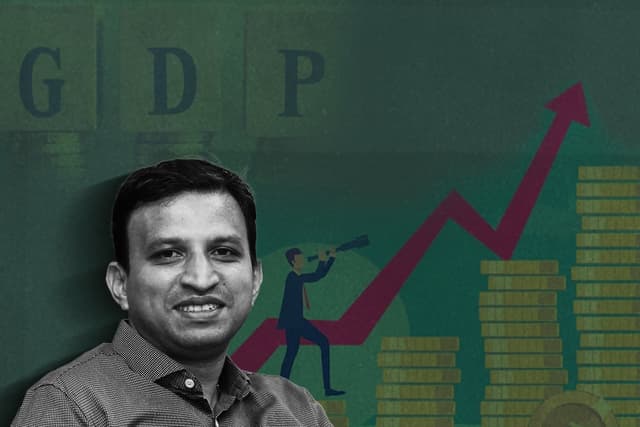
India's Q2 GDP growth of 8.2% sparked celebrations, but Professor Prasanna Tantri, Associate Professor of Finance at the Indian School of Business, urges caution against getting carried away by quarterly numbers. In a detailed conversation on Swarajya's What This Means podcast, Dr Tantri argues that while India remains on a positive trajectory, the real challenges — and opportunities — lie elsewhere.
(You can also listen to the full episode on Spotify or Apple Podcasts.)
The 8.2% Reality Check: Neither Boom Nor Bust
Despite facing the highest US tariffs globally at 50%, India achieved 8.2% GDP growth in Q2 — a sharp reversal from last year's 5.6% in the same quarter. However, Prof Tantri maintains the same position he held a year ago: neither number represents the economy's true state.
"Neither 5.6% is the real representation of what the economy was last year, nor is 8.2%," he explains. "We are still in that 6.5-7% range, maybe 0.5% more because RBI has been kind and the government has done very good things."
The government has indeed implemented several reforms Prof Tantri previously advocated for — cutting taxes, reducing government size, and even decreasing capital expenditure. But he's not ready to celebrate 8% growth projections just yet.
Three Key Takeaways From Q2 Numbers
Prof Tantri identifies three critical observations from the latest GDP data:
First, the numbers confirm India remains on a high growth track. Manufacturing, services, and agriculture all contributed positively.
Second, the government appears to have returned to meaningful reforms. "That's the best part," Prof Tantri notes, highlighting labor reforms as particularly significant — "far more important than most other things the government has done."
Third, and most concerning, are statistical inconsistencies. With nominal growth at 8.7% and real growth at 8.2%, inflation comes out to just 0.5% — a figure Prof Tantri finds "very hard to digest."
The Inflation Puzzle and Market Skepticism
The half-percent inflation figure creates logical contradictions. "If our inflation is half percent, our real interest rate is 5%," Prof Tantri points out. "If you have 5% real rate, most of the industry should have gotten shut by now, which means you are able to increase your prices at half percent while paying interest rates of 5%."
Moreover, such high real rates should have attracted massive capital inflows and caused rupee appreciation. Instead, the rupee has depreciated — hitting record lows on the very day of the GDP announcement.
Market reactions tell a similar story. Despite the surprise jump from an expected 7.4% to 8.2% Q2 GDP, markets showed muted response rather than gap-up opening. "If it's such a surprise, it should have been a gap-up opening," Prof Tantri observes. "There is some skepticism that needs to be addressed about these numbers."
He clarifies: "Error does not mean fraud. Fraud is when you fudge numbers; error is when your estimates have issues. Even the best estimates can have errors."
IMF's 'C' Grade
The IMF recently flagged India's national income calculation methods, assigning a C grade due to the outdated 2011-12 base year. Rather than dismiss this as conspiracy, Dr Tantri praises the government's mature response.
"One way of reacting is that everyone's trying to degrade us, they're conspiring against us," he says. "The other is what the government has done — a very mature way of handling this. If there is an Olympics somewhere, we have to play with the same rules until we start dictating the rules."
The government has committed to updating the base year and improving methodologies — a pragmatic approach that should address international concerns.
RBI's Next Move: A Strategic Pause Or Rate Cuts
The central bank should pause and wait for the February budget announcement, says Prof Tantri.
"RBI should signal to the government that it is conditional on your fiscal discipline," he argues. "If the government expenditure remains at Rs 50-53 lakh crore and they maintain discipline despite revenue losses from tax cuts, then RBI should straight away cut 50 basis points — even call an emergency meeting on February 1st evening after the budget."
But if the government increases spending and runs higher deficits, "RBI should not cut rates. If you cut rates, then you are playing to the gallery, fuelling government excesses, and that will create an inflationary cycle."
This approach reflects a key insight: current inflation is driven by supply shocks (monsoons, oil prices), not demand or monetary factors. "When there are increased rates, this is what I was saying — there's nothing to do with RBI. The third factor is beyond these people's control," referring to supply factors."
The Next Frontier: Judicial Reforms
When asked about the next bottleneck, Prof Tantri doesn't hesitate: "Of course, judiciary is number one."
India's contract enforcement remains a critical weakness. "Even when ease of doing business rankings used to be there, even when we improved, that's one area we were in the 150s, 160s ever(India ranked 163 out of 190 economies in the "Enforcing Contracts" indicator). It takes forever to settle disputes here."
This isn't just bureaucratic inconvenience — it fundamentally undermines investment confidence and business operations.
The Innovation Deficit: India's Existential Challenge
But Prof Tantri's deepest concern isn't about quarterly numbers or even judicial reforms. It's about innovation — or the lack thereof.
"My latest obsession is innovation," he declares. "We think that we have talent and all that we need is financing. I think our top talent leaves the country. Unless we get that top talent, funding alone is not going to solve the problem."
He draws a stark comparison with China's trajectory. "China had this brilliant way of copying things. Look at our IT — we've had IT as long as China had manufacturing, or maybe five years less. They have become leaders in that."
The result? "The US cannot dare to impose tariffs on China the way they can on India. India faces 50% tariffs. Why is China not the highest taxed? They cannot. Why have we not been able to build dependency? Because we are doing low-end work. They are doing high-end work."
Dr. Tantri is quick to honour India's first-generation tech pioneers. "We should keep photographs of Narayana Murthy in our houses. Otherwise, we would have been in some farm doing farming now. Politicians are getting Bharat Ratnas — these guys who started IT and Infosys should get Bharat Ratnas."
But he insists India must graduate to the next level. "Having said that, somehow after that we have failed to graduate to the next level. Now we have to understand what are the forces within India that prevent us from graduating. Why don't we go to the frontline? Why don't we make the world dependent on us on something atleast."
The Talent Imperative
Recent RDI investment announcements are positive, but Prof Tantri wants to see specific focus on people, not just capital. "In that R&D fund, I would like to see something on people. Get 100-200 top people, house them here, give them outsized rewards."
Prof Tantri believes, "If you get talent, capital will flow. If you get capital, talent may not flow."
The emphasis on "top" talent is deliberate. "Don't get another mediocre 85% — we don't need that; there are many. I want that 99.9% guy. Not in terms of marks, in terms of innovation ability. That guy is the one who's going to create magic. Get 100 such people."
The Global Perception Problem
Perhaps most troubling is the growing disconnect between domestic enthusiasm and global investor sentiment. "We are becoming a reverse AI story — people are shorting India. All our enthusiasm is inside; outside, we're losing sheen. We have underperformed."
Prof Tantri challenges a common narrative: "I see a lot of people saying FIIs have left India, but retail investors have made money. It's so wrong, unfortunately. FIIs who left India and invested in the US have outperformed India massively. The rupee has depreciated."
Market reaction to the GDP surprise confirms this skepticism. "With so much enthusiasm, Dow Jones was yesterday 0.7% down (The episode was recorded on Monday). It's an event study — it should have led to at least a 1% increase for such a surprise number. It did nothing."
The Real Exchange Rate Story
Another inconsistency: our real exchange rate is depreciating; that means our exchange rate is depreciating beyond the inflation differential.
So if India's inflation is 0.5% and US inflation is 3%, the rupee should appreciate by 2.5% based on inflation differentials. Instead, it's depreciating.
The 10-15 Year Window
Prof Tantri's urgency stems from demographic and economic realities. "The question is we are still at $2,500 per capita income. We have to reach $50,000-60,000 if we want to become Viksit Bharat, and we have to do it quickly. If we go at this pace, the worry is we will get stuck at $5,000-7,000 — the middle-income trap — and then we will slow."
Current 6.5-7% growth is "not bad — it's a great number. Nobody has done 7% for a sustained period except China and very few others." But it's not enough.
"This is not going to be forever," he warns. So hopefully we will think about innovation and getting this talent back. Long-term history shows economic growth is not created by politicians — it's created by innovators and investors."
Looking Ahead: Budget and Beyond
As India approaches the February budget, Prof Tantri's prescription is clear:
Fiscal restraint: Keep expenditure at Rs -53 lakh crore despite tax revenue losses
Monetary support: If fiscal discipline holds, RBI should cut rates by 50 basis points
Regulatory simplification: Ensure reforms address binding constraints, not just headline numbers
Innovation focus: Use RDI investments to attract and retain top global talent
Long-term perspective: Pace up reforms, don't get carried away by quarterly volatility
"Broadly, if you ask me, it's way better this year than last year," he concludes. "At least taxes have gone down. That itself is a great thing."
But for India to truly become "Vishwa Guru" — it needs more than good quarterly numbers. It needs to win the innovation race, create global dependencies, and make its economy indispensable rather than easily tariffed.
The 8.2% GDP number is fine. The real question is: what happens 10-15 years from now?
Diksha Yadav is a senior sub editor at Swarajya.
 Join our