Economy
India's TFR Declining Faster Than Anticipated: Dr Shamika Ravi Says Women Need Childcare Support
Diksha Yadav
Nov 20, 2025, 03:45 PM | Updated Dec 09, 2025, 10:26 AM IST
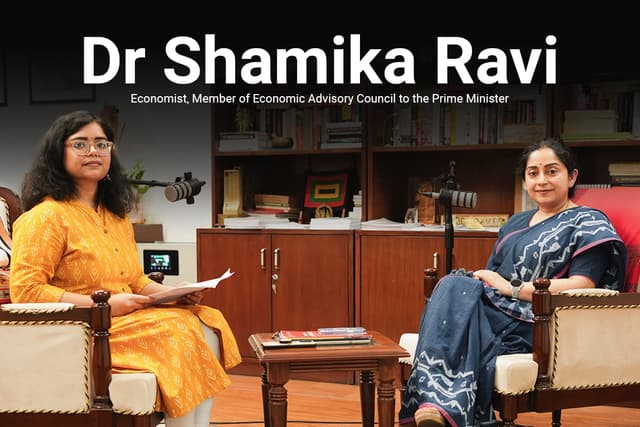
In a wide-ranging conversation, economist and member of the Economic Advisory Council to the Prime Minister of India, Dr Shamika Ravi speaks with Swarajya on What This Means podcast on Bihar's economic trajectory, the unique challenges it faces, and broader policy questions about India's growth, from female labour force participation to the culture of innovation.
(You can watch the full episode on Spotify, Apple Podcast or YouTube.)
1. Female Labour Force Participation, TFR Decline, And Working Women's Hustle
One of Dr Ravi's research findings concerns women's working patterns. While female labour force participation in India improved (from 23.3% in 2017-18 to 41.7% in 2023-24, approaching the global average of 47.2%), the age distribution reveals troubling patterns.
"Women enter the labour force at the age of around 20, but they drop out around 40," Dr Ravi explains. "Men enter at similar times but stay on much longer. Men get at least a decade and a half more of working age on average."
Why do women exit at 40? "It can be because the kids are now at a time when schooling happens and exams happen, and women are staying back, taking a lot of leave, and eventually dropping out because they need to support kids."
This isn't just about early childhood. "You can't just send kids to school and forget about it. They come back from school, they take exams. Education is also quite labour-intensive."
Marriage and children have vastly different impacts on men's and women's labour force participation. "Marriage seems to make almost no change to men's labour force participation. To women it does," Dr Ravi notes. "Similarly with children."
The root cause? An unfair distribution of care work. "Young couples don't have kids just for their own self-gratification. Children are for families, for community, for society. There is a social good element to having babies. But if that is the case, how can all the costs of doing that only be borne by women in the house?"
Traditional support systems are breaking down rapidly. "Joint families are almost not there anywhere. You are nuclearising very fast as a family. You are urbanising very fast, which means younger couples are also extremely mobile — moving from rural to urban areas, from urban areas to metropolises, because that's the nature of the job market. What happens to the babies? What happens to the children?"
This has demographic implications. "Left to the market, this is the choice young couples and women are going to make — have fewer children. Now, from a larger economy and society perspective, a certain balance is warranted."
"We really need to grow for the next four to five decades to get to high-income status, which means we need a working population which can sustain not just little kids who are dependents but also rapidly expanding older people. We have around 120 million people above the age of 60."
Policy Solutions: Family-Friendly Economics
The total fertility rate is "declining much faster than was initially anticipated" across India. This was "a bit unanticipated if you look at all past projections, state after state." Dr Ravi advocates for comprehensive policy interventions:
Taxation Reform: "We should think of taxation at a family level. Couples should be filing together. There should be benefits to having children or to having elders that you are taking care of."
Care Infrastructure: "We need public policy to have a role. Daycare, childcare, eldercare — we need much more staff that can support with nursing, children and elders. All of that right now is on the shoulders of young women."
Cultural Shift: "We can't just value people if they go out and earn a living. The work in the household, raising a healthy family, and running a well-run family are also labour-intensive, and it's a big contribution. There's value."
The care economy in India is estimated at "around 17% of the GDP. There is a lot of value being created. It's just in the household, so there's no money transacted. So we discount it."
This cultural devaluation must change: "We should make it okay for young women to stay back and raise families. But at the same time, if you want to work, then having children should not be as painful as it is currently with very minimal support."
2. Women In Leadership
Progress in leadership positions has been remarkable in certain sectors for women. "When we think of pilots, India has 15-16% of all pilots who are women. Globally, this averages between 5% - 6% — threefold, it's massive."
Banking is another success story: "In India we do have a lot of women who are heading banks. Traditionally a male bastion, but we're seeing change."
The ISRO moon mission images of women scientists symbolise broader transformation. "The real economy of India, what is happening on the ground, the changes are much faster than what is being documented. That is why there is an element of surprise every time you look at granular data."
The passage of the women's reservation bill — first tabled in the mid-1990s and rejected repeatedly — demonstrates how much has changed. "It was first tabled by Deve Gowda and resoundingly rejected. After that, it was tabled numerous times, including by former Prime Minister Atal Bihari Vajpayee. Rejected each time."
And finally the bill was passed in 2023. What changed? "The ground has shifted, and the politicians who do have their ears on the ground — they are responding."
"Unlike most European nations or other smaller countries, in India we already have a very robust pipeline of women sarpanchs and women on the ground who have been leading for the last 15-20 years now."
3. The Bihar Paradox: Growth Without Revenue
Bihar presents a fascinating economic puzzle. The state has made remarkable progress since 2005, yet when compared to neighbours like Uttar Pradesh and Madhya Pradesh, the gap remains stark. Understanding this paradox requires looking at Bihar's unique economic structure.
"Bihar is a very important part of the heartland with a very unique economic mix," Dr Ravi explains. "Agriculture is predominant, and Bihar has actually done very well in terms of crop diversification."
However, this agricultural success doesn't translate into state revenue. "Agriculture growth and modernisation don't directly lead to higher government revenue because agriculture is by and large not taxed," Dr Shamika Ravi explains. This creates a fundamental constraint: the state can improve agricultural productivity and social indicators but struggles to generate the government revenue.
To understand Bihar's current position, one must reckon with its recent history. "The GDP of Bihar in 1991 and 2005 are almost identical," Dr Ravi reveals. "These are the 15 years when the whole country grew. State after state, you had a major growth spurt. Unfortunately, that was the time when Bihar stagnated."
This wasn't merely stagnation — it was active destruction. "There was a lot of expropriation, a lot of not just crime, but actual destruction of capital goods during the RJD's jungle raj," she explains. The business community was driven out, and entrepreneurial capability was systematically dismantled.
The result? "The salvaging of that, the subsequent improvement, made sure that in 15 years your net gains remain the same." Bihar spent the next fifteen years merely recovering lost ground while the rest of India surged ahead.
4. What Has Worked: Social Indicators And Law And Order
Despite revenue constraints, Bihar has made impressive strides in specific areas:
Crime and Safety: "If you look at crime, particularly crime against women, they have done exceedingly well in reducing it and improving the law and order situation," Dr Ravi notes.
Health Outcomes: Bihar's infant mortality rate (IMR) has improved dramatically—"it's half, so much more improved if you compare it with UP or any of the neighbouring states." In 2005-06 (NFHS-3), Bihar's IMR was 61.7 deaths per 1,000 live births. As per a press release shared by the Ministry of Health and Family Welfare on 8 February 2025, the IMR for Bihar was at 29 deaths per 1,000 live births in 2019.
Poverty Reduction: "Bihar's poverty today is much lower than any of its neighbours, like UP, West Bengal, Jharkhand," thanks to government investments in health infrastructure, irrigation, and education.
Female Labour Force Participation: Perhaps most remarkably, female labour force participation has increased. Traditionally, Bihar had the lowest Female LFPR in India, but "in the last 10-15 years it has increased almost 4 times." Bihar had a female LFPR in rural areas at 3.9% in 2017-18, it increased to 23.3% in 2022-23, nearly six times higher than 2017-18.
5. The Migration Question
Approximately 7.2% of Bihar's population resides in other states for work. States now compete to recruit Bihar labour. "Particularly after the pandemic, we saw lots of private companies and many states run special aircraft and trains to get people back," Dr Ravi observes.
This isn't just about unskilled labour. "You see the entire spectrum of skill. People from Bihar are very hardworking. In fact, if you look at data, states that are competing to get them back recognise this."
But why can't Bihar retain its own people? "The kind of jobs that they're doing outside — largely industrial jobs, working in factories, security, labour, services — those jobs are not getting created in Bihar," Dr Ravi explains.
Bihar faces another peculiarity: "An extremely high demand or preference for government jobs. People spend 10 years, 15 years taking exams for a government job." This includes people quitting "decent private corporate jobs for the sake of a government job."
This preference reflects deeper issues. "What we are linking it to is not necessarily productivity in those government jobs, but the benefits, the security, and the lack of other opportunities," Dr Ravi explains. "That kind of fascination feeds on the fact that you're less entrepreneurial in terms of taking risks."
The jungle raj's destruction of the business class created lasting damage: "When a very large group of entrepreneurs and businessmen were driven out through sheer politics and expropriating policies, it's not very easy to overturn that overnight. It will take time."
6. The Youth Unemployment
When discussing Bihar's youth unemployment, Dr Ravi provides important context: "Youth unemployment is a global phenomenon. People below the age of 30 are not in a rush to join a job. It's not peculiarly Indian or peculiarly a Bihari problem."
The real issue is job creation outside government. "If you look at the data, states which are creating jobs or which have very low unemployment are states that are growing economically outside of agriculture. Jobs are created by value creators — by businesses, enterprises, factories, services firms."
Bihar needs entrepreneurship development, but "it requires that initial cost in terms of who takes the risk. Labour, yes, we have very large numbers. Bihar is also the youngest demographic in the country. But business and investment is the challenge."
7. The Culture of Growth: Why Innovation Happens Elsewhere
Nobel Prize winner Joel Mokyr is "one of my favourite economists because there is a historical perspective to economics that he brings," Dr Ravi notes. Mokyr's work demonstrates that "culture has a very direct and significant impact on nations and the way they grow or not grow."
His research examines which cultures are "not fearful of challenging nature. Innovation is an outcome of that interaction."
India's Risk Aversion Problem: India's historical trajectory created deep-seated risk aversion. "We had several hundred years of relative decline. During that, the economy shrank and was devastated. We became extremely poor. Because of very low levels of income and high extent of poverty, it led to risk aversion."
This explains the government job obsession: "The fetish for government jobs comes from a place of insecurity — looking for greater security for themselves and their families."
Over The Time: The pandemic provided an unexpected vindication of India's progress. "During the COVID crisis, repeatedly I would hear references that globally the expectation was that if hunger deaths are going to happen, they would happen in India. Everyone was expecting hundreds of millions of people to die. And that didn't happen."
"Some amount of it has to do with the fact that we have grown now. We are a low middle-income country rapidly continuing to grow. We are no longer poor. We have the means to do bigger and greater things."
The Brain Drain Problem: Why do Indians innovate abroad but not at home? "Just like the economy, people also — your labour market and the outcome in terms of brain drain, these are all outcomes of socialist policies."
"We brought in extremely restrictive and over-regulated, highly criminalised policies. Small business offences were criminal offences. The kind of policies India brought in the first 50 years, which we have been lately trying to dismantle through labour reforms and other economic reforms — these are the causes."
The IITs and IIMs were "fantastic institutions," but "too few." More fundamentally, "R&D was not much in focus."
However, the situation is improving. "A lot of the reverse brain drain has been the reason why we have had great growth in IT. Even if you look at pharmaceuticals and medical devices, there are lots of sectors where reverse brain drain has helped."
But sustainable return requires more than patriotism. "People might come back for the love of the land and family, but that is not a sustainable economic model. It will mean they are able to really extract the value of their time and effort. For that, we will just have to invest more in R&D."
Breaking The Risk-Aversion Cycle
Transforming India's innovation culture requires multiple shifts:
Accepting Failure: "We will have to make our institutes of research and higher education much more friendly to innovation and allow failure. The markets also have to evolve, and culturally we have to be open to and accepting of failures."
Government Support for R&D: The government's focus on research through schemes like RDI and ANRF matters because "compelling evidence of the last 50 years tells us that countries where governments have supported basic R&D and then development happens by private firms — private ownership of patents but supported through government funding — is having the biggest impact on productivity gains and growth."
Startup Ecosystem: "India does have a very rich ecosystem of startups. We continue to hope it does better and better. We want more young people to take risks and do new things."
8. The Compliance Paradox
The Modi government has worked to ease compliance burdens — simplifying direct taxes and GST, for example. Yet they came up with new requirements like KYV, know your vehicle, which is again a cumbersome step for the citizens. What explains this?
"One thing you assume is that as the economy becomes more dynamic, the nature of regulation stays the same. No, that's not true," Dr Ravi explains. "The regulation will also have to evolve. Today we need much larger government capacity."
"Sector after sector, we need much more government capacity to regulate, oversee, and support. And government capacity, just like the rest of the economy, suffers from lack of high skill. Government is part of the economy and society."
Industry surveys confirm this: "Financing is no longer the biggest constraint. It is not finding skilled manpower. Government is no different."
"So the kind of rules, therefore, that do get written require correction. And you're seeing that happen but the hope is that we do it quickly and in the least cost way. The solution involves "digitisation, greater dependence on data — there's an element of objectivity. People are also getting trained. There is an upgradation happening."
9. How Many Hours Is Too Many Working Hours
Dr Ravi's research on working hours in India reveals important truths about economic development.
"The richer economies don't work that much. And that has to do with the fact that they do have a lot of surplus. They need to work less to sustain a very high quality of life."
India's situation is different: "In terms of number of hours worked, we are similar to China or Vietnam. We do work hard, much more than the richer nations, but that is expected. No country has grown without working hard."
The comparison with China is revealing. "Per capita income in China is almost four and a half times India's. But if you look at the private consumption part of it, then it's not that much more — only one and a half times more."
"People in China are just marginally better than people in India in terms of consumption level. The state there is getting a lot. That's the difference democracies get you. Relative to our growth, the consumption level and quality of life in India is actually not that much different from China. Of course the capacity of the state in terms of finances and how many resources are available – yes, the Chinese state today has a lot more money.
Sectoral and Regional Variations: "Agriculture is the least" in terms of working hours, which makes sense given it's "still very much sunlight and weather dependent." But as processing increases, "you will see that agriculture sector working hours will increase."
The bigger concern is regional: "The northeastern states on average are working 2.5-3 hours less per day. How can you have states where you are working five hours a day, four hours a day, and expect the same kind of economic growth?"
The relationship is clear: "Your fastest growing states are also working the maximum hours. So growth is not a mystery. It's an outcome of hard effort, a lot of hard work, and a lot of discipline."
Government vs. Private Sector: The research validates common perceptions: "Government employees work almost one hour or so less than private employees. And the difference between rural and urban government employees — rural government employees further work one hour less, or one and a half hours less than urban."
But the compensation picture is more complex. "At the lower rung, if you look at employees, they're paid much more compared to the private sector. As you get towards the top, then there is a sort of reversal — senior officers would insist they get paid much less."
"Leisure time also — government employees on average have an hour and a half, two hours more leisure per day. And that indicates quality of life."
This explains the preference for government jobs: "Salary by itself is not the only comparison you should look at. Quality of life means I should earn a certain minimum amount. I should have health insurance. My children should have access to schooling. I should be able to travel a certain amount, pension, housing."
10. The Need for More (Good) Government And Competitive Federalism
"We are at a stage where we need more government. The rate at which we are expanding economically, becoming a much more complex economy, means we need more government employees — more police, more nurses."
"We also have a huge shortage when it comes to even A-grade officers. We have vacancies at all levels. We have one of the shortest diplomatic corps globally."
The question is "who should we attract in government jobs? Government jobs should attract the most motivated, the smartest people. Private sector allows for a lot of risk-taking, but there is failure. That's the fundamental difference."
One certainty: "Economic growth requires your public servants or officials to be entrepreneurial. Otherwise it's compliance-based. Growth requires officers also to be quick on their feet and make decisions, not just checklists."
"The best thing that has come out in the last 10-12 years is the competitive federal structure. States are now competing, which means things they should have been doing long back — becoming investor-friendly and business-friendly — they're doing now under duress or under competition. That is the power of competition."
"Research coming out of China is helping us understand how such a large country transformed. Corruption levels are quite high at all levels, and yet growth gets incentivised at all levels. Officers at the highest to the lowest level are incentivised to grow the economy and the local economy."
11. Reading Recommendations
For anyone starting in economics, Dr Ravi recommends "Basic Economics by Thomas Sowell. Start simple, start basic, start with your principles. Read Joel Mokyr's work."
"Read the five-year plans to understand how far we have come from the kind of thinking that we started out with. You appreciate things more."
"Beyond theory, the data tells you the real extent of things. Those empirical reality checks are very important. A large country like ours cannot be run theoretically. We need a lot of evidence."
Diksha Yadav is a senior sub editor at Swarajya.
 Join our