Economy
Weapons Of Statecraft: The Economic Survey On Tariffs And India
Anmol N Jain
Jan 30, 2026, 10:30 AM | Updated 10:48 AM IST
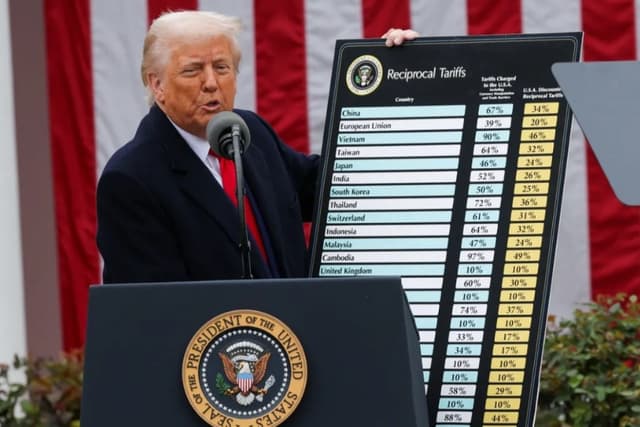
The Economic Survey 2025-26 addresses tariffs with unusual directness. The subject could not be avoided. India faced the sharpest external trade shock in decades during FY26, and the Survey's response reveals both the government's reading of the situation and its strategic posture going forward.
The Timeline
April 2025 brought the first blow. The President of the United States announced reciprocal tariffs of 25 per cent on India. The expectation in Delhi was that India would negotiate an early agreement and see these tariffs reduced. India was supposed to be among the winners in the new American trade architecture.
August 2025 brought the second blow. An additional penal tariff of 25 per cent landed on most of India's merchandise exports to the United States. The cumulative burden reached 50 per cent. India had moved from expected winner to explicit target.
The Survey notes the surprise: "it surprised many since India was expected to be one of the early winners in the new tariff regime of the United States."
The Economic Impact
Growth forecasts were revised downward after the August announcement. But here the narrative takes an unexpected turn. Growth accelerated anyway.
The government used the crisis to push through reforms that might otherwise have faced resistance. The GST underwent its most radical overhaul since 2017. Nuclear power opened to private sector participation. Insurance moved to 100 per cent FDI permissibility. The four labour codes were notified. Quality Control Orders that had been strangling downstream industries were suspended.
The First Advance Estimates placed FY26 growth at 7.4 per cent. The tariff shock did not derail the economy. It accelerated reform.
The Structural Reading
The Survey frames tariffs within a broader transformation of global economic relations. Economic instruments have become tools of statecraft.
The chapter explicitly lists the mechanisms of economic statecraft now in play globally.
Export controls limit the transfer of critical technologies, industrial equipment, and raw materials to rival nations. Semiconductor restrictions on China represent the most visible example.
Trade tariffs protect domestic industries and signal political alignment. They now serve strategic as much as economic objectives.
Financial sanctions restrict access to global banking systems, with SWIFT disconnection as the ultimate weapon.
Investment restrictions screen FDI for national security implications, blocking acquisitions in sensitive sectors.
Fiscal policy itself functions as statecraft through expenditure allocation and deficit financing during geopolitical crises. Europe faces competing demands: defence spending for external stability, social spending for internal stability, green initiatives for climate stability, fiscal discipline for economic stability.
The EU's Carbon Border Adjustment Mechanism, fully effective from 2026, places tariffs on imports based on embedded emissions. This targets high-pollution exporters including India.
Against this backdrop, tariffs represent one instrument among many in a fragmented global order. Treating them as isolated trade policy misses the strategic context.
The Currency Connection
The Survey draws a direct line from tariffs to currency pressure, though not in the obvious direction.
India's rupee underperformed in 2025 despite the strongest macroeconomic fundamentals in decades. Three credit rating upgrades. Fiscal deficit declining. Inflation contained. NPAs at multi-decade lows. Yet the rupee weakened.
The explanation offered: "The paradox of 2025 is that India's strongest macroeconomic performance in decades has collided with a global system that no longer rewards macroeconomic success with currency stability, capital inflows, or strategic insulation."
The tariff shock contributed to this dynamic. Uncertainty over trade relations affects investor sentiment and capital flows. A country facing 50 per cent tariffs on its largest export market presents different risk calculus than one with stable market access.
The Survey notes that having an undervalued rupee carries some benefits in this environment: it partially offsets the tariff impact on export competitiveness. But investor reluctance to commit capital reflects the uncertainty tariffs create.
The Trade Agreement Response
The Survey highlights trade agreements concluded in 2025 as India's strategic response: European Union, United Kingdom, Oman, New Zealand.
The EU agreement receives particular attention. After three years of negotiations, it will require ratification by the European Parliament. The Survey frames its significance in the current context: the agreement expands market access for India's labour-intensive manufactured exports while enabling deeper integration with Europe's technological and manufacturing capabilities.
Europe seeks to revitalise parts of its manufacturing base. India seeks export markets and technology access. The agreement serves both.
The Survey explicitly states that ongoing trade negotiations with the United States "are expected to conclude during the year." This is forward guidance. It signals that tariff resolution remains the policy priority, and that Delhi expects progress.
The Strategic Posture
The Survey's framing reveals how the government positions India's response to the tariff environment.
First, crisis as opportunity. The reform acceleration following the tariff shock was not accidental. External pressure created political space for difficult domestic changes.
Second, diversification over dependence. The trade agreements with EU, UK, and others reduce reliance on any single market. If US market access remains constrained, alternatives must absorb export growth.
Third, manufacturing emphasis. The repeated stress on manufacturing exports reflects recognition that services alone cannot deliver the trade resilience tariff uncertainty demands. The 9.4 per cent growth in total exports versus 6.4 per cent in merchandise exports represents a structural vulnerability, not just a statistical detail.
Fourth, building negotiating position. The Survey's explicit expectation of US trade deal conclusion signals intent to negotiate from strength. India's demonstrated growth resilience despite tariffs improves its bargaining position.
The Domestic Tariff Question
The Survey also addresses India's own tariff policies, though more obliquely.
The discussion of Quality Control Orders, effectively non-tariff barriers suspended in 2025, acknowledges that protection of upstream industries had been taxing downstream manufacturers and exporters. The warning against "seeking negotiated shelter" applies to Indian industry seeking protection as much as to foreign tariffs.
The tiered framework for strategic indigenisation accepts that some protection serves strategic purposes while warning against blanket application. "Decisions about what NOT to protect can be as important as decisions about what to support."
India cannot credibly negotiate tariff reductions abroad while maintaining indiscriminate protection at home. The reform push of FY26 partially addressed this tension.
What Remains Uncertain
The Survey does not resolve several questions.
- Will US trade negotiations actually conclude in FY27? The expectation is stated but the basis for confidence is not elaborated.
- What concessions might India offer? The Survey does not preview negotiating positions.
- How will CBAM affect Indian exports to Europe? The agreement timing coincides with full CBAM implementation, creating compliance requirements for emissions-intensive exports.
- How will the GENIUS Act (US stablecoin legislation effective January 2027) affect capital flows? The Survey flags this as potentially disruptive to emerging market finance.
The tariff environment of 2025-26 forced India into reactive mode. The Survey signals intent to move toward strategic positioning: building resilience, diversifying markets, and negotiating from demonstrated strength. Whether FY27 delivers on this intent depends on factors beyond India's control.
Anmol N Jain is a writer and lawyer with a background in International Relations, Political Science, and Economics. He posts on X at @teanmol.
 Join our