Economy
Military Keynesianism Takes Hold As World Economy Runs Out Of Options
Prof. Vidhu Shekhar
Jan 07, 2026, 06:59 AM | Updated Feb 03, 2026, 07:10 PM IST
Something extraordinary is happening in the world economy. Something so vast and so visible that most policymakers prefer not to name it. Global growth has stalled. Households are drowning in debt. Corporations are overleveraged. Every traditional engine of demand has weakened.
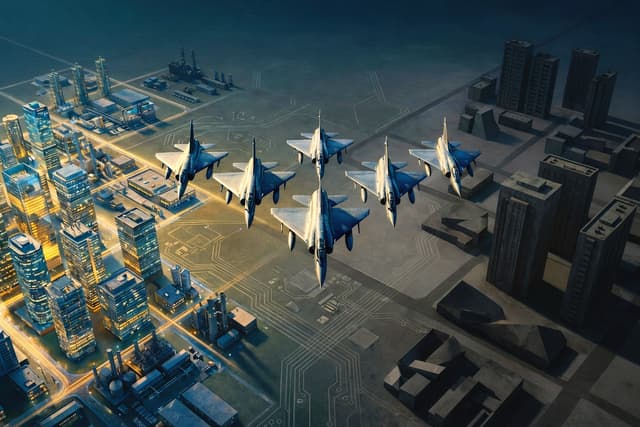
Yet military spending is surging at a pace unmatched since the Second World War.
Since 2021, defence budgets have quietly become something other than responses to geopolitical danger. They have become the last remaining instrument through which governments can sustain growth.
The world has entered the grip of Military Keynesianism.
Understanding Keynesianism
Keynesianism, named after economist John Maynard Keynes, rests on a simple idea: when private spending collapses, the government should step in and spend.
For much of the last century, downturns were managed through this logic. By spending when the private sector could not, the state sustained demand, preserved jobs, and stabilised growth until confidence returned. This counter-cyclical approach (governments expanding when households contract) underpinned recoveries across advanced economies for decades.
That logic has now run its course. The same tools have been deployed repeatedly, at ever-greater scale, for ever-longer periods. They no longer work. Stimulus fails to revive demand, balance sheets remain impaired, and growth does not restart.
The End of Civilian Stimulus
The global economy has become resistant to stimulus. The reason is simple: nearly every major part of the system is already overloaded with debt.
Start with households. In the United States, household debt exceeds $18 trillion. Across Europe, mortgage borrowing is near record levels. In China, household debt has crossed 60 per cent of GDP, driven by a property boom that has since collapsed.
When families are this indebted, extra income services loans rather than fuelling spending. Despite years of government effort, Chinese consumption remains weak. Households are paying down debt, not opening wallets.
Companies face the same constraint. Chinese non-financial corporate debt exceeds 200 per cent of GDP; the collapse of Evergrande was merely the most visible symptom. The result is severe overcapacity: in steel, chemicals, automobiles, and machinery, China has built massive excess capacity, in some sectors even more than total global demand.
Europe and Japan display the same pattern, with high debt suppressing both consumption and investment.
Governments are boxed in too. Global public debt approaches 100 per cent of GDP, the highest outside wartime. Japan exceeds 230 per cent, the US stands near 125 per cent, and much of Europe remains bound by fiscal rules. Combined with recent inflation, large-scale monetary easing is no longer politically viable.
The system has reached its limits. Households cannot borrow more. Companies cannot invest more. Governments cannot spend freely.
The world economy has run out of traditional ways to generate growth.
Military as the Last Economic Lever
Into this vacuum steps the one sector that bypasses every balance-sheet constraint. Defence.
Military spending does not depend on household confidence, corporate profitability, or global demand. The government is the buyer and the payer. And unlike recessions, security threats (real or perceived) do not recede on cue.
This makes defence demand self-reinforcing. A perceived threat justifies higher budgets. Higher budgets sustain defence industries. Those industries, in turn, shape the very threat assessments and capability requirements that justify further spending. The system feeds back on itself.
This is the essence of Military Keynesianism: defence becomes the only sector where governments can still inject large sums directly into the economy and reliably generate activity.
This need not be a coordinated strategy. It is, at minimum, an emergent outcome of debt saturation, political constraint, and institutional inertia.
The Military Spending Surge
The shift towards defence spending is now clearly visible in the data.
According to the Stockholm International Peace Research Institute, global military expenditure crossed $2.7 trillion in 2024, the highest level ever recorded. In just three years, spending rose by $500 billion, with 9.4 per cent in 2024 alone, the steepest since the Cold War.
Europe is undergoing its largest rearmament since the Cold War. Germany is debating defence spending of 3 to 3.5 per cent of GDP, whilst EU finance ministers have granted many member-states flexibility from fiscal rules to permit higher defence spending. Earlier this year, NATO members agreed to raise their long-term defence and security spending target to 5 per cent of their GDP.
Poland is already at more than 4 per cent of GDP, with others moving in the same direction.
Defence spending has moved beyond crisis response. It now functions as industrial policy.
China continues to expand its naval, missile, and aerospace forces even as its economy slows. The United States is approaching a trillion-dollar defence budget whilst rebuilding an industrial base hollowed out over decades. Globally, defence firms are hiring at the fastest pace since the Cold War ended, a signal that governments expect sustained, multi-year demand.
The scale and synchronisation of this buildup demand an explanation beyond geopolitics alone.
Why Rearmament Has Become Structural
Some argue that rising defence budgets simply reflect a more dangerous world. Nations are rearming because threats have increased, not because their economies require the spending.
That explanation is incomplete. If threat alone were driving rearmament, spending would vary by geography and security exposure. Instead, defence budgets are rising in parallel across countries with very different threat profiles. Germany and Japan are militarising at the same pace as frontline states such as Poland and South Korea.
Consider another common explanation: American retrenchment.
The US is withdrawing from alliance commitments, forcing partners to rearm. But Japan, where the US has increased its military presence and commitment, is militarising at the same pace as Europe. China is expanding its forces even as its economy slows and its primary adversary allegedly retreats. If American withdrawal were the driver, we would see divergence across regions, not convergence. The synchronisation demands a different explanation.
A simple test sharpens the point. If defence spending were purely threat-driven, it would slow in economies facing weak growth and fiscal stress. The opposite is happening. Budgets are rising fastest precisely where civilian demand is weakest and traditional stimulus has failed. That inversion marks structural behaviour, not situational response.
In a world where households cannot spend and firms cannot invest, defence remains the only channel through which governments can inject demand directly into the economy.
History has seen this pattern before.
Lessons from the 1940s
During the Great Depression of the 1930s, civilian stimulus lost its effectiveness. By 1939, after nearly a decade of public works, welfare programmes, and monetary easing, unemployment in the United States remained around 17 per cent. The system was stuck with excess capacity and weak demand.
Then came large-scale mobilisation for war. Governments redirected resources on an unprecedented scale towards military production. Factories ran at full capacity, idle labour was absorbed, and supply chains were rebuilt. By 1944, US unemployment had fallen to about 1.2 per cent and economic output had nearly doubled.
War mobilisation solved the economic problem by forcefully absorbing surplus capacity and labour. That solution cost an estimated fifty million lives.
Today's Military Keynesianism is not total war, but it follows the same underlying logic. When economies fail to generate growth through civilian channels, armament becomes the fallback.
The risk is amplified by global polarisation. The world is dividing into rival blocs, and flashpoints from the Taiwan Strait to Eastern Europe function as pressure points in an overstrained system.
When defence spending becomes essential to economic stability, conflict does not need to be desired. It only needs to be usable.
The Dangerous Logic of Inventory Pressure
This shift carries a serious and often ignored risk: inventory pressure.
Once a country commits to large-scale military procurement, it builds an industrial system that must be continuously supplied with orders. Production lines cannot be shut down easily. Skilled workers cannot be dismissed and rehired without loss. Contractors depend on steady contracts, and politicians must justify the spending that keeps the system running.
Over time, stockpiles grow faster than they can be reduced or retired. In a healthy economy, governments can slow production, draw down inventories, and absorb the cost. In a stagnant economy where defence spending has become a primary source of growth and employment, that option disappears. Continued production requires existing stockpiles to be used up.
Instead of slowing production, the system pushes towards renewal. Instead of reduction, replacement. Instead of restraint, deployment. Use becomes a way to justify replenishment.
The arms races before 1914, the militarisation of the 1930s, and decades of Cold War proxy conflicts followed this pattern. Today's buildup is faster, more global, and far more technologically dense.
By 2030, the world will hold the largest concentration of advanced weapon systems ever assembled: hypersonic missiles, autonomous drones, modernised nuclear forces, and vast conventional stockpiles.
In a stagnant global economy, the cost of restraint rises. The path of least resistance increasingly runs through escalation.
India: Exception or Beneficiary?
Against this bleak landscape, India stands out as an anomaly. It is the only large economy that does not require Military Keynesianism to sustain growth, yet it is positioned to benefit from the current cycle more than most.
A decade of balance-sheet repair has left Indian private-sector debt ratios low by global standards. Consumption is rising organically. Corporate investment is returning without heavy fiscal compulsion. India remains one of the few major economies where growth is driven by fundamentals rather than stimulus exhaustion.
Yet India can scarcely afford to stand apart from a rapidly militarising world. China's military modernisation, Pakistan's deterrent upgrades, and intensifying Indo-Pacific competition leave New Delhi with limited strategic choice.
The distinction, however, is critical. India is adding defence-industrial capacity on top of an expanding civilian economy, not in place of one. The push for Aatmanirbharta is building a domestic defence manufacturing base alongside broader industrial growth.
This positions India as a structural beneficiary of the current cycle rather than a participant trapped within it. Whether that advantage proves durable depends on sustaining civilian growth even as global demand fragments. That test lies ahead.
The Cycle is Already in Motion
Military Keynesianism is what remains when all other options are exhausted. For most of the world, that point has arrived.
Defence spending may sustain growth, but it does so by tightening the link between economic survival and militarisation. The tragedy is not that nations are rearming. It is that they increasingly feel they have no alternative.
Unless new civilian growth models emerge, this logic will continue to dominate the global economy. History suggests it rarely ends peacefully.
When growth requires armament, armament requires threat. And threat requires enemies.
The cycle is already in motion.
Dr. Vidhu Shekhar holds a Ph.D. in Economics from IIM Calcutta, an MBA from IIM Calcutta, and a B.Tech from IIT Kharagpur. He is currently an Associate Professor in Finance & Economics at Bhavan's SPJIMR, Mumbai. Previously, he has worked as an investment banker and hedge fund analyst. Views expressed are personal.
 Join our