Ideas
Are Indian Courts Making Crypto-Christianity Impossible To Prove?
R Jagannathan
Mar 10, 2026, 08:30 AM | Updated Mar 09, 2026, 06:28 PM IST
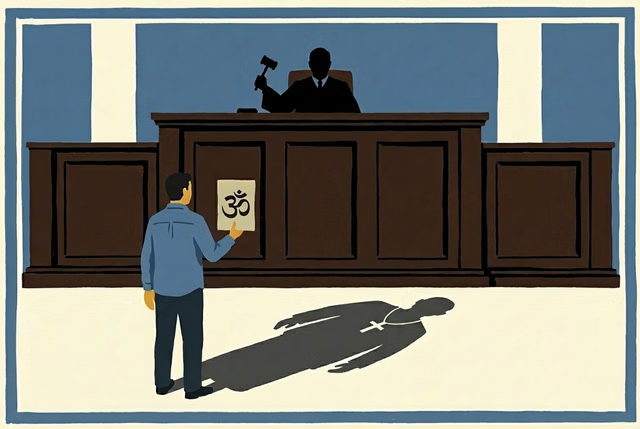
Is the Indian judiciary inadvertently supporting crypto-Christianity, where a convert to Christianity remains Hindu on paper in order to benefit from the various affirmative action programmes of the government?
A recent judgement of the Nagpur bench of the Bombay High Court, comprising Justices Mukulika Jawalkar and Nandesh Deshpande, ruled that the mere presence of a Jesus statue or the symbol of the cross at someone's home cannot be seen as proof of conversion to Christianity.
In a sense, this is true, since Hindus often have no objection to venerating the sacred symbols of other religions. But if the burden of proof for establishing conversion to Christianity is going to be set this high, it implies that the authorities need to be more intrusive in their investigations. Since this is not possible in every instance of suspected conversion, crypto-Christians can get a free ride and the best of both worlds: the benefits offered by their new faith, and the compensations offered by the faith they claim to have been oppressed by.
On the one hand, they are free to criticise Hinduism for the caste system. On the other, they can claim to be victims of the caste system and benefit from reservations in jobs and educational institutions by remaining Hindu on paper.
The High Court bench said more proof is required to establish conversion, including baptism records or certificates. But quite apart from the fact that not all Christian denominations require a believer to undergo baptism (the Quakers and the Salvation Army have no such requirement), which church is going to cooperate with the caste-issuing authority by disclosing who has been baptised and who has not?
In the case before the Bombay High Court, an Akola-based student challenged the rejection of his Scheduled Caste certificate by the Akola Caste Scrutiny Committee, which noted that the student's forefathers had converted to Christianity. The student argued that no formal conversion had taken place and that he remained a Hindu.
The Madras High Court Goes Further
In an earlier judgement in a Tamil Nadu case, the Madras High Court went as far as to suggest that even someone's involvement in everyday Christian activities and practices cannot be deemed conversion to Christianity.
A member of the Hindu Pallan community, P Muneeswari, lost her Scheduled Caste certificate after she married a Christian. Once married, she agreed to raise her children as Christian, attended church, and prominently displayed the cross in her clinic.
According to a Times of India report on the Madras High Court judgement, delivered by a two-judge bench comprising Justices Sanjib Banerjee and M Duraiswamy, the bench said: "There is no suggestion in the affidavit (filed by the district authorities who cancelled her SC certificate) that she has abandoned her faith or that she has embraced Christianity. It is equally possible that she, as a part of a family, may accompany her husband and children for Sunday matins, but the mere fact that a person goes to church does not mean that such person has altogether abandoned the original faith to which such person was born."
Did anyone actually check whether she had retained her Hindu practices despite going to church? We do not know, for this would imply more intrusive investigations into a person's personal life. No state can delve that deep into the private affairs of so many people.
The Supreme Court and the Privacy Shield
In another case, the Supreme Court quashed multiple FIRs filed against a missionary organisation based on a citizen's claims of conversion through inducements in Uttar Pradesh's Fatehpur district (UP has an anti-conversion law). The court raised precisely the issue of privacy. The bench, comprising Justices J B Pardiwala and Manoj Misra, indicated that the law's "statutory requirement of making public the personal details of each person who has converted to a different religion may require a deeper examination to ascertain if such a requirement fits well with the privacy regime pervading the constitution".
The Combined Effect
The judgements of the two High Courts and the Supreme Court's observations in the UP case, taken together, effectively facilitate conversions while shielding them from scrutiny.
The two High Court judgements raise the burden of proof for the authorities to establish that someone has converted. The Supreme Court, by framing intrusive investigations into conversions as an assault on privacy, is effectively saying that the state must not probe a person's faith too deeply, since Articles 25–30 promise freedom of conscience.
The result is a legal environment where proving conversion has become harder and investigating it has become constitutionally suspect. For those who convert to Christianity but wish to retain SC status, this combination provides near-complete insulation. The burden falls entirely on an already overburdened state apparatus to prove what the individual and the church have every incentive to conceal.
The law, as it currently stands, is tilting against the interests of the Hindu communities whose affirmative action protections these provisions were designed to serve.
Jagannathan is former Editorial Director, Swarajya. He tweets at @TheJaggi.
 Join our