Ideas
Beyond Bias: Reverse Discrimination And The Flawed Analogy In UGC's 2026 Anti-Discrimination Guidelines
Rhea Rao
Feb 23, 2026, 05:05 PM | Updated 05:05 PM IST
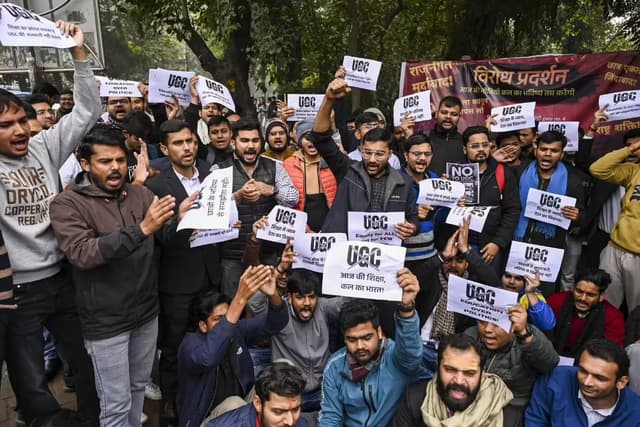
In a February 2, 2026, article by the Telegraph online titled “Why Disha Wadekar moved Supreme Court over UGC's rules on campus discrimination," the Advocate's efforts to challenge and reform the University Grants Commission's (UGC) anti-discrimination guidelines are presented as a vital push for equity in higher education.
Inspired by suicides like those of Dr. Payal Tadvi in 2019 and Rohith Vemula in 2016, allegedly due to caste-based harassment, it depicts the 2019 Supreme Court petition as essential for enforcing and enhancing the 2012 regulations. It culminates in the UGC's January 13, 2026, guidelines, viewed as progress despite some shortcomings.
While Wadekar addresses real institutional casteism, it exhibits notable flaws like bias favoring one viewpoint that positions marginalized groups as sole victims while overlooking bidirectional discrimination, which is a selective framing that idealizes the advocacy without scrutinizing its premises. It minimizes enforcement risks and potential of misuse, omits obscure regulatory and social landscape and neglect of wider societal dynamics, including documented reverse discrimination.
Reverse discrimination, a bias against General Category (GC) individuals, is real and evidenced, prompting questions about the UGC's exclusion of GC protections. And one of the most substantive concerns raised about the 2026 guidelines centers on what was removed rather than what was added.
The 2012 regulations, despite their implementation failures, contained detailed illustrations of how caste-based discrimination manifests within educational settings. These illustrations identified specific contexts where discrimination typically occurs, such as differential treatment in admissions processes, biased evaluation of academic performance, discriminatory hostel assignments, unequal access to scholarships and financial support, and exclusion from extracurricular activities and leadership positions.
Bias Towards One Perspective: A Unidirectional View of Caste Dynamic
The revised guidelines eliminate much of this illustrative detail, leaving the identification of discrimination largely to the discretion of equity committees. This shift raises fundamental questions about legal clarity and predictability.
In any regulatory framework, particularly one that can result in serious consequences including suspension or rustication, the principle of fair notice requires that individuals understand what conduct is prohibited. When discrimination is defined broadly without specific examples or clear benchmarks, committee members must exercise considerable subjective judgment in distinguishing legitimate criticism or disagreement from discriminatory conduct.
This concern is not merely theoretical. Consider the challenge of distinguishing between legitimate academic evaluation and discriminatory grading, between robust debate about reservation policies and harassment, between personal friction and casteist conduct. These distinctions require careful consideration of context, intent, impact, and the broader pattern of behavior.
When guidelines provide detailed illustrations, they establish shared reference points that can guide both committee deliberations and individual conduct. When such illustrations are absent, committees operate with greater discretion but also with less guidance, potentially leading to inconsistent interpretations across institutions and creating uncertainty about what conduct crosses the line from disagreement into discrimination.
Supporters/Activists and Policymakers of the revised approach might argue that detailed illustrations risk limiting the scope of protection by implying that unlisted forms of discrimination fall outside the regulations' coverage. There is validity to this concern. Discrimination is adaptive and manifests in context-specific ways that no list could comprehensively capture.
However, this argument for flexibility must be balanced against the need for legal certainty and the protection of free expression and academic debate. A middle path might involve providing illustrative examples explicitly stated as non-exhaustive, offering guidance while preserving the flexibility to address novel forms of discrimination.
Moreover, Wadekar’s primary bias manifests in its one-sided portrayal of caste interactions, depicting Scheduled Castes (SC), Scheduled Tribes (ST), and Other Backward Classes (OBC) as exclusive victims while suggesting upper castes or GC as default aggressors. This narrative, rooted in reflections on "institutional casteism" in Tadvi's case, ignores data showing caste bias flows in multiple directions.
UGC reports indicate a 118% increase in caste-based discrimination complaints from 2019 to 2025, mostly against SC/ST/OBC. Yet, independent analyses and media highlight reverse discrimination, where GC students encounter slurs, exclusion, or harassment in OBC-dominant areas. In states like Bihar and Tamil Nadu, dominant OBC groups target upper castes, with OBCs implicated in up to 80% of SC/ST atrocity cases.
This unidirectional bias is evident in Disha Wadekar's advocacy, which frames the litigation as a preventive measure against harm to marginalized groups without acknowledging the potential for reverse bias. For instance, Wadekar reflects on her own college experiences of fear due to lack of safeguards, but it fails to explore how such fears could apply bidirectionally in diverse campus settings.
The Analogy in Policy Discussions
When activists and policymakers discuss the 2026 UGC guidelines, they inevitably invoke the Prevention of Sexual Harassment (POSH) Act. The logic seems straightforward. POSH worked for women, so similar mechanisms should work for Scheduled Castes, Scheduled Tribes, and Other Backward Classes. Internal Complaints Committees successfully handle sexual harassment, Equity Committees should similarly handle caste discrimination. However, this analogy while useful in some respects, obscures important differences between these forms of discrimination that have implications on regulatory designs.
Sexual harassment law, as developed through the Vishaka guidelines and subsequently the POSH Act, addresses conduct that is typically unwelcome, involves clear power imbalance, often includes physical conduct or explicit sexual language and creates a hostile environment through behavior that a reasonable observer would deem to be inappropriate. The conduct at issue in sexual harassment cases typically falls along a spectrum from obviously impermissible acts like assault or quid pro quo demands to more ambiguous situations involving comments or behavior that might be interpreted differently by different observers.
However, even in ambiguous cases, the sexual nature of the conduct provides a relatively clear focal point for analysis. Such ambiguity, though unique in each case, can be relieved partly through criminal law definitions of assault and harassment, creating clear bright lines about certain types of conduct, even as it also addresses more ambiguous situations through civil remedies and institutional policies. This intersection with criminal law provides certain procedural protections and standards of evidence that influence how civil and institutional processes unfold.
On the other hand, caste discrimination operates differently and continues to evolve as the society progresses. It manifests in the professor who consistently questions the intellectual capacity of SC/ST students while praising mediocre work from upper-caste peers. It appears in the hostel where certain rooms remain mysteriously unavailable to students from particular communities. It lurks in the informal study groups that somehow never include Dalit students. It's the comment about 'reservation students' lowering standards, the 'joke' about surnames, the subtle exclusion from networks that determine career trajectories.
How does a committee distinguish between a professor's legitimate academic critique and casteist contempt? Between a student's robust political debate about affirmative action and harassment? Between personal friction and discrimination? The 2026 guidelines offer little clarity, having eliminated the detailed illustrations that appeared in the 2012 regulations.
This isn't an argument against regulation. It's an argument for regulation sophisticated enough to capture caste discrimination's unique characteristics which includes its subtlety, its systemic nature, its embeddedness in institutional culture. Simply importing the POSH framework, designed for a different problem, risks missing the very conduct these guidelines should address while potentially chilling legitimate academic debate.
Moreover, the legal frameworks differ in important respects. Caste discrimination, while it can also involve criminal conduct under specific statutes like the SC/ST Prevention of Atrocities Act, more often involves conduct that falls short of criminal behavior but nevertheless creates discriminatory environments.
The intersection of caste with other forms of identity and power also creates complications that the gender-harassment analogy does not fully capture. While gender is a binary or near-binary category for purposes of harassment law, even as we increasingly recognize non-binary identities. Caste involves multiple categories with complex historical relationships and varying degrees of disadvantage. An OBC individual might face discrimination from upper-caste individuals while also holding relative privilege compared to SC or ST individuals. These layered power dynamics require more nuanced analysis than a simple perpetrator-victim framework allows.
Furthermore, the political dimensions of caste discrimination introduce complications that gender discrimination, while certainly politically contested, does not always involve. Disagreements about reservation policies, about the appropriate role of caste identity in public life, about historical narratives and contemporary inequalities, are themselves sites of political contestation. The challenge for anti-discrimination frameworks is to protect individuals from harassment and hostile environments while preserving space for political disagreement and debate. This requires careful attention to distinguishing discriminatory conduct from expression of political views, even when those views are controversial or offensive to some community members.
These differences do not invalidate the comparison between caste and gender discrimination frameworks, but they suggest that simply importing sexual harassment procedures and expecting them to work identically for caste discrimination may be insufficient. The regulatory framework for caste discrimination might need to develop its own distinctive features, learning from sexual harassment law where appropriate but also recognizing the particular challenges of defining, identifying, and addressing caste-based discrimination in educational settings.
Selective Framing and Downplaying Risks
The supporters romanticise the guidelines as “Constitutional Victory for Prevention” dismissing backlash as “misinformation”. However it overlooks Clause 3(c)’s asymmetry which protects only SC/ST/OBC from caste based discrimination potentially dividing campuses. The rationale is clear that these communities have faced systematic oppression for millennia. The statistics are damning. An 118% increase in caste discrimination complaints from 2019 to 2025, predominantly from SC/ST/OBC students. The institutional bias is real, documented, deadly.
But does acknowledging historical oppression require creating a regulatory framework that explicitly excludes some students from protection against caste-based abuse?
I offer an uncomfortable truth. Caste-based prejudice, like all prejudice, can flow in multiple directions. While upper-caste discrimination against marginalized communities remains the dominant and most pressing concern, a genuinely principled approach would prohibit caste-based discrimination by anyone against anyone.
Furthermore, in applying an intersectional lens to caste, discrimination cannot be reduced to a simple upper-versus-lower binary. It operates as a dense web of overlapping hierarchies where caste intersects with gender, class, region, and even sub-caste status, producing layered oppressions that no single group is exempt from inflicting or suffering.
OBCs, numerically dominant in much of rural north and central India, routinely discriminate against Dalits through land grabs, social boycotts, sexual violence against Dalit women, and denial of common resources, patterns repeatedly documented in NCRB atrocity data and state police records, where a significant share of reported caste crimes involve OBC perpetrators against SC victims rather than solely “upper-caste” ones.
At the same time, intra-caste discrimination is ubiquitous, within OBCs, dominant jatis (Yadavs, Kurmis, Jats) look down on smaller or “lower” OBC sub-castes, among Dalits, Pallars scorn Paraiyars in Tamil Nadu, Mahars exclude Mangs in Maharashtra, and even within a single jati, gotra or economic “creamy-layer” distinctions enforce endogamy, marriage vetoes, and social ostracism. A consistent anti-discrimination ethic must therefore condemn every vector-OBC against SC, dominant OBC against subordinate OBC, upper against everyone, and the micro-hierarchies that persist inside every caste block because prejudice retains its moral wrongness regardless of who wields it.
In the context of the UGC Regulations, 2026, this principled stance becomes especially urgent. A truly equitable UGC framework would broaden protections to prohibit caste-based prejudice in all directions, explicitly condemning discrimination regardless of the caste identity of perpetrator or victim while acknowledging the intersectional realities.
Ironically, the UGC already had a better template. The National Education Policy (NEP) 2020. Wadekar’s underlying advocacy entirely overlooks the guidance provided by the National Education Policy (NEP) 2020, which serves as the foundational framework for these UGC regulations. Chapter 14 explicitly mandates that all higher education institutions 'strictly enforce all no-discrimination and anti-harassment rules'. Not rules protecting only certain categories, but comprehensive protections.
NEP 2020 envisions holistic equity achieved through multiple, complementary mechanisms like affirmative admissions for Socio-Economically Disadvantaged Groups (SEDGs), bridge courses and mentoring for students from disadvantaged backgrounds, curriculum reforms to ensure representation and inclusivity, robust enforcement of anti-discrimination rules protecting everyone, and regular institutional audits tracking outcomes across different communities. This comprehensive vision recognizes that equality requires both targeted support for historically marginalized groups and universal protections against discrimination. The 2026 UGC guidelines abandon this vision, creating instead a narrow, identity-based framework that risks perpetuating the very divisions it seeks to overcome.
What would a better approach look like? It would include comprehensive campus climate surveys tracking all students' experiences, not just complaints. The current framework's unidirectional protection undermines its own moral authority. It suggests that discrimination is wrong not because of what it is, which is the denial of human dignity based on birth, but because of who commits it and against whom. This is precisely the logic that perpetuates caste hierarchy.
A genuinely transformative approach would protect all students from caste-based discrimination while maintaining robust affirmative action, targeted support, and institutional transformation to address historical marginalization. These goals are not contradictory. One addresses who gets into university, the other addresses how everyone is treated once there. None of this is beyond our capacity. It simply requires moving past the superficial appeal of analogies and identity hierarchies to engage seriously with caste discrimination's specific characteristics and the complex requirements of justice.
Breaking the Cycle
When Payal Tadvi's family described years of harassment culminating in suicide, they documented how institutional indifference enables discrimination's deadly consequences.These tragedies demand action. But action is not the same as good policy. The desire to 'do something' can produce regulations that satisfy political constituencies while failing to address root problems or, worse, creating new injustices while claiming to remedy old ones.
The 2026 UGC guidelines emerge from genuine concern about real discrimination. But they represent a failure of regulatory imagination. The lazy assumption that frameworks designed for one problem automatically translate to others, the politically expedient creation of identity hierarchies rather than universal protections, the sacrifice of clarity and due process on the altar of accessibility.
The appropriate tribute to Payal Tadvi is not flawed regulations rushed through to satisfy political pressure. It's the hard work of building truly equitable institutions. Institutions sophisticated enough to address caste discrimination's unique manifestations, principled enough to protect everyone equally, and committed enough to the transformative project of making caste irrelevant.
We owe her nothing less. And we owe ourselves — all of us, regardless of caste, the possibility of educational spaces genuinely freed from the poisonous legacy of birth-based hierarchy. The 2026 guidelines, as currently constituted, don't deliver that possibility. They deserve substantial revision before implementation, not reflexive defense or rushed adoption.
About the author: Rhea Rao (@_BRRao_ on X) practicing advocate at the Supreme Court of India.
Rhea Rao is a lawyer practicing at the Supreme Court and a political commentator. She tweets at @_BRRao_.
 Join our