Ideas
Build That Factory: The Path To Hindu Convergence Is Not Pre-Industrial Nostalgia
Goblipura Subbaramiah
Feb 27, 2026, 07:00 AM | Updated 12:52 PM IST
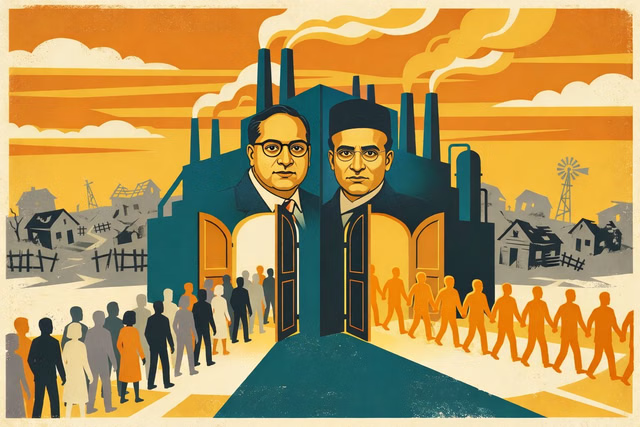
There is an illness that afflicts a certain section of the Indian political right, and it manifests as a chronic inability to count. It is the disease of civilisational romanticism untethered from electoral arithmetic: a longing for a pre-industrial golden age that never quite existed, pursued with a fervour that actively sabotages the very civilisational revival its proponents claim to desire. The Hindutva purist, the “trad,” as the internet has come to call him, is often so intoxicated by the glories of the pre-colonial, pre-Mohammedan era that he forgets he lives in a democracy where numbers decide who governs, and where nostalgia has no seat at the table of power.
Let us begin with a cold appraisal of the numbers. India is a country of approximately 1.45 billion people. Of these, Muslims constitute 14.2 per cent according to the last census, but in a first-past-the-post system, raw demographic share understates effective electoral weight. The Muslim vote is geographically concentrated in decisive pockets across Uttar Pradesh, West Bengal, Kerala, Assam, and Bihar, giving it the electoral heft of roughly a fifth of the electorate in the constituencies that actually determine parliamentary majorities.
This is a population that has, with some honourable exceptions, remained electorally consolidated and, in significant pockets, separatist in orientation since well before Partition. The census, whenever it is eventually conducted, will confirm what demographers have long anticipated: this share is growing. These are people who, by and large, will never vote for a Hindu nationalist party. This is not a moral judgement; it is a demographic and electoral fact.
Now consider the Scheduled Castes, who constitute roughly 16 to 17 per cent of the Indian population. This is a community that has, over the past seven decades, produced an astonishing trajectory of educational advancement. The SC literacy rate climbed from a dismal 10 per cent in the first census decade after independence to 66.1 per cent by the 2011 Census. A new generation of SC youth, educated, politically conscious, and deeply shaped by the thought of Dr B.R. Ambedkar, is emerging as a formidable electoral and intellectual force. And it is precisely this community that a section of the Hindu right seems determined to alienate.
Add the two together: a permanently non-negotiable Muslim voting bloc with the effective electoral weight of 20 per cent and an increasingly estranged SC population of 16–17 per cent, and you arrive at approximately 36 to 40 per cent of the Indian electorate that is either implacably hostile or drifting towards hostility against the Hindutva project. In a first-past-the-post democracy, this is not merely inconvenient. It is suicidal.
A coalition that commands 45 to 50 per cent of the vote share can withstand defections, economic shocks, and media hostility. A coalition stuck at 35 per cent cannot. The difference between these two numbers lies precisely in the willingness to engage with the Scheduled Caste community, and, by extension, with the Ambedkarite legacy that defines its political identity.
And this is not merely a question of social justice or moral enlightenment. It is a question of economic strategy. Industrial policy requires consistency: a factory cannot be built today and dismantled tomorrow because the government changed. It requires regulatory stability, labour market predictability, and infrastructure commitment that spans fifteen to twenty years. Without an unassailable electoral coalition, industrial policy becomes a casualty of competitive populism: parties promising immediate consumption over delayed investment, subsidies over infrastructure, and grievance over growth. The coalition question is not separate from the industrialisation question. It is the industrialisation question.
The question, then, is why a section of the Hindu right seems so determined to make this coalition impossible. The answer lies not in stupidity but in something more dangerous: a misunderstanding of what they are actually fighting for.
What the Trad Actually Wants
Before diagnosing the disease further, it is worth understanding what exactly drives the nostalgist’s politics. On the surface, his nostalgia appears to be for an era: the Vedic age, the Gupta golden age, the temple-building dynasties of the South. He speaks the language of civilisational recovery, of dharmic revival, of returning to the wellsprings of an ancient and magnificent culture. But if you press the matter, if you trace the nostalgia to its root, what you find is not merely a longing for an era but a longing for an order — specifically, the social order that characterised pre-industrial agrarian life.
This is the point that must be stated plainly, because everything else follows from it. It is not that the trad is wrong to find the temple beautiful, or the parampara valuable, or the continuity of tradition stirring. These are genuine goods, and this essay does not argue otherwise.
Where he goes wrong is in believing that these goods are inseparable from the specific social arrangements of pre-industrial village life: that you cannot have the hymn without the hereditary occupation, the festival without the fixed hierarchy. This is a failure of imagination, not of devotion. The civilisational tradition is deep enough to survive, indeed to flourish in, an industrial economy. The question is whether his attachment is to the civilisation or to the particular institutional form it took under conditions of agrarian scarcity and state weakness.
The village was not merely a unit of economic production; it was a unit of social ordering; and, in the context of a pre-industrial civilisation without a strong centralised state, an effective one. Hereditary occupation provided predictability. The jajmani system, whatever its injustices, ensured that every function was performed and every family fed in an economy too fragile for the disruptions of open competition. The hierarchy was rigid because it had to be: in a world without industrial surplus, without geographic mobility, without a state apparatus capable of enforcing contracts between strangers, social stability required fixed roles.
This is not an apology for caste; it is an explanation of its persistence. And it is precisely this explanation that the revivalist refuses to engage with, because to accept it is to accept that the hierarchy he admires was a product of material conditions, not of eternal dharmic truth, and that when those conditions change, the hierarchy must change with them.
This is why the purist reacts with such visceral hostility to any attempt at integrating Ambedkarite thought into the Hindutva framework. He faces two threats he cannot distinguish. The first is the argument made in this essay: that the hierarchy he admires was a product of material conditions, not of eternal dharmic truth, and that it must change as those conditions change. The second is Ambedkar himself, not because Ambedkar made this argument (he did not; his critique was moral and polemical, not materialist), but because Ambedkar is the symbol around which 200 million people have organised their political identity.
The purist conflates the two, imagining that if he can refute Ambedkar’s scriptural readings, he has disposed of both the materialist challenge and the political reality. He has disposed of neither. His opposition to “digestion,” his insistence on “fundamental differences,” his reflexive hostility towards any politician who invokes Ambedkar too enthusiastically — all of it flows from this conflation.
He does not want Ambedkarite convergence because such convergence requires conceding that the old order has outlived its conditions. His politics is not, in truth, a politics of civilisational revival. It is a politics of institutional nostalgia: an attachment to the stability mechanisms of a pre-industrial world, mistaken for attachment to the civilisation itself. The civilisation will survive industrialisation; it has survived far worse. The ossified hierarchies will not, and they should not, because the conditions that necessitated them no longer exist.
But the nostalgist’s confusion about his own motivations is only half the problem. The other half, arguably the more consequential half, is his total failure to understand what Ambedkar actually represents to the people whose votes he needs.
What the Nostalgist Does Not Understand About Ambedkar
Ambedkar was not a scholar of Sanskrit or a theologian of the Hindu tradition. He was a polemicist — an extraordinarily intelligent one, but a polemicist nonetheless — whose engagement with Hindu scripture was instrumental rather than exegetical. He read the texts to indict them, not to understand them, and his scriptural critiques served a political project: the consolidation of a Dalit identity independent of the Hindu fold.
The purist is often right to contest Ambedkar’s readings on scholarly grounds. What he cannot seem to grasp is that Ambedkar failed as an electoral politician in his own lifetime; his Republican Party of India never won significant power, and yet succeeded beyond any plausible expectation as an identity-maker. The polemic outlived the politics. The identity he forged is now carried by 200 million people who do not care whether his reading of Manu was philologically sound.
The caste romanticist who insists on relitigating Ambedkar’s theology is fighting a man who has been dead for seven decades and losing to his ghost.
The identity Ambedkar created does not depend on the quality of his scholarship. It depends on the fact that he existed: that a man born into untouchability became the most consequential constitution-maker in Indian history. For the SC community, this is not a debating point. It is a founding myth, and founding myths do not answer to philology. The Ambedkar sceptic who attacks Ambedkar’s readings of scripture is not undermining this myth. He is reinforcing it, because every attack confirms the SC community’s conviction that the Hindu establishment would rather relitigate texts than acknowledge their dignity.
And yet, beneath the polemic and the identity politics, there existed a point of genuine agreement, one that could have served as the foundation for the very coalition the Hindu right now desperately needs. To see it, we must go back to the moment it was destroyed.
Gandhi’s Agrarian Fantasy and the Convergence It Destroyed
Mohandas Karamchand Gandhi was, by any measure, a political genius of the first order. His ability to mobilise millions, his instinct for symbolic action, and his moral courage in the face of colonial power are beyond dispute. But his economic vision was, to put it plainly, a disaster. His ideal India was a republic of self-sufficient villages, a vision built on a profound and openly stated hostility to industrial modernity.
“India is to be found not in its few cities but in its 7,00,000 villages,” he declared, locating the soul of the nation in the soil. [1] This was not a preference, but a creed. He saw the machine as an engine of exploitation, stating unequivocally in Hind Swaraj that “it is machinery that has impoverished India,” before delivering a verdict that revealed the full extent of his anti-modernism: “Machinery is the chief symbol of modern civilization; it represents a great sin.” [2]
This was not merely quaint. It was dangerous. And on this point, perhaps the only point of genuine convergence between them, both Vinayak Damodar Savarkar and Bhimrao Ramji Ambedkar agreed: Gandhi’s agrarian fantasies had to be rejected.
Ambedkar’s critique of the village was devastating and unsparing. He saw the Indian village not as a site of pastoral harmony but as a prison of caste hierarchy: a place where the Dalit was condemned to hereditary servitude, where occupational mobility was impossible, and where the tyranny of the jajmani system ensured that social status was determined at birth and fixed until death. For Ambedkar, industrialisation was not merely an economic programme; it was a programme of social liberation. The factory floor, unlike the village square, did not ask a man his caste before assigning him a task. The assembly line was, in this sense, the great equaliser.
“The salvation of the whole of India lies in greater urbanisation, in reviving our towns, in building our industries, in removing as much population as we possibly can from our villages to the towns.” — Dr B.R. Ambedkar
Ambedkar argued, with the rigour of a trained economist from Columbia and the London School of Economics, that agriculture was the most congested occupation in India and that the remedy lay not in enlarging landholdings but in increasing capital goods and promoting urbanisation. He envisioned state-led industrialisation as the vehicle for both economic growth and social transformation, a mechanism to break the stranglehold of caste by creating new forms of employment that were not tethered to hereditary occupation.
Savarkar’s critique of Gandhian economics, while arriving from a very different ideological direction, reached a remarkably similar conclusion. Savarkar was a thoroughgoing modernist. He had no patience for the spinning wheel or the cult of the village. He believed that India’s survival as a civilisational state in the modern world depended on its ability to industrialise, to build military capacity, to master modern science and technology, and to compete with the Western powers on their own terms. His vision of Hindutva was emphatically post-industrial: a Hindu civilisation reborn not through a retreat to the past but through an aggressive embrace of the future.
Jawaharlal Nehru, too, despite his many disagreements with both Savarkar and Ambedkar, shared this fundamental orientation towards modernity and industrialisation. Nehru’s famous declaration that “dams are the temples of modern India” was an explicit repudiation of Gandhi’s preference for the charkha over the steel mill. Both Nehru and Ambedkar were deeply influenced by the Soviet model of command-economy industrialisation, and both saw planning as the instrument through which India would vault from an agrarian backwater into a modern industrial power.
Here, then, was a genuine point of convergence, a rare area of agreement among three of the most powerful intellectual traditions in modern Indian political thought: the Ambedkarite, the Savarkarite, and the Nehruvian. All three understood that the path forward ran through the factory, the mill, and the university, not through the village and the spinning wheel. All three, in their different ways, recognised that India’s social pathologies (caste, poverty, ignorance) could not be addressed without rapid modernisation and industrialisation.
We could have easily taken this as a point of convergence and built a nation on it. We did not. And the consequences of that failure haunt us to this day.
The Missed Bus: 1950s to 1970s
Instead of building on the shared commitment to industrial modernity, India’s political factions spent the decades after independence waging fratricidal wars of ideology that left the country stranded at the station while the East Asian express roared past.
The numbers tell a story of colossal failure. In the early 1950s, after the Korean War had reduced the peninsula to rubble, South Korea’s per-capita GDP was roughly comparable to India’s. By 2000, it was nearly thirty times higher in nominal dollar terms. The Korean War had virtually destroyed whatever economic infrastructure and social hierarchy Korea had inherited from the Chosun dynasty and Japanese colonial rule.
When South Korea began its industrialisation drive in the early 1960s, almost everyone was on an equal economic footing. The result was one of the most remarkable episodes of “compressed growth and transformation” in the developing world, and, critically, a dramatic flattening of the old class hierarchy. Korean data shows that while 65 per cent of the population had been farmers by origin, fewer than 15 per cent remained in the farmer class by the next generation. Rapid industrialisation did not merely create wealth; it created social mobility on a scale that centuries of moral exhortation had failed to achieve.
Japan’s trajectory was similar. After the devastation of the Second World War, Japan achieved near-full employment and established a remarkably equal class structure through rapid economic growth, a lifetime employment system, progressive taxation, and robust social security policies. The huge middle class that emerged did not just underwrite Japan’s “affluent society”; it also stabilised its politics and verified, empirically, the proposition that industrialisation narrows class divisions.
India, by contrast, missed this bus entirely. The Hindu rate of growth persisted through the 1960s and 1970s, sustained by a toxic combination of Nehruvian over-regulation, the licence raj, public sector inefficiency, and a deep political reluctance to embrace the kind of export-oriented manufacturing that was transforming East Asia.
The Indian economy experienced serious food shortages towards the end of Nehru’s tenure. Beginning in 1950, trade deficits mounted. The government ran major budget deficits. Fiscal resources were consumed by wars and their aftermath, leaving little for the kind of sustained industrial investment that was transforming Korea and Japan. And through all of this, the caste system, which rapid industrialisation might have weakened, as it weakened class hierarchies in Korea and Japan, remained largely intact.
This is the critical insight that the Hindutva purist refuses to grasp: the failure to industrialise in the 1950s through 1970s was not merely an economic failure. It was a social failure. It preserved the caste system by denying millions of lower-caste Indians the one mechanism that history has shown, repeatedly, to be the most effective solvent of hereditary hierarchy: the factory job. That failure has reduced the probability of eliminating caste discourse significantly. The window was open, and India chose not to walk through it.
The more sophisticated nostalgists will object at this point that Japan and Korea industrialised without any equivalent of Ambedkarite convergence or caste politics. They did so through authoritarian state direction, ethnic homogeneity, and a Cold War security umbrella that gave their governments room to impose painful transitions without electoral accountability.
India has none of these advantages. It is a democracy of staggering diversity, in which industrial policy must survive elections, coalition negotiations, and the competitive populism of states bidding for investment with subsidies they cannot afford. The East Asian shortcut (industrialise first, democratise later) is not available. India must build its industrial consensus through democratic coalition, which means the caste question is not a distraction from the economic question. It is the precondition.
The failure to industrialise entrenched a divide that now runs through the heart of Indian politics, and, critically, through the heart of the Hindu right itself.
The Post-Industrial vs. Pre-Industrial Divide
Both Savarkar and Ambedkar stood on the post-industrial side of this divide. Savarkar’s Hindutva was not a programme of regression; it was a programme of civilisational modernisation. Ambedkar’s vision was similarly forward-looking: the destruction of the feudal-agrarian prison through industrial transformation. These two visions are not identical, but they are oriented in the same direction: towards the future, towards modernity, towards the factory floor as the site of national rebirth.
The tragedy of contemporary Indian politics is that a vocal section of the Hindu right has abandoned Savarkar’s post-industrial orientation and retreated into precisely the kind of pre-industrial nostalgia that Savarkar himself would have found contemptible.
This section opposes every attempt at “digestion,” at integrating Ambedkarite ideas into the Hindutva framework, in the name of a “fundamental difference of ideas.” In doing so, they are not defending Hindu civilisation. They are ensuring its political marginalisation. To insist on “irreconcilable differences” is to concede the entire frame to the opposition, to hand them a weapon and then complain when they use it. This peculiar genius for making enemies where allies might be found is not a virtue; it is a pathology, a form of strategic self-sabotage that must be cured if the civilisational project is to survive.
If there is a last remaining opportunity to correct this, it exists in the present moment. And it is an opportunity that is being squandered not by its opponents, but by the very people who should be its most ardent champions.
The Modi Era: Last Chance at the Station
Narendra Modi’s economic programme represents the most ambitious and sustained push towards industrialisation that India has undertaken since independence. The Make in India initiative, launched in September 2014, set out to transform India into a global manufacturing hub. The Production Linked Incentive scheme offered approximately $26 billion in industrial incentives to boost domestic production across key sectors from electronics to defence.
India has jumped dramatically in the World Bank’s Ease of Doing Business rankings. Infrastructure spending has been unprecedented: new highways, railways, dedicated freight corridors, ports, and industrial corridors are being built at a pace India has never seen. The semiconductor mission, the defence manufacturing push, the electronics assembly revolution that has turned India into the world’s second-largest mobile phone manufacturer — these are not incremental changes. They represent a fundamental reorientation of the Indian economy towards industrial production.
Modi is dragging the country towards industrialisation, often against the resistance of large portions of the electorate that would prefer the comfort of agricultural subsidies and welfare transfers to the disruptions of industrial transformation. Without the kind of durable coalition described in Section I, this industrialisation programme remains perpetually vulnerable, one election away from being traded for a return to competitive populism. Many portions of the country vote against such forward-looking ideals, and yet the direction of travel remains unmistakable. This is precisely what a post-industrial leader is supposed to do.
Simultaneously, Modi has tried, with considerable effort, to bear-hug the Ambedkarite discourse. The invocation of Babasaheb at every rally, the construction of grand memorials, the celebration of Constitution Day, the consistent framing of welfare programmes in Ambedkarite language — all of this represents a deliberate and sustained attempt to build a bridge between the Hindutva and Ambedkarite traditions.
One can argue that this co-option has at times been overdone, that it has not always pointed clearly enough to the genuine convergence between the two traditions, creating an impression of appropriation rather than synthesis.
But to argue that this man is acting in bad faith is a claim that does not withstand scrutiny. A leader who devotes enormous political capital to invoking Ambedkar, who stakes his economic programme on industrialisation, who pushes urbanisation and infrastructure development at a scale India has never attempted, who has built more toilets, gas connections, and bank accounts for the poor than any predecessor — such a leader may be accused of imperfect execution, but not of hostility to the modernising project that both Savarkar and Ambedkar championed.
And yet, even Modi operates within constraints that his most zealous supporters refuse to acknowledge.
The Institutional Lag and the Fifteen-Year Horizon
Here is a truth that the impatient must reckon with: every major institution in India (the judiciary, the bureaucracy, the universities, the media, the cultural establishment) remains either hostile or indifferent to the Hindutva project. This will be the case for another fifteen years, at least. This is not because of some conspiracy. It is because institutions change slowly, because the people who staff them were trained in an earlier ideological paradigm, and because building parallel institutions from scratch takes time: an enormous amount of time, and an enormous amount of political and managerial bandwidth.
The demand to keep existing institutions “in check” (inko kaabu mein rakho) reflects a misunderstanding of how institutional power works. You cannot simply capture an institution by placing your people at the top; you have to build the managerial depth, the intellectual infrastructure, and the cultural authority that sustains institutional power over time. India’s existing institutions are barely comfortable with the use of UAPA against jihadists; how do you expect them to react to an assault on other entrenched interests? The answer is: with fierce resistance, backed by decades of accumulated institutional capital.
This means that the political project of Hindutva must operate within constraints that its most zealous proponents find intolerable. It must build rather than destroy. It must persuade rather than coerce. And above all, it must win elections, not just once, but repeatedly, for decades, which requires the kind of broad-based coalition that is impossible to assemble if you are simultaneously alienating 40 per cent of the electorate through an inability to understand what Ambedkar means to the SC community or a refusal to abandon pre-industrial social fantasies.
The arithmetic is inescapable. The institutional timeline is long. The only path forward runs through the territory the purist refuses to enter.
The Convergence Imperative
The path forward is not complicated to describe, even if it is fiendishly difficult to execute. It requires recognising that the shared commitment to industrialisation and modernity, the one point on which Savarkar, Ambedkar, and Nehru all agreed, is the natural foundation for a political coalition that can command the kind of durable majority required to transform India’s institutions over a fifteen-to-twenty-year horizon.
This means taking the Ambedkarite legacy seriously: not as a statue to be garlanded, not as a polemic to be refuted, but as a political identity to be engaged with. It means recognising that Ambedkar’s economic prescription (industrialisation, urbanisation, the destruction of occupational heredity through economic transformation) is entirely compatible with a forward-looking Hindutva, regardless of what one thinks of his scriptural readings.
And it means understanding, with real humility, that Ambedkar represents something to the SC community that transcends argument, something that no clever debating point will dislodge, something that must be respected as a fact of Indian political life rather than treated as an obstacle to be overcome.
But who, within the SC community, is the natural interlocutor for this convergence? Not the reservation-dependent intelligentsia: the government servants, public school teachers, and university faculty whose power derives from the perpetuation of grievance and whose material interests are served by maintaining the SC community’s posture of permanent victimhood. This class controls the epistemological gates of the SC community, and to engage with it on its own terms is to ensure that the conversation never moves beyond the politics of resentment.
The natural interlocutor is the emerging SC business elite, and alongside them, a younger generation of SC thinkers willing to engage with the modernist project on shared terms: the entrepreneurs, contractors, professionals, and startup founders who have succeeded in the private sector outside the reservation system. This class does not view Savarna traders as ritual oppressors but as business partners. It does not seek quotas in government jobs but contracts in infrastructure projects. It is interested in the same things the Hindu right claims to prioritise: ease of doing business, contract enforcement, logistics corridors, and manufacturing zones.
The PLI schemes and infrastructure projects must be explicitly framed not merely as “development,” but as the fulfilment of Ambedkar’s economic prophecy: the destruction of caste through industrial transformation. The Dhamma hall should become not merely a theological centre but a business networking hub where Ambedkar’s economic vision is taught alongside Savarkar’s industrial nationalism, where SC contractors and Savarna industrialists negotiate supply chains, and where the locus of SC leadership shifts from the government office to the factory floor.
It means abandoning the agrarian fantasies and pre-industrial nostalgia that have no place in the twenty-first century. The world will not wait for India to finish relitigating debates about varnashrama dharma. China is not waiting. East Asia did not wait. Every year that India spends arguing about whether Ambedkar and Savarkar can be reconciled is a year in which some other country builds the factories, trains the workers, and captures the markets that should have been India’s.
And it means understanding that caste will not be annihilated by moral exhortation, by temple entry movements, by inter-caste dining programmes, or by any of the other well-intentioned but historically ineffective strategies that have been tried over the past century. Caste will be annihilated — or, more precisely, will wither into irrelevance — when the economic conditions that sustain it are eliminated.
When a Dalit engineer earns more than a Brahmin clerk, caste loses its material foundation. When an OBC entrepreneur employs upper-caste workers, the hierarchy inverts itself organically. The factory floor, the software office, the startup ecosystem — these are the killing grounds of caste, not the debating halls of political parties.
And it means, above all, that the Hindu right must learn to count.
Build the Factory, Win the Future
The argument of this essay can be stated simply. India missed the industrialisation bus in the 1950s through 1970s, and the consequences of that failure (persistent caste rigidity, widespread poverty, and political fragmentation) continue to haunt the country to this day. The Modi era represents the last realistic window for a course correction: an opportunity to push India towards the kind of rapid industrial transformation that dissolved class hierarchies in East Asia and that both Ambedkar and Savarkar recognised as the essential precondition for social modernisation.
But this opportunity will be wasted if the Hindu right continues to alienate the very communities, particularly the Scheduled Castes, that should be its natural allies in the project of post-industrial national reconstruction. The alienation stems from two failures of understanding: first, that the purist’s own nostalgia is not for a civilisation but for a hierarchy; and second, that Ambedkar is not a debating opponent but a foundational symbol for 200 million people, and that no amount of argumentation will change this. Until the Hindu right grasps these two truths, it will continue to manufacture enemies out of potential allies.
The Ambedkarite and Savarkarite traditions share a common commitment to modernity, industrialisation, and the rejection of agrarian romanticism. This shared commitment is the foundation on which a durable political majority can be built. The alternative is arithmetic doom: a permanent 40 per cent bloc opposed to Hindutva, an ever-shrinking base of support, and the gradual extinction of the very civilisational revival that the Hindu right claims to champion.
Somewhere in India today, a Scheduled Caste entrepreneur is negotiating a supply contract with a Savarna manufacturer. No one asked either of them their caste before the meeting. The factory floor has already begun the work that a century of moral exhortation could not accomplish. The only question is whether the Hindu right will build more of these factory floors, or whether it will continue relitigating the theology of a man who has been dead for seven decades while the future is assembled, without India, somewhere else.
 Join our