Ideas
Did India Lack Sense Of History? Or Just Understood Time Differently?
R S Hariharan
Mar 15, 2026, 06:59 AM | Updated Mar 14, 2026, 12:21 AM IST
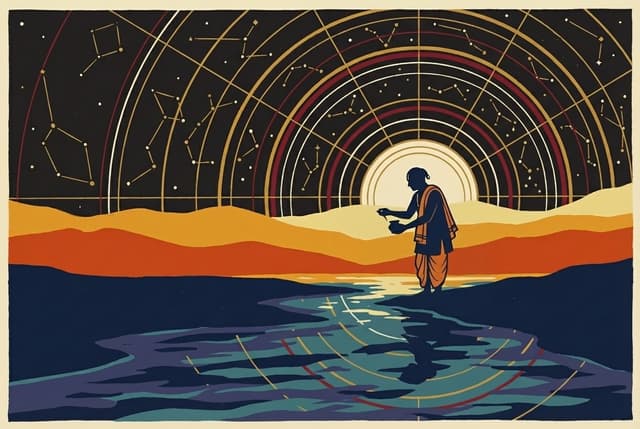
Just before a karma (ritual act) begins, a purohita (priest) recites a brief formula known as the saṅkalpa. In a few measured sentences he situates the act within the current kalpa, the ongoing manvantara, and the present yuga. He names the region where the ritual is being performed, the current year of the traditional calendar, the lunar day (tithi), the stellar constellation (nakṣatra), and the position of the Sun.
To someone unfamiliar with the practice it may sound like little more than a ritual preamble. Yet the saṅkalpa does something remarkable. It places a simple human act within a chain of elapsed time stretching from a cosmic beginning to the present moment.
This everyday practice hints at something rarely acknowledged in discussions of Indian civilisation. Far from lacking a sense of history, Indic traditions developed a sophisticated way of locating human life within several layers of time: cosmic, civilisational, and personal.
For more than a century, however, a very different claim shaped much historical writing. Ancient India, it was said, possessed mythology and philosophy but little historical consciousness. European scholars trained in the traditions of Greek historians such as Herodotus and Thucydides searched Indian texts for similar narrative chronicles. When they did not find them in the expected form, they concluded that India lacked a historical mindset.
A closer look at Indian ritual, astronomy, and textual traditions suggests that this conclusion may have been premature. What earlier historians often assumed was that historical consciousness must take the form of linear narrative chronicles, similar to those written by Herodotus or Thucydides. Yet different civilisations have preserved their memory of the past in different ways. In the Indian case, historical awareness was often embedded in ritual practice, astronomical calculation, genealogical traditions, and sacred narrative rather than in continuous political histories.
A recent study by R.N. Iyengar in the journal of the Mythic Society examines how Indic traditions conceptualised elapsed time and how this awareness appears within ritual practice itself.
Three Scales of Time
The Bharatiya understanding of the past operates across several scales.
At the most immediate level lies the civil calendar. It tracks lunar days (tithi), constellations (nakṣatra), and solar transitions. These units organise daily ritual life, agricultural cycles, and seasonal festivals. The calendar itself reflects centuries of careful observation of the movements of the Sun and stars.
A second level appears in historical eras used to date events and inscriptions. Indian chronology preserves several such eras, including the Shaka era. Epic traditions and Purāṇic narratives also anchor cultural memory around figures such as Krishna and Rama, placing them within remembered periods of the past.
Inscriptions provide clear evidence of this chronological awareness. The famous Aihole inscription, composed by the poet Ravikirti, dates the reign of Pulakeshin II using the Shaka calendar together with detailed calendrical markers. Records of this kind show that careful dating was a familiar practice across the subcontinent.
Beyond these human timescales lies the most striking dimension of Indian thinking about time: the cosmic framework of yugas, manvantaras, and kalpas. These cycles describe immense spans of time running into millions or even billions of years. Whether interpreted symbolically or cosmologically, they reveal a civilisation comfortable thinking about time on a scale far beyond the span of a human life.
Within this framework, time is understood less as a list of dates and more as elapsed duration since a cosmic beginning.
Astronomy and the Memory of the Sky
Astronomy played a central role in shaping this temporal framework. Ancient Indian scholars observed the movements of the Sun, Moon, and stars in order to maintain calendars and determine ritual timings.
Classical texts such as the Surya Siddhanta calculated the length of the solar year as about 365 days, 6 hours, 12 minutes, and 36 seconds. The figure is remarkably close to the modern value and reflects long periods of careful observation.
One interesting example concerns the pole star known in tradition as Dhruva. In the Taittiriya Aranyaka a star called Abhaya-Dhruva is described as occupying a fixed point in the heavens. Astronomers have noted that around the third millennium BCE the star Thuban lay close to the celestial pole, making such an observation plausible to the naked eye.
Over long periods the Earth's axis slowly shifts through axial precession, a gradual movement that takes roughly 26,000 years to complete. This motion changes which star appears closest to the pole. Later astronomical traditions in India seem to have recognised this slow transformation of the sky. By the early modern period, scholars such as Kamalakara Bhatta identified Polaris as the star nearest the celestial pole.
Such observations reveal a culture attentive not only to daily celestial motion but also to slow changes unfolding across centuries.
Civilisational Memory in the Purāṇas
Texts such as the Purāṇas, often treated today as mythological literature, also functioned as repositories of civilisational memory.
They preserve long genealogies of kings, sages, and dynasties extending across vast spans of time. Their aim was not merely to catalogue political events but to place human history within a wider cosmological framework.
Rather than separating myth and history into rigid categories, the Purāṇic tradition brings them together within a single narrative. The avatāras of Vishnu, for instance, are located within cosmic cycles so vast that their earthly lives become part of a much larger story.
This approach may be described as para-historical. It preserves civilisational memory while embedding human events within cosmic time.
Śiṣṭācāra and the Continuity of Tradition
Indian texts also preserve an intriguing concept known as śiṣṭācāra. In later Sanskrit usage, the word śiṣṭa usually refers to cultured or learned persons whose conduct serves as a model for society. But Purāṇic literature points to an older meaning.
In this earlier sense the term is connected with śeṣa, meaning "that which remains." The śiṣṭas are those who remain after periods of disruption such as floods, droughts, migrations, or social upheavals. They carry forward the memory and practices of earlier generations, and their conduct becomes a guide for those who come after them.
Traditional accounts suggest that these survivors preserved inherited knowledge through teaching, ritual practice, and storytelling. In this way cultural memory could survive even when kingdoms disappeared or institutions collapsed. The past continued not only in written texts but in the living practices maintained by those who transmitted the tradition.
The Purāṇas describe śiṣṭācāra in terms of eight ethical principles that sustain dharmic life: dāna (charity), satya (truth), tapas (discipline or meditation), jñāna (knowledge), vidyā (learning), dayā (compassion), ijyā (ritual worship), and vrajana (journeying or resettlement). These are presented not merely as moral ideals but as practices preserved from the most ancient ancestors of the tradition.
Some traditions may also preserve memories of environmental change. The decline of the Sarasvati River, for example, appears in textual references and in community traditions associated with the Sarasvata lineage. Whether understood as history, memory, or inherited narrative, such accounts show how knowledge could pass across generations even during times of disruption.
Taken together, the idea of śiṣṭācāra reflects a distinctive way of preserving the past. Memory is carried not only in chronicles or political records but in the conduct, practices, and teachings that survivors transmit to later generations.
Deep Time in Sacred Objects
The Bharatiya relationship with the past also appears in striking ways within ritual life.
Consider the worship of Saligrama found in Himalayan rivers. These are fossilised ammonites that formed hundreds of millions of years ago. In religious practice they are revered as manifestations of Vishnu.
Ancient worshippers did not describe them in geological terms. Yet the reverence accorded to them reflects, at least symbolically, an engagement with the deep antiquity of nature. Sacred landscapes across India likewise preserve memories of floods, droughts, and celestial events that left lasting impressions on communities.
Time and the Living Sky
Traditional Bharatiya calendars were originally grounded in direct astronomical observation. Solar transitions, solstices, and equinoxes structured ritual life and seasonal activities.
Over time, some computational traditions drifted slightly from the actual positions of celestial bodies. As a result, certain festival dates today no longer coincide exactly with the astronomical events they once marked.
Some modern scholars have therefore suggested recalibrating traditional calendars so that ritual observances once again align more closely with the movements of the Sun. Such proposals echo an older ideal: keeping cultural practice in harmony with the sky.
A Civilisation That Remembered
The Bharatiya understanding of time cannot easily be reduced to a simple chronology. It is better understood as a layered system linking everyday life with cosmic duration.
The saṅkalpa recited in temples and homes across India captures this vision in a few lines. It moves from the vast scale of the universe to the immediate act of worship performed at a particular place and moment.
In this worldview, time is not merely a record of past events. It is a living continuum connecting the present with an immeasurably deep past.
Seen in this light, the old claim that India lacked historical consciousness becomes difficult to sustain. Indian civilisation preserved memory in many ways: through astronomy, inscriptions, ritual practice, and narrative traditions that carried knowledge across generations.
Each recitation of the saṅkalpa quietly affirms that continuity.
In that sense, it becomes a civilisational declaration of time itself.
R S Hariharan, PhD, is Assistant Professor at CAHC, JAIN University. With a background in science and technology and experience across research, linguistics, and industry, his work explores Sanskrit literature and India’s civilisational and scientific thought.
 Join our