Ideas
Mahatma And Bodhisattva With Satellites: Why Industrialisation Alone Cannot Annihilate Caste
Aravindan Neelakandan
Mar 13, 2026, 04:03 PM | Updated 04:06 PM IST
The discourse surrounding the socio-economic-cultural future of India often finds itself polarised between the proponents of rapid, large-scale industrialisation and the perceived defenders of a stagnant, pre-industrial past. The well-argued and deeply perceptive article 'Build That Factory: The Path to Hindu Convergence Is Not Pre-Industrial Nostalgia' attempts to resolve this tension by asserting that the 'factory'- the quintessential symbol of mass industrialisation- is the primary engine of Hindu civilisational convergence and social modernisation.
Part-I Re-evaluation of Gandhi: Ludditism or Proto-Ecological Futurism?
A recurring trope in contemporary Indian economic commentary is the dismissal of Gandhiji’s skepticism toward machinery as a form of unthinking Ludditism or romantic pre-industrialism. The target article also reflects this view by implying that any move away from the 'factory' is a potential retreat into a dark past.
However, a more in-depth analysis of Gandhian thought reveals that his opposition was not directed at technology in the abstract, but at 'machinism'- the specific socio-technical arrangement of colonial tech-centralisation and extraction, and the mass displacement of humanity that characterised the classical West-centric industrial revolution.
Re-framing the Charkha and the Cow as Process Technologies
To understand Gandhi’s critique, one must move beyond a literalist reading of his symbols. The spinning wheel (Charkha) and the cow were not merely nostalgic artefacts; they were deep metaphors for universal-centric, transparent, and decentralised process-technologies and worldviews.
In the Gandhian framework, a technology is judged not just by its output, but by its impact on the agency of the individual and the stability of the local ecosystem. The Charkha represented the return of the means of production to the household, effectively bypassing the exploitative mediation of the centralised factory that required the uprooting of labourers from their traditional milieus.
Similarly, the Gandhian emphasis on the cow and the village economy was an early articulation of what modern ecologists call the soil-nutrient cycle or the circular economy. By integrating animal husbandry with organic agriculture and localised artisanal production, Gandhi envisioned a system that was high-autonomy and low-entropy.
This was not a rejection of science but an attempt to ground technology in a 'non-anthropocentric ethic'. While the industrial factory views nature as a passive resource to be strip-mined for 'Artha' (wealth), the Gandhian model views the environment as a living system with intrinsic value, where humans are stewards rather than masters.
The Obsolescence of Centralised Industrialism
In this context, framework of energy-centric civilizational waves that futurologist Alvin Toffler (1928-2016) provides a crucial lens for understanding Gandhi.
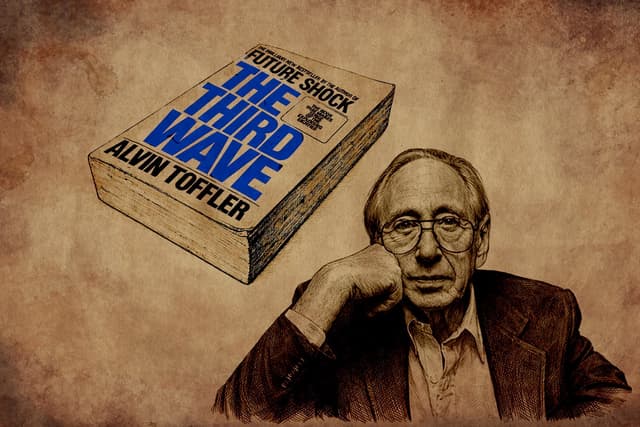
The First Wave was agrarian; the Second Wave was industrial, characterized by mass standardisation, specialisation, synchronisation, centralisation, maximisation, and capital-concentration. The factory was the engine of this Second Wave, necessitating the creation of massive urban centres, the break-up of the multi-generational family, and the alienation of the 'producer' from the 'consumer'.
The Third Wave, however, is defined by 'de-massification' and 'de-centralisation'. Today’s advanced technologies do not require the concentration of labour in a single geographic location. The rise of the electronic cottage, where high-value work is performed in decentralised, home-based or village-based nodes, represents a return to the integrated life of the prosumer (producer-consumer) that Gandhiji foresaw in his own way, but with the added power of global connectivity.
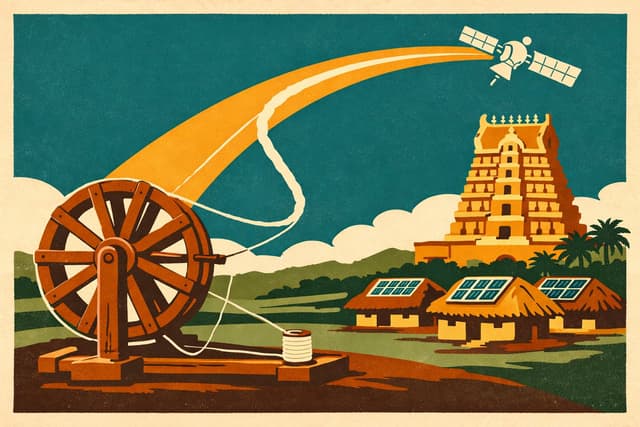
'Gandhi with Satellites': High Technology in the Service of Swaraj
In this Tofflerian 'Third Wave' paradigm, digital tools naturally facilitate the decentralization of production and localized value addition without destroying the biosphere.
Additive Manufacturing : Allows for 'localised production' of complex tools and spare parts in a village setting, eliminating the need for long, carbon-heavy supply chains and centralized mass-production factories.
Renewable Micro-Grids: Solar and wind technologies enable energy Swaraj (self-rule), where villages generate their own power instead of remaining dependent on a centralised, often corrupt, state-industrial energy grid.
The Global Digital Commons: Information technology allows a village artisan or software developer to access global markets and knowledge without migrating to a megacity slum, thus preserving the social fabric of the 'Beautiful Tree' of indigenous community life.
Toffler wrote:
Developments like these in energy, agriculture, technology, and communications suggest something even deeper-whole new so¬ cieties based on the fusion of past and future, of First Wave and Third Wave. One can begin to picture a transformation strategy based on the development of both low-stream, village-oriented, capital-cheap, rural industries and certain carefully selected, high-stream technolgies, with an economy zoned to protect or promote both. Jagdish Kapur has written: “A new balance has now to be struck between” the most advanced science and technology available to the human race and the Gandhian vision of the idyllic green pastures, the village republics.” Such a practical combination, Kapur declares, requires a “total transformation of the society, its symtels and values, its system of education, its incentives, the flow of its energy resources, its scientific and industrial research and a whole lot of other institutions.” Yet an increasing number of long-range thinkers, social ana¬ lysts, scholars, and scientists believe that just such a transformation is now under way, carrying us toward a radical new synthesis: Gandhi, in short, with satellitesThird Wave, 1980, p. 361
Nearly five decades have elapsed since Toffler’s The Third Wave first traced the contours of our techno-social evolution. From the vantage of forty-six years, the ledger of its foresight presents a complex legacy of startling prescience and sobering misjudgement. One might easily relegate Toffler’s near utopian techno-optimism to a relic of more hopeful era, or argue that the developing world was diverted from this transitional pathway into a far more fractured and chaotic trajectory. Alternatively, in the current emergence of an array of sustainable technologies and pluralistic economic systems, a series of movements, though still nebulous perhaps, but decidedly decentralised, one can discern an alignment with the future techno-historiography of Toffler.
Yet, that such a metamorphosis could be conceived at all, that a decentralised, post-industrial future was no mere utopia but a tangible civilizational departure, finds its most profound and gestational seed-vision within the Gandhian worldview.
Though he lacked the modern lexicon of 'waves' to describe it, was one of civilizational alchemy. He sought to rescue the eternal values of Hindu heritage, long-enshrined in the agrarian structures of the First Wave and transplant them directly into a decentralised, post-industrial Third Wave future. In doing so, he consciously attempted to leapfrog the Second Wave, whose industrial excesses and dehumanising scale he viewed not as progress, but as a dark and systemic malady.
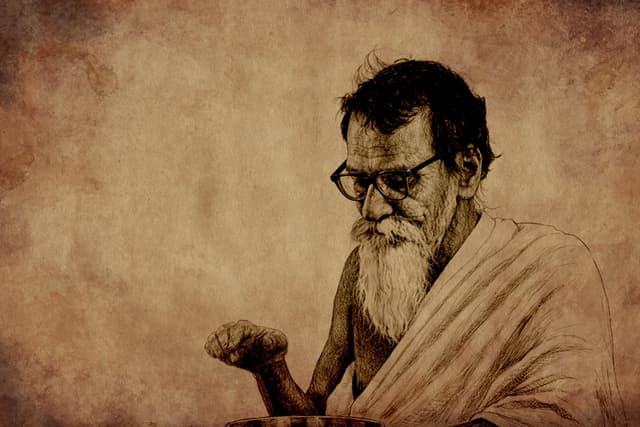
Gandhian thinker Kishorlal Ghanshyamlal Mashruwala (1890-1952) who was also the editor of 'Harijan' after Gandhi, in his last book 'Gandhi and Marx' (1951) pointed out the centrality of decentralisation to the social vision of Mahatma. Acharya Vinoba in his detailed introduction brought out the essence of Gandhi's social vision:
With due regard for this elasticity and freedom we may consider Gandhi's thoughts on the social order under three heads: (i) Varna-vyavastha (life-vocation), (ii) trusteeship and (iii) de-centralisation. Gandhi adapted the traditional concept and infused a new spirit into it. The new idea is, nevertheless, based on the old one and preserves its meaning and purpose.... The second principle is trusteeship.... The word 'de-centralisation'... is new and has therefore gathered no associations, either good or bad. It is also a new word for a new idea.... A decentralised order means that there should be an integrated and comprehensive plan behind the various industries. In the absence of such a plan they are merely scattered enterprises. Such isolated industries broke down inevitably at the first impact of the machine age. A genuine decentralised order will not break down but will break down the machine age.Vinoba, Third Power, Trans. Marjorie Sykes & K.S.Acharlu, (1950:2000)), pp.10-13
Then Vinoba goes on to explain what a decentralised system would be with respect to the machine age system:
When therefore we say that decentralisation will destroy the machine age, we mean that we shall first make use of whatever good it can provide. The old unorganised village industry had no power to assimilate the machine age in this way. This is the basic difference between un-centralised and de-centralised industry.... But the principle of decentralisation is not limited to industry, it also applies to the authority of the state.ibid., p.14
This aspect was integrated into the conceptual framework of Hindutva thinkers who followed particularly Deendayal Upadhyaya (1916-1968) and Ram Swarup (1920-1998).
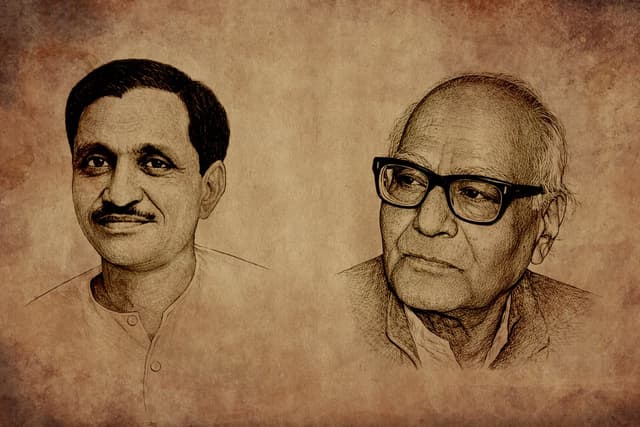
In his foundational lecture series on Integral Humanism (22nd to 25th April, 1965) Upadhyaya emphasized decentralisation. For him, in the creation of the social context for realising the highest human potential was 'possible only through a decentralised economy'. He even conceptualised a de-centralised economic system as an alternative to capitalist and socialist capital formation:
For capital formation, it is essential that a part of production be saved from immediate consumption, and be used for further production in future. Thus, capital can be formed only by restraint on consumption. This is the basis of capital formation to which Karl Marx refers to as ‘surplus value’ in his treatise. In the capitalist system, the industrialist creates capital with the help of this surplus value. In a socialist system, the State undertakes this task. In both the systems, the entire production is not distributed among the workers. If production is carried on through centralised large-scale industries, the sacrifice on the part of the worker in creating the capital is not given due recognition. The advantage in decentralisation is in the fact that the worker has a sense of direct participation in the management of the surplus value or capital.Deendayal Upadhyaya, Lecture-IV, 25-April-1965
Three years later at the fifth National Convention of the Swatantra Party held at Bhubaneswar between October 5 and 6 1968, the resolution was adopted on capital participation of labour in trade, industry and commerce. M. Mohammad Hussein wrote the following in Swarajya:
By encouraging the workers to take shares in their establishments, managements can get spectacular results. It creates a sense of belonging to the business. Enthusiasm, initiative, loyalty and devotion' to duty are encouraged. By producing more the worker stands to earn more by pay linked to output, bonus' and dividends.... By encouraging the workers to take shares in their establishments, managements can get spectacular results. It creates a sense of belonging to the business. Enthusiasm, initiative, loyalty and devotion' to duty are encouraged. By producing more the worker stands to earn more by pay linked to output, bonus' and dividends.M. Mohammad Hussein, A Fair Deal for Labour, Swarajya, Nov-30-1968
One can very well see that in both the thoughts of Gandhi-Vinoba and Pandit Upadhyaya, there is an anticipation of the emergence of a new form of economy which they envisioned as being in resonance with ancient Hindu social order. What was needed was an appropriate technology.
Hindutva thinker Ram Swarup pointed out this aspect in his lecture on Gandhian Economics.
A technology is a powerful thing. The way we produce and consume things influence our social relations, thinking and feeling as Marx observed. A Gandhian Economics, the economics of decentralization, local production and independent workers, is not possible without developing a technology appropriate to it. In the last 200 years, a technology has come into being which favours centralization, large-scale operations and circular production. Whether this technology is as efficient as it appears to be is a moot point.... But if an appropriate third Technology is developed, it could be a great constructive force. It could help development in the East without vast disorganisation and uprooting and other evils which accompanied industrialization in the West. It may even offer a solution to some of the problems which the West faces in its own pattern of development.Ram Swarup, A Gandhian Economics: Supporting Technology, 1976, p.34
It is interesting to see that the Indic thinkers from Vinoba and Rajaji to Deendayal and Ram Swarup, each of them arrived at a conceptual prefiguring of 'Third Wave' and they arrived from the core Gandhian paradigm.
In stark contrast, the prevailing architectural vision for a New India was forged in the heat of the industrial furnace. For Pandit Nehru and Veer Savarkar the smoke-stacks of the Second Wave were the promised land; they viewed rapid industrialisation as the singular panacea for the nation’s deep-seated socio-economic paralysis. Untouchability and casteism could be done away with strong appeals to nationalism (in the case of Veer Savarkar) or socialist patriotism (in the case of Nehru) along with Constitutional interventions. Hindu Mahasabha even toyed briefly with the idea of 'Hindu socialism'.
A superficial view of history often groups Dr. B.R. Ambedkar with these modernists, not completely in an unjust manner. Indeed, the Bodhisattva championed urbanisation and the 'liberal' air of the urban habitations as a necessary escape from the parochial stagnation of the Indian village. His economic thinking clearly had what could be interpreted as 'bourgeois' thinking, so much so that in his magnum opus 'Volga to Ganga' Sanskriticist and Marxist theoretician Rahul Sankrityayan (1893 – 1963) criticised him for being only interested in creating bourgeois among the Scheduled Communities.
Yet, to conflate Ambedkar’s urbanity with Nehru’s socialist or Savarkarite nationalist industrialism is to miss a subtle, vital nuanced core.
Part-II - Fundamental Spiritual Change, They Sought
Bodhisattva and the Lion of Advaita
To Dr. Ambedkar urbanisation was a social phenomenon. It was no panacea. While romanticising rural India would keep his people in sustained misery and block their progress compared to urbanisation, Dr. Ambedkar was convinced that Hinduism has to adapt itself to the liberal democratic society that was coming up, failing which Hinduism would become a stumbling block to India's development and worse a toxic stranglehold on the basic human rights of the marginalised people. This was the reality for Dr. Ambedkar irrespective of urban or rural settings.
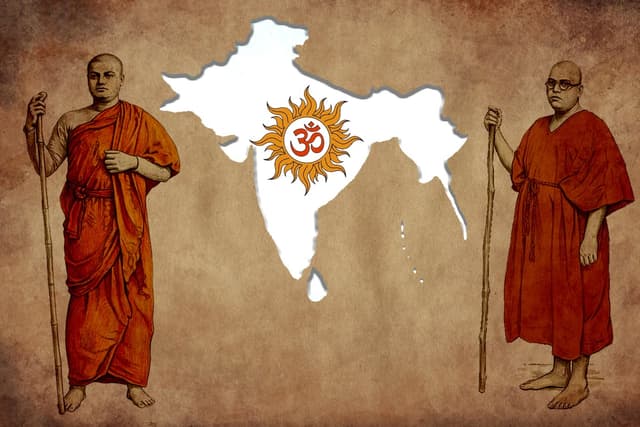
Here strangely Dr. Ambedkar has more common ground with whom he considered as his arch-competitor in ways more than one - Mahatma Gandhi.
For both the change should be spiritual not socio-economic.
But this has deeper Advaitic roots.
Hindu Dharma has to remove the basic riddle it contains. Baba Saheb wrote in the unfinished manuscript on the riddles in Hinduism:
To support Democracy because we are all children of God is a very weak foundation for Democracy to rest on. That is why Democracy is so shaky wherever it made to rest on such a foundation. But to recognize and realize that you and I are parts of the same cosmic principle leaves room for no other theory of associated life except democracy. It does not merely preach Democracy. It makes democracy an obligation of one and all....The question is what happened to this doctrine of Brahmaism ?... When asked why this happened the answer is that Brahmaism is only philosophy, as though philosophy arises not out of social life but out of nothing and for nothing.... It is not enough to know. Those who know must endeavour to fulfil....The result is that we have on the one hand the most democratic principle of Brahmaism and on the other hand a society infested with castes, sub-outcastes, primitive tribes and criminal tribes. Can there be a greater dilemma than this ?Dr. Bhimrao Ramji Ambedkar, Complete Works, Vol.4. pp.286-7
In 1893 Dr. Ambedkar was two years old.
That year Swami Vivekananda wrote a letter from Breezy Meadows, United States to his friend Alasingha Perumal in Madras. He wrote:
No religion on earth preaches the dignity of humanity in such a lofty strain as Hinduism, and no religion on earth treads upon the necks of the poor and the low in such a fashion as Hinduism. The Lord has shown me that religion is not in fault, but it is the Pharisees and Sadducees in Hinduism, hypocrites, who invent all sorts of engines of tyranny in the shape of doctrines of Pâramârthika and Vyâvahârika.Swami Vivekananda's Letter dated 20th August, 1893, Complete Works, Vol.5
One can see both the words echoing the same emotions, the same values. Both acknowledge Hindu Dharma as having the strength to remove the social differences through its spiritual values. Both hold the sections arrogating the religious-authority to themselves as accountable for criminally neglecting this spiritual strength to serve India and her masses.
Then Vivekananda asked the traditionalist stranglers of Dharma in his own inimitable style to disappear while handing back the Vedic wisdom they had been hoarding without any benefit to humanity:
However much you may parade your descent from Aryan ancestors and sing the glories of ancient India day and night, and however much you may be strutting in the pride of your birth, you, the upper classes of India, do you think you are alive? You are but mummies ten thousand years old! It is among those whom your ancestors despised as "walking carrion" that the little of vitality there is still in India is to be found; and it is you who are the real "walking corpses".... In this world of Maya, you are the real illusions, the mystery, the real mirage in the desert, you, the upper classes of India! You represent the past tense, with all its varieties of form jumbled into one. That one still seems to see you at the present time, is nothing but a nightmare brought on by indigestion. You are the void, the unsubstantial nonentities of the future. ... Fleshless and bloodless skeletons of the dead body of Past India you are, why do you not quickly reduce yourselves into dust and disappear in the air? Ay, on your bony fingers are some priceless rings of jewel, treasured up by your ancestors, and within the embrace of your stinking corpses are preserved a good many ancient treasure-chests. Up to now you have not had the opportunity to hand them over. Now under the British rule, in these days of free education and enlightenment, pass them on to your heirs, ay, do it as quickly as you can. You merge yourselves in the void and disappear, and let New India arise in your place.Swami Vivekananda, Memoirs from European Travel, Vol.7
The words pulsate with power.
The inversion is sharp. Traditionalist Acharyas in their Brahmasutra commentaries called Shudras (and they defined a Shudra by birth) as not even a dead body but a mobile crematoria. Vivekananda punched back sharp. You are shrunken mummies, lifeless, repulsive but of only museum interest. Yet the lifeless corpses, the shrunken mummies are guarding the life-rejuvenating treasures of the civilization - the Vedic and Upanishadic wisdom.
Thus one sees in both Vivekananda and Ambedkar the call for Vedic values to liberate society.
Mahatma and the Bodhisattva
Gandhiji also focussed on the same. He believed that the spiritual values hold more power for societal transformation than the economic systems. They treated the problem of untouchability as a problem of religion. More than Constitutional Reform both Gandhiji and Dr. Ambedkar insisted on genuine change in the core social views of Hindus. Legislature is good against untouchability for it is a social crime and a crime against humanity. But with regard to religious discriminations in the temples and Hindu sacred spaces which go on till this day, both Dr. Ambedkar and Mahatma Gandhi wanted a genuine change of heart from the Hindus.
Interestingly here Gandhi did not hesitate to get the help of legislative instruments.
But the Bodisattva wanted nothing short of the change in core Hindu values. Failing which Dr. Ambedkar advised Avarnas to simply get out of Hindu Dharma of the Savarnas. With respect to Ranga Iyer's Bill on removing disabilities of Avarna Hindus, Dr. Ambedkar withheld his support and explained the reasons:
Firstly the Bill could not hasten the day of temple entry and secondly the majority of the caste Hindus including Shankaracharyas were opposed to the measure and there was no hope that they would honour the legislation even after it was passed.Shubamanii Naganna Busi, Mahatma Gandhi and Babasaheb Ambedkar, 1997,p.152
On the other hand Mahatma Gandhi entirely supported the Bill. Chakravarti Rajagopalachari lobbied for the Bill. He canvassed door to door for the rights of the Avarna Hindus to enter the Hindu sacred space as well as the civil infrastructure without discrimination. In this regard Gandhiji asked Rajaji not to take to heart 'Dr. Ambedkar's explosion, the Government's decision and Malaviya's opposition.'
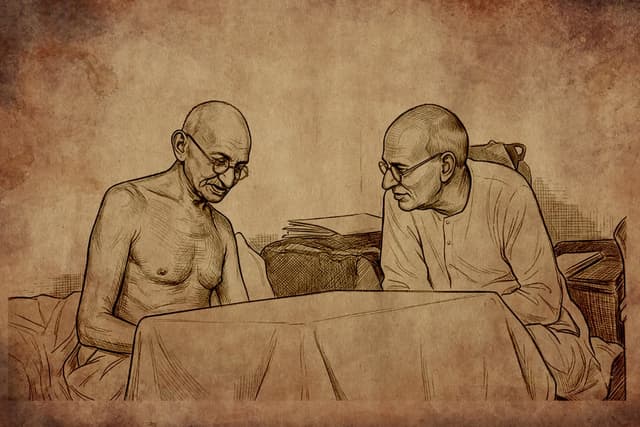
For both Rajaji and Mahatma Gandhi the approach was holistic - legislative instruments as well as fundamental change in the heart of the Hindus.
When Indian communities move from the socially stagnant First Wave and colonially imposed Second Wave into the Third Wave civilization, Gandhi wanted the core Sanatan values to be transferred to the Third Wave civilization. This he wanted to do through a combination of change of Savarna heart and also through legislative means.
Gandhiji always considered the problem of untouchability as a cardinal problem of Hindu religion. So when in 1932 he started the historical fast for the removal of separate electorates for the 'Depressed Classes' he mad it very clear where he stood with respect to the problem of untouchability. The diary of Sri Mahadev Desai contained the following incident.
On the Communal Award and separate electorates Vallabhbhai Patel commented that this was a deep conspiracy wherein the British would rule through a few 'untouchables'. According to him, the special representations to them would keep the other Hindus out of the Legislatures. To this Gandhiji replied:
It is only the political aspect. If the matter was purely political I would not give my life. What hurts me most is the moral aspect.Gandhi cited in Mukut Behari Verma, History of the Harijan Sevak Sangh:1932-1968, 1971, p.38
Gandhian chronicler of the history of Harijan Sevak Sangh Mukut Behari Verma writes:
Gandhiji also expressed the fear that the British Government wanted to arrest the marvellous growth of the work of Hindu reformers who had dedicated themselves to the cause of the untouchables. He said the Government wanted to tell the untouchables not to believe the social reformers but to believe Muslims and even Goondas. The Muslims will use the untouchables for attacks on temples and would even burn them. On September 10, Gandhiji said the Award carried the seeds of the conversion of the untouchables to Christianity or Islam.... Under these circumstances there was no other way for Gandhiji except to stake his life. He expressed the confidence that his death would arouse the conscience of Hindu society... He wrote to Mirabehn that no penance was too high for washing away the sin of untouchability. To Shrinathji, the Guru of Kishori Lal Mashruwala, Gandhiji wrote that the object of the fast was not to get the Award changed, but to create an awakening and the purity which would be generated by the attempts to change it. What he meant was, that it was an attempt to strike at the root of untouchability.ibid. p.39
The conversation between Dr. Ambedkar and Mahatma Gandhi went back and forth. Finally Dr. Ambedkar gave in. He had bargained hard and did not return empty-handed. At the same time later he felt cheated because as he had warned Gandhiji even during the discussions, he was not sure the Savarna Hindus would follow the vision of Gandhiji in letter and spirit. Nevertheless he made a profound statement at the conclusion of the talks.
Dr. Ambedkar said that it appeared to him that there was more in common between him and Gandhiji than between him and the others.ibid., p.46
Even after Dr. Ambedkar had agreed to sign the treaty along with Shri. M.C.Rajah, Gandhiji was not prepared to end his fast. At each and every point, he stressed that the core of the issue was that of religion. In a statement, Gandhiji had informed Miss Wilkinson that the British Government should accept the agreement only if it considered it a religious matter, otherwise it should reject it.
The fast was not about the removal of Communal Award. If so it was then only a political strategy, even an unjust emotional blackmail. In fact, many have criticised Gandhi exactly of the same. But despite his harsh words later, even Dr. Ambedkar agreed Gandhi was sincere in his own wWain when Gandhiji made Rajaji do the lobbying for 'Harijan' temple entry, Jawaharlal Nehru could not see why such an importance was attached to temple entry. He was irritated at the way Rajaji was lobbying from door to door - asking people to support the temple entry of 'Harijans'.
Not all Congressmen welcomed the Harijan movement or C.R.’s (Rajaji's) preoccupation with the Bill. ‘Reform,’ it was alleged, was weaning men away from a political fight. In his prison, Jawaharlal Nehru thought that C.R.’s Assembly effort was strange and blameworthy. As for orthodoxy, it was unsparing in its attacks on Gandhi and C.R.Gandhi, Rajmohan. Rajaji: A Life), Penguin Books, 1996, p. 156
However later Nehru realised his folly.
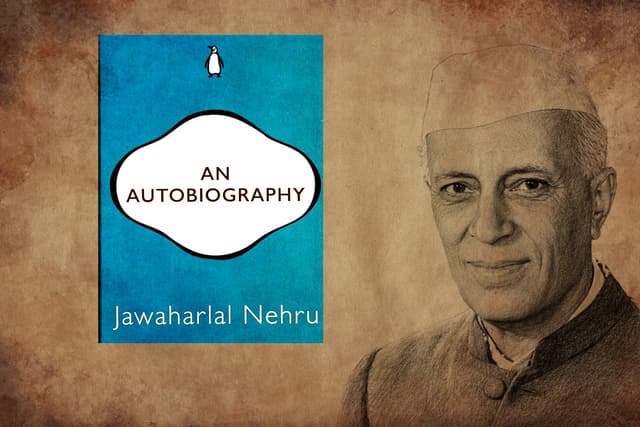
In his autobiography he made an insightful observation which is worth quoting in some detail here:
There was a great agitation for removing the barriers to temple entry, and a Bill to that effect was introduced in the Legislative Assembly. And then the remarkable spectacle was witnessed of an outstanding leader of the Congress going from house to house in Delhi, visiting the members of the Assembly and canvassing for their votes for this Temple Entry Bill. Gandhiji himself sent an appeal through him to the Assembly members. And yet civil disobedience was still going on and people were going to prison, and the Assembly had been boycotted by the Congress and all our members had withdrawn from it…. I was amazed at Gandhiji’s appeal, under the circumstances then existing, and even more so by the strenuous efforts of Rajagopalachariar, who, a few weeks before, had been the acting President of the Congress…. The Government attitude to this Temple Entry Bill, then and subsequently, was very revealing. It put every possible difficulty in the way of its promoters, went on postponing it and encouraging opposition to it, and then finally declared its own opposition to it, and killed it. That, to a greater or lesser extent, has been its attitude to all measures of social reform in India, and on the plea of non-interference with religion, it has prevented social progress. But this, it need hardly be said, has not prevented it from criticising our social evils and encouraging others to do so.Jawaharlal Nehru, An Autobiography (New Delhi: Oxford University Press, 1936:1942/1982), 381-2.
Rajaji ran Thiruchengodu Ashram where he took up 'Harjian' emancipation programme and this involved creating a decentralised industrial base. As late as 1973 Khadi and Village Industries Commission , hails Rajaji's Gandhi Ashram as the ' Gangotri of Khadi ' in South India (Swarajya, 1973). The village vocations were taken and they were learnt and done by Ashram inmates irrespective of their Jathi affiliation. Rajaji himself learnt and practiced tanning. At the same time he was also very particular in securing temple entry. He even broke the vow of non-cooperation and took up the case of a Dalit who had entered the temple near Tirupati and won the case for him.
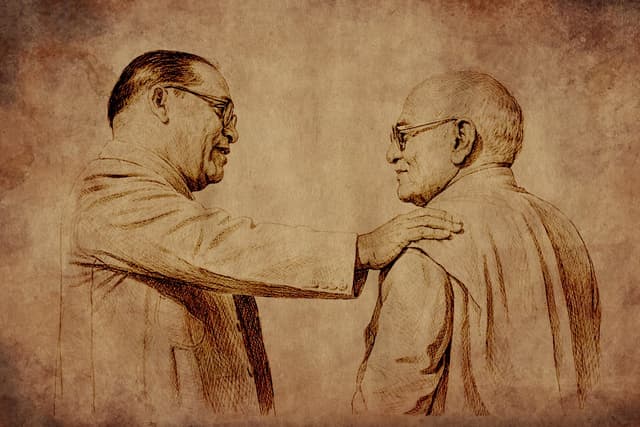
Rajaji was clear. While supporting free enterprise and decentralisation, the fight against untouchability and its root cause the birth-based caste system should go. The latter could be achieved through religion.
While Veer Savarkar was for industrialisation and nationalism, he demanded the abolition of untouchability and its roots cause the birth-based caste system through the change of mind, not the change in national mode of production. Sastra-Adhikara based Jathi was for him a disease of the mind according to him, It would disappear when one ceases to believe in the Sastras, he said. That is a spiritual transformation. It would not happen by industrialisation.
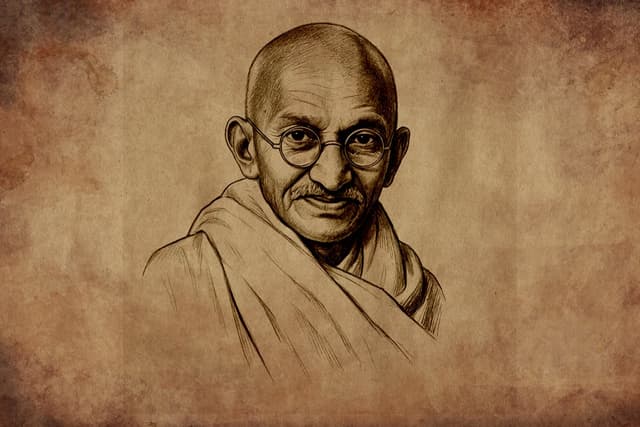
Gandhi possessed a profound intuition regarding the 'Third Wave' civilization - a future defined by decentralisation and sustainable humanism. He sought to preserve and transmit the eternal essence of Sanatana Dharma, specifically the universal values of Advaita (non-duality), into this new era. However, he recognised that untouchability and birth-based discrimination were the most depraved civilizational shadow of by Hindu Dharma. The more all-encompassing and luminous the core values of a culture are, the more profoundly depraved and inhuman its corresponding shadows can become if left unaddressed.
He knew neither Toffler nor Carl Jung. But what he gave was a blueprint to integrate the shadow into the collective psyche of the civilization - veritably a Dharmic -civilizational individuation. That was his Bhagirathic attempt.
The shadow did make a counter.
Why not just concentrate on economic upliftment, why should one bother about temple entry?
The variant of this argument is the argument that industrialisation is enough to weaken Casteism and we need not worry about fundamental root-and-branch reform of Hindu religion.
When the issue was raised to Gandhiji at New Delhi by some members of the 'Depressed classes' itself, the answer given by Mahatma was recorded in the documents of Harijan Sevak Sangh:
Gandhiji told them that while economic uplift, was no doubt important and could not be ignored, money in itself was not enough. It would avail the Harijans nothing if plenty of money was given to them but they were made to live in 'palaces' of their own outside the villages and away from the other people.M.B.Verma, p.96
This observation was made by Gandhiji around the year 1933. Veracity of this observation comes from another independent source.
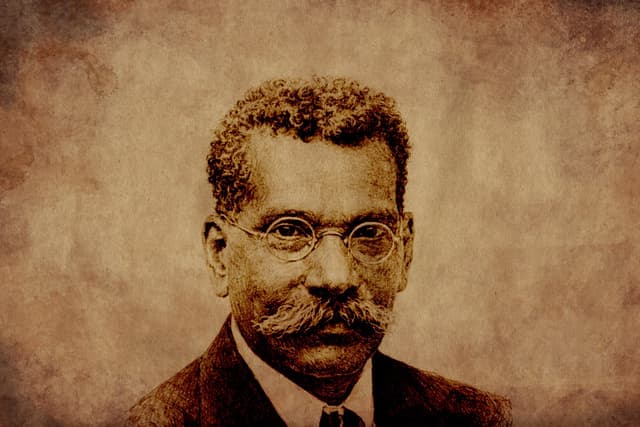
In his autobiography published in 1938, Rettaimalai Sreenivasan (1860-1945) who came from an above-middle class family of Paraiyar community explains his childhood school days in a Coimbatore school:
During my time at Coimbatore school, out of nearly four hundred students, all but ten were upper-caste. The dictates of caste were observed with rigid severity. I lived in constant fear that if I befriended my peers and they discovered the particulars of my caste, my lineage, or my home, they would treat me with disdain. To avoid such encounters, I would sit and read in solitude far outside the school grounds, entering the classroom only after the opening bell had rung. As soon as classes were dismissed, I would hurry home with such haste that no other student could reach me. The cruelty of being barred from joining my peers in play weighed heavily upon my spirit; I would dwell on it endlessly, searching for a way to transcend this suffocating oppression.Rettaimalai Srinivasan - Jeeviya Sarithira Surukkam (Condensed Autobiography Tamil 1939) . Thadagam 2019, p.32
This shows that economic upliftment in itself cannot change the situation for Scheduled Communities.
Rather than acting as a universal solvent for caste, industrialisation often served as a new vessel for it. As the Scheduled Communities and caste communities workers entered the industrial workforce, they did not find a neutral playing field; instead, they encountered a structural transfer of old prejudices into a modern, regimented environment.
Far from diluting the core problem, the industrial era saw untouchability evolve into more sophisticated, systemic forms. Even in the nascent decades of the twentieth century, the shadow of caste remained so pervasive that it dictated the very architecture of labour- shaping the formation, internal hierarchies, and collective actions of trade unions themselves.
A case in point is the 1921 mills strike in Madras:
Although the caste leaders and the Assistant Commissioner of Labour played a great part in influencing the decision of the Adi-Dravidas, the experience of the Adi-Dravida workers during the 3-month-long-lockout must have weighed equally in the decision-making. The Adi-Dravidas were not prepared for another long period of unemployment and suffering. So, on June 20, about 700 Adi-Dravida workers marched to the Buckingham Mill defying the union’s call for a sympathetic strike. With this, they changed the course of the workers’ struggle; a struggle demonstrating solidarity and unity was transformed into a struggle against strikebreakers, and because of the caste of the strikebreakers, into an inter-caste conflict. Binny and Co. and the Government could not have been happier.D.Veeraraghavan, The Making of Madras Working Class, Leftword, 2020, pp.128-9
The Fragmented Fraternity
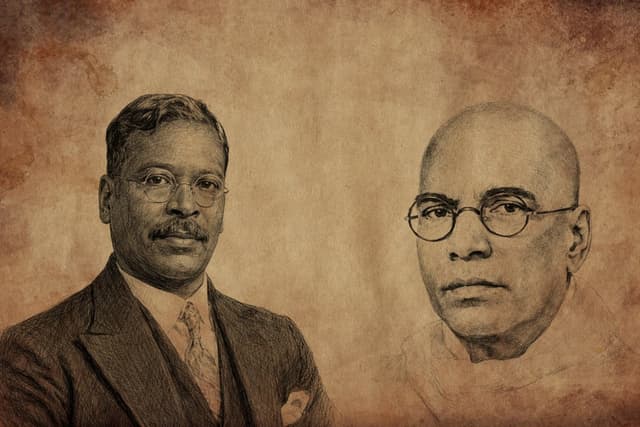
Even when led by two devoted patriots - one Savarna and one Avarna - the labour movement remained shackled by the deep-seated compartmentalisation of Jati system. This internal rift was not merely a social disagreement; it was a spiritual deficiency that rendered true fraternity an impossibility. Their divergent socio-economic perspectives, birthed from centuries of caste isolation, prevented a unified front. Ultimately, this lack of cohesion served as a strategic windfall for the colonial government and the British mill owners of Madras, who exploited these internal divisions to maintain control.
Consequently, industrialisation is not an inherent solvent for caste or untouchability. Far from dissolving these ancient prejudices, the industrial era often acted as a new lattice, allowing caste to compound, complicate, and add sophisticated modern layers to an old oppression.
We need to combine all the wave structures and find out the optimal solution to annihilate caste but primarily at least decouple it from Dharma.
A good example is land redistribution. Acharya Vinoba insisted that the land redistribution through voluntary donations by land holder. It was initially successful but ultimately became ineffective because there was no systemic approach.
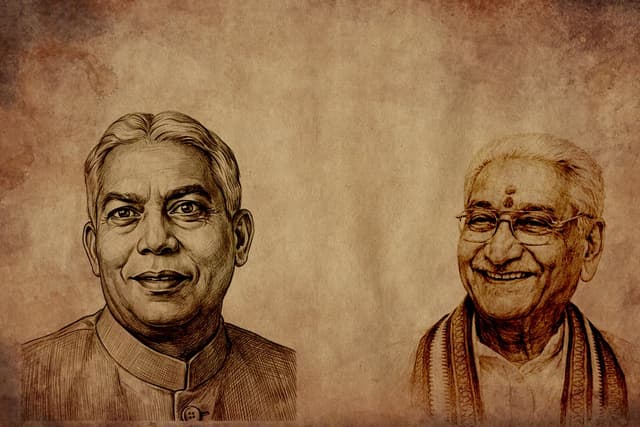
Almost half a century later a Sanghatanist leader of the RSS and Chairman of Scheduled Castes and Scheduled Tribes (SC/ST) Commission, Dr. Suraj Bhan (1928-2006) pointed out to the same strategy for Avarna emancipation:
The Government cannot employ four crore people, but it can give them land, an important status symbol in this country. The Wasteland India Atlas of 2000 says India has 20 crore acres of wasteland. Redistribution of this land among the poor will benefit four crore families, or 20 crore people. It will also increase grain output in the country. There is unutilised land on either side of our railway lines, along highways and degraded forest land. Redistribution of this land was recommended by the governors' committee in 2001 and by the Mohan Dharia Committee on Wasteland Development.... The Government must also create quotas in procurement contracts for backward caste co-operative societies. Each year, it purchases shoes, boots, cloth and uniforms worth crores from the open market. Quotas in labour and liquor contracts should also be created for the economic upliftment of backward castes. I have also suggested that the Khadi and Village Industries' Commission can select 50 beneficiaries from each of India's 600 districts every year and make them self-sufficient by training them in rural industries and procuring items from them.'India Today', May 15, 2006
At the same time he also asked for the scriptural removal of all the disparaging terms against Shudras and Avarnas from Hindu Dharmic texts.
In 2005 Suraj Bhan was the chairperson of the SC Commission. He had asked the religious authorities to remove all derogatory remarks perceived as demeaning to the scheduled caste communities in so-called scriptures such as Manu Smrithi. He conveyed his wishes to the Shankaracharya of Sringeri himself urging that this detoxification of Hindu scriptures must be done. But the orthodoxy claimed that there was not a single word of objection in the Hindu scriptures and that they need not be changed.
But a prominent non-ignorable personality, sided with Suraj Bhan and stated that Manu Smrithi did contain objectionable derogatory references and that they should be removed. He was the then VHP President Ashok Singhal.
Here one sees a practical socio-economic solution that has been combined with the Dharmic core solution. Both should go hand in hand. The fundamental unchangeable is the Dharmic solution.
Casteism into Third Wave Civilization
In modern times right into Third Wave civilization also the toxic casteism has entered. Untouchability has new forms. Scheduled Community youths get killed by Savarna mobs for having ringtones praising Dr. Ambedkar. An Avarna Hindu lives in constant fear in public space. He or she could be assaulted for scoring high marks in the school over a Savarna as it happened in the case of Nanguneri attacks. A better dress could bring home a murderous attack. While for other communities such violence is an outlier event, for an Avarna living a life without casteist violence is an outlier event.
The immediate reasons may be secular. A vengeance, an anger, a conflict in school, college or workplace. But the deeper reason is the lack of Hindu fraternity. The deeper cause is spiritual. How does a national unity arise? Bodhisattva Ambedkar explains:
If unity is to be of an abiding character it must be founded on a sense of kinship, in the feeling of being kindred. In short it must be spiritual.
The inability of Savarna Hindus to feel the injustice imposed by their Varna system upon Avarna Hindus is not because of social situations. The social situations either increase of decrease the feeling of pain but the inability is a spiritual deficiency. That the very learned and very pious Savarna Dharmacharyas perpetuate such a system of injustice, is not the failure of those leaders but the failure of the Savarna Dharma system. With such spiritual deficiency the system ceases to be Dharmic. It becomes Adharmic.
That is why both the Mahatma and the Bodhisattva saw the shadow engulfing the Dharmic soul of the Rashtra. Dr. Ambedkar migrated out of the devouring shadow into Dhamma.
Mahatma Gandhi forged an unified frontal assault on the devouring system.
What we need today is a combined, all out attack on casteism - not rhetorical but systemic and fundamental.
Whenever the discourse turns toward the persistence of caste, the reflexive response from Savarna Hindus is a pivot to the perceived injustice of reservations. Yet, this is a profound misapprehension of the mechanism. Reservations are not a form of state-sponsored entitlement; they are a civilizational restitution - a necessary, intra-Dharmic settlement of an ancestral debt, a collective integration of the Shadow of casteism for civilizational individuation.
They represent a late and limited attempt at representative pluralism, born of the need to counter a much older, far more absolute form of reservation that has long choked the cultural and spiritual spheres where merit alone should have reigned.
The prevailing grievance among the privileged is that seventy years of affirmative action have compromised excellence and institutionalised mediocrity. Yet, if a few decades of secular quotas are claimed to have eroded national merit, one must confront a far more staggering logic: what has a millennium of exclusive, hereditary reservation done to the spiritual and intellectual vitality of the Sanatana domain?
The consequences of this ancient monopoly are not hidden; they are manifest in the social literacy of our leadership. Today, one finds that an average Catholic priest often possesses a far more nuanced understanding of contemporary ethical crises- ranging from infant mortality rates to the existential threat of climate change- than many a venerable Sankaracharya. While the former is trained to engage with the world’s suffering, the latter’s vision remains frequently entombed in a social vacuum, preserved by a system that rewards lineage over lived wisdom.
Not long ago, in 1933 soon after Poona pact was signed between Mahatma and Bodhisattva, Sanghatanist Hindus organised a conference in Bombay. There the Sanghatanist Hindu leaders passed the following resolution:
It is further agreed that it shall be the duty of all Hindu leaders to secure, by every legitimate and peaceful means an early removal of all social disabilities now imposed by customs upon the so-called untouchable class including the bar in respect of admission to temples.
To eradicate the scourge of untouchability, Hindu Sanghatanists must direct their efforts toward its civilizational fountainhead - the systematic segregation in the traditional Vedapadasalas. While social discrimination is a visible malignancy, it is the untouchability in the root of traditional Vedic education that provides the spiritual scaffolding for casteism. Until this core untouchability of the sanctum and the palm leaves is dismantled, all other reforms remain merely superficial.
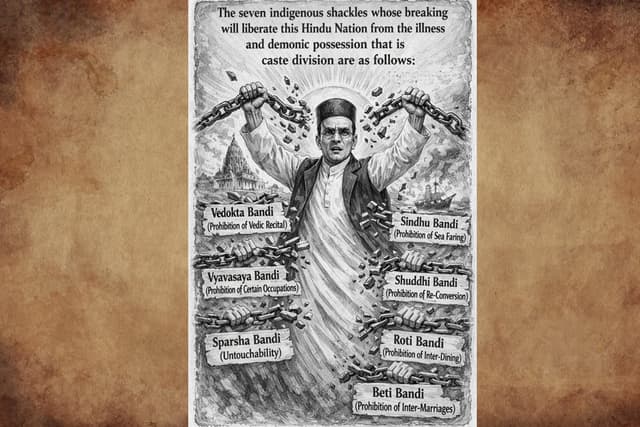
This spiritual blockade was precisely why the Sanghtanacharya, Veer Savarkar, identified Vedoktabandi - the prohibition of Vedic study and recital- as one of the seven shackles binding the Hindu community. To truly heal the thorn in the heart of Savarkar’s Sanghatan vision, a resolute Hindu Government must ensure that every Veda Padasala complies with desegregation and universal Hindu admission.
The State must exercise its authority to remove the historical injustice placed at the root of Hindu Dharma. While issues like inter-dining (Roti) and inter-marriage (Beti) address the symptoms of division, opening the doors of the Padasalas addresses the cause.
True social integration is impossible as long as the source of spiritual authority remains closed based on birth. By democratising the Vedic institutions, we do not merely reform Hindu society; we unify it at its most fundamental level, ensuring that the light of the ancient wisdom belongs to every Hindu equally.
To the traditionalists who oppose one always give the famous answer of Sanghtanacharya Swantra Veer Vinayak Damodar Savarkar:
With you if you come with us. Without you if you do not. Despite you if you oppose.
 Join our