Ideas
The Goddess Who Must Not Rise: Mary And Vatican's Theological Anxiety
Aravindan Neelakandan
Nov 06, 2025, 02:37 PM | Updated 10:15 PM IST
The Vatican released Mater Populi Fidelis on 4 November, 2025. This doctrinal note, whose title translates to 'Mother of the Faithful People of God' came from the Dicastery for the Doctrine of the Faith (DDF), the modern successor to the Supreme Sacred Congregation of the Roman and Universal Inquisition.
At first glance, the note appears a scholarly effort to deepen Marian devotion and clarify the essential nature of the Virgin Mary. Approved by Pope Leo XIV, this intervention carries the weight of Catholic history’s greatest doctrinal enforcer.
But beneath this veneer of spiritual refinement, however, lies another agenda: an unambiguous act of institutional containment.
The document functions not as a guide to proper veneration, but as a rigid instrument of control, meticulously crafted to define and enforce the absolute limits of Divine Feminine within a theological structure perpetually wary of giving ground to the Goddess in Her true glory.
This is, ultimately, a power play that seeks to contain the profound symbol of the Divine Feminine within a strictly Christocentric framework.
The doctrinal note explicitly addresses 'numerous requests and proposals' which sought to aggressively elevate Mary’s status through specific maximalist titles and even the lobbying for new dogmatic declarations.
The DDF’s explicit rejection of titles 'Co-Redemptrix' and 'Mediatrix of All Graces' is an act of institutional self-defence.
From the top-down vantage point of the Vatican, however, such fervent devotional terms arising from the grassroots pose a threat, risking not only 'sowing confusion among ordinary members of the faithful', but, more importantly, diluting the exclusive salvific authority of the male Christ.
This move is necessary for a masculine Trinitarian Godhead. In essence, the Vatican is engaged in an act of perpetual theological gynophobia, attempting to neutralise any autonomous female power at the pinnacle of divinity.
The release of the document was preceded by intense activity on social media and specific Marian reflection groups, that aimed to radically broaden the scope of Mary's perceived cooperation in the work of salvation.
Mater Populi Fidelis thus acts as a hierarchical dragnet, ensuring that popular piety cannot autonomously rewrite the boundaries of orthodox doctrine.
The core of this anxiety, and the reason for the DDF’s persistent vigilance, lies in deeper historical and cultural dynamics.
The very emergence and intense veneration of the Virgin Mary within the Roman Catholic tradition cannot be understood purely through Christian Gospel accounts or the foundational doctrines established by the early Church Fathers (Patristic theology); it must be viewed as a critically tactical process of religious appropriation.
The overwhelming popularity of Mary fulfilled a profound psychological and cultural need for the Sacred Feminine, a divine force that was dominant and central to many pre-Christian Pagan traditions but was systematically denied by the exclusive male Godhead of orthodox Christianity.
Even as the Marian cult flourished, Christian doctrine deliberately downgraded Mary from the status of an absolute Godhead—which She often held in the Pagan archetypes being assimilated—to a mere interlocutor.
The institutional Church’s subsequent, and predictable, attempts to reduce Mary's status are therefore a perpetual structural necessity, a recurring hierarchical reflex required to neutralise the autonomous female power inherent in the very spiritual forms the Church appropriated.
Mater Populi Fidelis is thus merely the latest chapter in a 1,500-year-old crusade against the Divine Feminine.
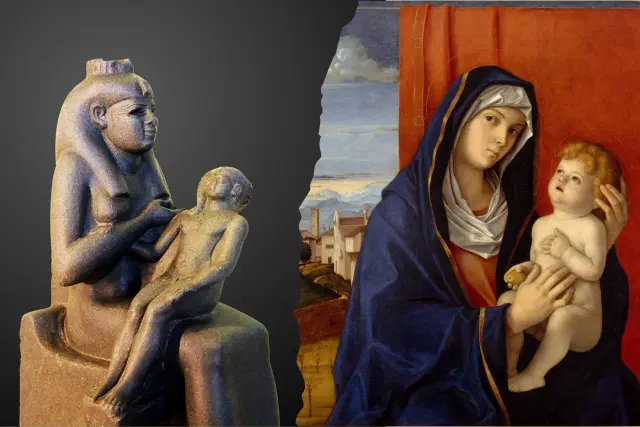
The clearest evidence of this enduring structural tension and appropriation strategy is found in the succession of the Egyptian Goddess Isis. Isis held great prominence in the Roman pantheon, admired as the comforting and powerful Mother Goddess—a divine role Mary later assumed for all humanity, albeit with downgrading of the Goddess-status.
Academic analysis confirms the close, almost seamless appropriation, particularly in early-Christian Egypt, where depictions of Mary and Isis offering their breast (Lactanss-Iconography) show marked, deliberate similarities.
Although early Marian worship was often private, often held secretly in catacombs, its eventual emergence into the public sphere following Constantine’s acceptance of Christianity mirrored the older, established public presence of Pagan cults, such as the Temple of Isis in Pompeii.
It is worth noting that while popular veneration for Mary has roots in early Christian appropriation, the formal, maximalist status of Marian worship—the very concept that the DDF now seeks to restrict—is largely a phenomenon of the relatively recent past.
While the Council of Ephesus declared her Theotokos (Mother of God) in the 5thcentury, the significant formal elevations that moved her closer to the quasi-divine status cherished by popular cults occurred much later: the Dogma of the Immaculate Conception came in 1854, and the Dogma of the Assumption of Mary was declared as recently as 1950—well within the last century.
As noted by critics like Simone de Beauvoir and Mary Daly, the ancient Goddesses 'commanded autonomous power'. Mary, however, is celebrated for being 'wholly the servant of God'. De Beauvoir argued that Mariolatry represents the 'supreme victory of masculinity' because Mary willingly accepts her inferiority by kneeling before her son after being conceived through a Male God who declared the child would be only a son. What if Mary had asked Holy Spirit that she would have a daughter instead?
Thus the Church’s hierarchy has consistently acted to control a figure whose popular strength they needed, hence the theological concessions and the doctrinal censures.
Now, responding to what they call 'exuberant' popular pressure for titles like 'Co-Redemptrix', the institution must pull the reins back again. This demonstrates not theological confidence, but a structural anxiety over the enduring, irrepressible human demand for the integral Divine Feminine.
Thus, the current DDF pronouncement on Marian titles is not about piety; it is the modern, administrative manifestation of the hierarchy's long-standing, anxious attempt to control the powerful, assimilated symbol of the Mother who was never meant to be merely an interlocutor, but whose independent sacred authority must be continually downgraded to maintain the male institutional monopoly.
This asymmetry projects a dysfunctional divine template onto the believer’s psyche, particularly the female psyche. When the ultimate spiritual model of feminine virtue is defined by 'faith and obedience' and her power is wholly 'derived and contingent', it structurally inhibits the realisation of inner, autonomous divine strength—the very spiritual sovereignty inherent in Hindu Goddesses Mariamman and Saraswati, Manasa Devi and Parvati, Mutharamman and Lakshmi.
From a Hindu viewpoint, which worships the ultimate reality as the comprehensive Consciousness-Force—the Mahashakti—the Christian representation of Mary is tragically incomplete. Our traditions hold that the Divine Feminine is not a mere accessory to the Male Godhead but is co-eternal, and even the primal Divinity embodying Sovereign Power, Omniscient Wisdom, and Integral Love.
So how should Hindus view Mary?
Very often Hindus worship Mary as an equivalent of their own Goddesses. Mary becomes an instrument of proselytising. However, understanding the theological status of Mary within Catholic religion in particular and Christianity in general, can make Hindus understand what Mary really is.
The Christian Mary, particularly when confined to the role of the sorrowful observer—the Mater Dolorosa or 'Madonna of Sorrows'—is definitely a powerful archetype - which explains why she appeals to a larger humanity cutting across religious boundaries but surely a subdued fragment. She is delegated the power to bear grief and grant solace, but she is structurally denied the autonomous force to conquer or save. Sri Aurobindo brings this out in his Savitri.
This theological severing of Power from Compassion, with Power reserved for the masculine Logos and passive endurance assigned to the feminine, results in an inherent spiritual asymmetry with disastrous consequence for the society.
Sri Aurobindo in his Savitri (Book VII-Canto IV) provides a deep literary-spiritual criticism. This characteristically Hindu critical yet spiritual perspective does not reject the Madonna of Suffering as false.
Instead, Savitri recognises her, with 'the seven stabs that pierced her bleeding heart' and as one who bears the weight of the world's pain, as a partial truth—a necessary fragment of the total Mahashakti. Sri Aurobindo also points out that the inevitable consequence of this Madonna, the 'Man of Sorrows' who being 'nailed on the wide cross of the universe', believes that 'To enjoy his agony God built the earth', as ultimately leading to steely doctrinal structures that makes one spiritually stagnant. The ultimate goal, however, is to move beyond this passive endurance.
This is a framework of criticism that Hindus should use in understanding and subsuming the monopolistic theologies and their structures. It also provides a strong Yogic-psychological framework to understand Marian phenomenon.
For those of us who worship the Mother in Her totality—as the dynamic, substratum as well as the energy of evolution, Mahashakti who is Sri Mata, Sri Maharajni Srimat Simhasaneswari—the Vatican’s need to perpetually limit, subordinate, and manage the figure of Mary is simply proof of a faith where the theological leadership is exerting itself to strictly regulate its devotional landscape.
The Vatican Doctrine Note can be read here.
 Join our