Ideas
The GDP Of India’s Housewives
Prof. Vidhu Shekhar
Mar 08, 2026, 07:15 AM | Updated Mar 07, 2026, 04:33 PM IST
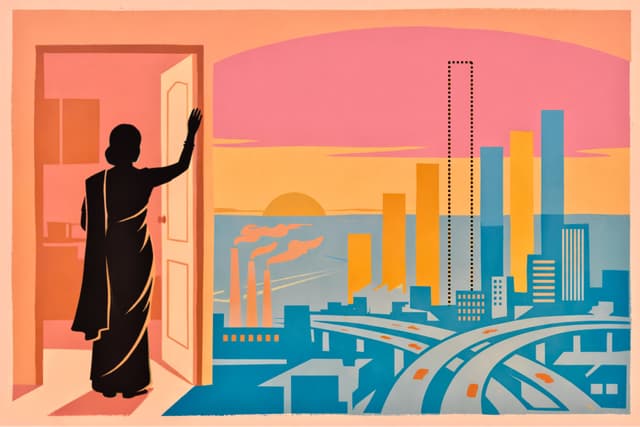
She woke up before you did and will sleep after you. There is no designation on her door, no salary slip at the end of the month. She manages the household. Yet the modern economy has quietly and consistently decided that this does not count.
I have spent months studying this question, because I kept meeting her. At family gatherings, at school gates. At dinner tables where someone would casually ask, "So what do you do?" and she would pause just a beat too long, searching for an answer that felt adequate.
A woman who had logged more hours of labour that week than most professionals in the room, yet hesitating to answer what she does.
That hesitation is what happens when a society trains people to measure worth through salaries and designations, and then assigns millions of women a role that has neither.
The Invisible Infrastructure
India has roughly 21.1 crore adult women whose principal occupation is domestic work. That exceeds the population of Brazil. They work full-time every day, without increments, without leave, and without a provident fund.
In the current nature of the professional economy, with long commutes, relentless deadlines, and a culture of availability that extends far beyond office hours, there is little room for the logistics of life. When a household has a full-time homemaker, daily life does not just run more smoothly; the working partner can work differently. With more focus, more resilience, and greater capacity to absorb professional pressure, because the underlying structure of life is stable.
Think about what holds a city together. Roads, power grids, water supply. When they work, nobody notices. When they fail, everything stops.
The Indian household runs on a similar logic. A functioning home is a piece of infrastructure: essential, largely invisible when it operates well, and suddenly obvious when it breaks down.
Indian housewives represent one of the largest organised deployments of human labour anywhere on the planet. Yet in the official national accounts, all of this work is recorded as zero.
And zero is a poor description of what is actually happening inside Indian households.
The Hours Behind the Household
India's Time Use Survey 2024 tracked how women engage in domestic work and spend their days. The finding is striking: an average of 289 minutes daily on tasks such as cooking, cleaning, washing, and organising (NSO, 2025).
Add caregiving for children and elders, adjusted for participation rates across age groups, and the daily total reaches approximately 342 minutes, nearly six hours. Without weekends or holidays.
Across a year, the total amounts to roughly 2,080 hours of labour per woman. A standard full-time salaried job in India runs to roughly the same number.
The woman managing a household is not helping out on the side. She is putting in a full working year's worth of effort without pay, without recognition, and increasingly without even the social capital that once made the role feel honoured.
To understand how much their work is actually worth in national accounting, we embarked on research to measure the Housewife GDP of India using three standard methods drawn from time use and national accounting literature: the opportunity cost method, the generalist replacement method, and the specialist replacement method.
The opportunity cost method asks: what might she have earned if the same hours were spent in paid employment? We apply conservative benchmark wages calibrated against female earnings reported in PLFS 2023-24 and converted to hourly rates using a standard 26-day working month.
The result is Rs 22.81 lakh crore, about 6.39 per cent of India's GDP. This can be read as a conservative floor, since it is tied to what the same person could plausibly earn in the labour market.
The generalist replacement method asks a different question: what would a household spend hiring a single domestic worker to cover the range of tasks a homemaker performs? Using prevailing full-time domestic worker wages drawn from organised placement agencies and state-level minimum wage schedules, we arrive at Rs 22.51 lakh crore, or 6.30 per cent of GDP.
The specialist replacement method recognises that household work is not one uniform job. Cooking, childcare, cleaning, and eldercare each carry different market prices. Instead of applying one flat wage, this method constructs weighted hourly rates based on task-specific market rates and the time shares reported.
The result lifts the estimate to Rs 38.12 lakh crore, or 10.67 per cent of GDP. This represents a more comprehensive "full replacement" ceiling among the time-based methods.
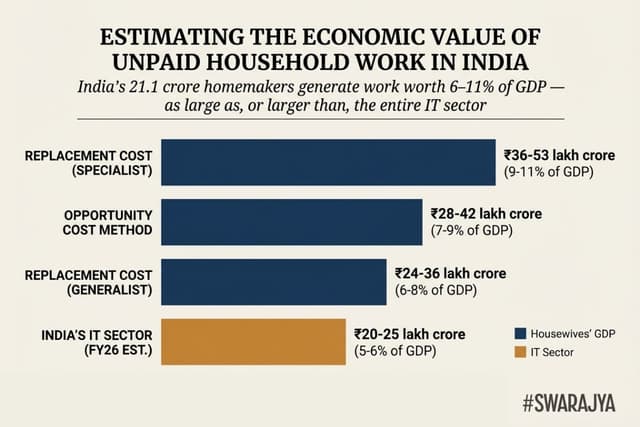

The precise estimate varies by method, as it always does in economic measurement. That is why our research reports a range rather than a single headline number. The broad conclusion, however, remains the same across all three approaches: India's homemakers are generating unpaid domestic and care work on a very large economic scale.
A Sector We Never Counted
Place these estimates beside another number. India's technology sector, the crown jewel of its modern economic identity, is projected to contribute roughly 7.8 per cent of GDP this year. It commands dedicated ministries, export promotion schemes, skill missions, and a permanent seat at every major policy conversation in Delhi. And rightly so.
Now place the housewife economy beside it. A domain of comparable scale, and on the upper estimate larger, receives no budget line, no policy framework, and no entry in the official national accounts. The people performing this labour are still routinely asked whether they "do anything".
As against market transactions, which generate visibility, household production does not. That accounting boundary shapes everything downstream, from policy priorities to social status.
When Zero Becomes Identity
It is precisely this zero, this absence from the national ledger, that does something deeper than distort economic statistics. It distorts how a person sees herself.
When the official accounts record her contribution as nothing, the message filters through. Across years of forms that list her as "non-working", of economic commentary that treats the household as a site of consumption rather than production.
The result is an identity crisis where she finds herself seeking validation elsewhere: in the career of her partner, or in side projects and justifications. Because the dominant signal of the modern economy is simple. Anything has value only if it is measured.
This also affects how women perceive their bargaining power within households. It shapes whether they feel entitled to rest, to ambition, and to resources.
The Civilisational Argument
India often speaks of its demographic dividend. But dividends do not appear automatically. They depend on children who grow up healthy, educated, and emotionally secure. Behind most of those outcomes stands someone who invested years of attention and labour in making them possible.
When societies systematically devalue that investment, fewer people make it.
Several advanced economies discovered this too late. Countries such as Japan, South Korea, and Italy built extraordinarily productive economies while allowing the social value of family formation and caregiving to erode. Today they face demographic contraction that economic policy alone cannot easily reverse.
India is not there yet, but the signals are visible. If the work of nurturing the next generation becomes invisible, financially unrewarded, and socially diminished, the incentives to do it weaken over time. And an economy without people is not an economy at all.
The household, remember, is infrastructure. When a country lets its roads decay, the costs do not appear on a single day. They accumulate slowly, in longer commutes and missed connections and opportunities that quietly vanish.
The same is true when a country lets the social value of caregiving decay. The costs arrive a generation later, and by then they are very difficult to reverse.
Counting the Work
So what can be done to recognise this contribution? And reap the benefits of a happy, healthy working family?
Among the first steps is to measure and recognise their contribution to the economy. As we realise their scale, ideas and efforts to better integrate and understand would naturally follow. Our research is aimed at the same.
But we need to go further and recognise this officially as a working economic segment with its own measure. GDP already relies on surveys and estimation methods. Extending measurement to unpaid household production is therefore entirely feasible.
India already possesses what it needs to undertake it. The Time Use Survey records how people allocate their hours. The Periodic Labour Force Survey provides wage benchmarks that can allow us to value those hours. Our research demonstrates exactly this: by combining time survey data with PLFS-based wage benchmarks and population parameters, a transparent, auditable satellite account estimate is already within reach.
What does not yet exist is a household production satellite account: a parallel account that tracks unpaid domestic output alongside GDP without altering the headline number. The System of National Accounts has supported this approach since its 1993 and 2008 revisions, and several countries have already produced such accounts on an experimental or regular basis.
Publishing such an account would change how policymakers view entire categories of investment. Subsidised childcare would appear not only as social spending but also as productivity policy. Clean cooking fuel and rural piped water would be recognised as time-saving interventions that reduce women's time poverty. Eldercare infrastructure would become part of the labour supply conversation.
Just as the government invests in roads and bridges because it measures their contribution to output, measuring household production would make it natural to invest in the infrastructure that supports it.
The Answer She Deserves
Every Women's Day, India celebrates the visible. The CEO. The Olympian. The scientist. The sportswoman. The corporate high-flyer. The politician who broke a barrier. These achievements deserve recognition.
But alongside them stands another figure. The woman who woke up before her household this morning and will sleep after it tonight. The woman whose labour has supported a significant part of this country for a very long time in a role the economy does not bother to count.
The least we can do is count the work, name the hours, and publish the number.
A woman who structures the daily life of a household, raises children with care and intention, supports a partner through a demanding economy, and holds the entire operation together across years and decades is not peripheral to India's productive life. She stands at its foundation.
The question she hesitates over, "What do you do?", deserves a clear, confident, and very large answer.
Author's Note: This article draws on our research, Housewife GDP in India: Estimating the Economic Value of Unpaid Domestic and Care Work.
Dedication: To my mother, Shailja, a homemaker, and also a writer, who dedicatedly shaped me into who I am today.
Dr. Vidhu Shekhar holds a Ph.D. in Economics from IIM Calcutta, an MBA from IIM Calcutta, and a B.Tech from IIT Kharagpur. He is currently an Associate Professor in Finance & Economics at Bhavan's SPJIMR, Mumbai. Previously, he has worked as an investment banker and hedge fund analyst. Views expressed are personal.
 Join our