Ideas
The Ideology Deficit: Hindutva Movement's Real Crisis Is Not Its IT Cell, But Its Intellectual Coherence
Goblipura Subbaramiah
Feb 26, 2026, 01:37 PM | Updated Feb 27, 2026, 12:52 PM IST
The machine works. I have argued as much. In a previous piece, I made the case that the BJP’s 21st-century welfare-delivery apparatus (the JAM trinity, the Direct Benefit Transfer pipeline, the labharthi revolution) represents the most effective vote-harvesting machine in Indian democratic history, and perhaps one of the most effective anywhere in the world. I argued that this machine is not something to apologise for. It is something to be proud of. I stand by every word.
But a machine, however magnificent, runs on fuel. And the fuel of a political machine that aspires to civilisational transformation, not merely electoral victory, is ideology. Not ideology in the thin, bumper-sticker sense that Twitter warriors deploy between breakfast and lunch. Ideology in the thick sense: a coherent, hierarchically ordered system of beliefs that tells every participant in the machine what to think, what to prioritise, and, crucially, what to sacrifice when two good things come into conflict with each other.
This is the Hindutva movement’s actual crisis. Not the “IT cell.” Not the memes. Not the “toxicity” that sends the liberal establishment reaching for its smelling salts. The crisis is that the movement which seeks to transform the civilisational basis of the Indian state does not possess, and has never possessed, a coherent ideological system. It has sentiments. It has grievances. It has a shared enemy. What it does not have is a shared intellectual architecture. And this deficit is now becoming existential.
Most people abusing the “IT cell” do not understand communications well enough to diagnose the actual disease. They see the symptom (incoherent messaging, reactive outrage cycles, own-goals on social media) and conclude that the method is the problem. The method is a problem. It is not the problem.
You can hire the best communicators in the world, give them the finest tools, the largest budgets, the most sophisticated algorithms. They will still produce incoherent output if the input is incoherent. Garbage in, garbage out. The IT cell is not failing at communication. It is succeeding at communicating exactly what the movement believes, which is everything and nothing, simultaneously, depending on the time of day and the person you ask.
The Left’s Unfair Advantage
Let us begin by giving the devil his due. The Indian left (and I use the term broadly to encompass everything from card-carrying Marxists to the NGO-academic-media complex to the drawing-room liberal who thinks reading Arundhati Roy constitutes political education) possesses something that the Hindutva movement does not. It possesses ideological coherence.
This is not a compliment to the content of left-wing ideology. The content is largely rubbish: a warmed-over stew of Marxist class analysis, postcolonial resentment, and Western progressive fashions imported with all the discernment of a Zara franchise.
And yes, the left has its own fractures: the class-first Marxist despises the identitarian, the Ambedkarite rejects the Brahminical communist, the Congress liberal has nothing in common with the Naxalite except a shared subscription to The Wire. These fractures are real. But they are fractures within a structure, not fractures instead of one.
The left’s coherence is not ideological perfection. It is operational alignment on defaults: shared assumptions about who the villain is, which direction “progress” moves, and how to staff institutions. When a novel situation arises, the left’s warring factions converge on the same institutional grammar even as they fight about vocabulary. The Hindutva movement’s factions do not converge. They do not even recognise that they are speaking different languages.
The left knows what it believes. More importantly, it knows the order in which it believes things.
Material conditions determine consciousness. Class is the primary axis of analysis, though it has now been supplemented (some would say supplanted) by identity categories: caste, gender, religion, sexuality. The state is the primary instrument of social transformation. Individual liberty is subordinate to collective justice. Tradition is suspect. Modernity, defined in specifically Western progressive terms, is the goal. The nation-state is a convenient fiction to be transcended when possible and captured when necessary.
One may disagree with every element of this system. I do. But one cannot deny that it is a system. It has axioms. It has a hierarchy of values. When two principles conflict (say, free speech and the protection of “marginalised communities”) the left knows which one yields. Free speech yields. Always. When economic growth conflicts with environmental justice, the left knows which one yields. Growth yields. When national sovereignty conflicts with international human rights norms, the left knows which one yields. Sovereignty yields.
This clarity is an enormous operational advantage. It means that a left-wing activist in Chennai and a left-wing professor in Jawaharlal Nehru University and a left-wing journalist in The Wire’s newsroom will, when confronted with a novel situation, arrive at roughly the same position without needing to consult each other. They share a grammar. They share a syntax. They may quibble about vocabulary, but the language is the same.
The Hindutva movement has no such grammar. It does not even have an agreed-upon alphabet.
The Transition That Nobody Is Talking About
To understand why this matters now, why it has become urgent rather than merely important, one must understand the nature of the transition the BJP and the broader Hindutva ecosystem are currently undergoing.
In my previous essay, I described the BJP’s evolution from a party of 2 seats in 1984 to 303 seats in 2019 as a journey from pure ideology to welfare-delivery machine. This is accurate as far as it goes. But it does not go far enough. The BJP is not simply a machine. It is a machine in the process of becoming something more, or at least, it needs to become something more if it wishes to achieve what its most serious thinkers have always wanted: not just electoral dominance, but civilisational transformation.
The trajectory is as follows. Phase one was ideological politics without a machine: the Jan Sangh and early BJP era, full of conviction but devoid of the organisational and delivery capacity to translate conviction into sustained power. Phase two, the Modi era, was the construction of the machine: the creation of a formidable apparatus for winning elections and delivering welfare. This phase has been spectacularly successful. The machine works.
Phase three, the phase we are now entering whether we like it or not, is machine-enabled ideological politics. This is the phase where the machine’s vast reach and organisational depth must be harnessed not just to deliver gas cylinders and pucca houses, but to propagate and institutionalise a coherent civilisational worldview. The machine must expand and become more competent. Simultaneously, the beliefs that the machine’s participants carry must be systematised, clarified, and made internally consistent.
This is where we are failing. The failure is not the BJP’s alone; the party has built the machine, which was its job. The failure belongs to the ecosystem: the intellectuals, the commentators, the think-tankers, the weekend philosophers, the podcast pundits who were supposed to be the ideological supply chain for the machine and have instead delivered a crate of contradictions wrapped in saffron.
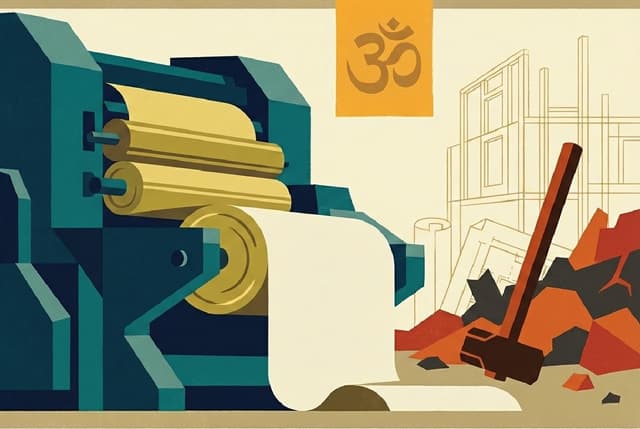
The machine is being asked to propagate an ideology that does not yet exist in any coherent form. It is as if the printing press has been invented, the distribution network has been built, the subscribers have been enrolled. But nobody has written the book. What we have instead is a box of notes, scribbled on napkins by different people at different times, many of them contradicting each other.
The Mirage of “Decolonisation” and the Necessity of Imperium
Before we catalogue the contradictions, let us deal with the most fashionable and most insidious of them: the one that has colonised (the irony is deliberate) the intellectual wing of the Hindutva movement with particular virulence, the decolonial framework.
There is, within the ecosystem, a growing chorus that speaks the language of “decolonisation”: the recovery of Indian knowledge systems, the dismantling of colonial epistemology, the rejection of Western frameworks of thought. The impulse behind this is understandable. Centuries of Mughal and then British rule did, in fact, distort, suppress, and delegitimise Indian intellectual traditions. The desire to recover and revitalise them is legitimate.
But the decolonial project as actually practised by the Hindutva right suffers from two fatal defects, one theoretical and one practical. The theoretical defect first.
The decolonial framework, even in its diluted Hindutva-right form, carries within it an inherited assumption that is lethal to Indian civilisational interests: that the projection of one civilisation’s power over another is inherently illegitimate. The decolonisation advocate on the right may not state this as plainly as his Western academic counterpart. He may not have read Fanon or Spivak. But the logic is embedded in the vocabulary he has borrowed. If “colonial imposition” is the all-purpose indictment, then what is the Maurya empire’s expansion into Kalinga? What is the Chola projection of naval power across Southeast Asia? What is the Vijayanagara empire’s consolidation of the Deccan? These were civilisational power projections of the first order. By the decolonial framework’s own logic, they are indictable.
The honest reckoning with Indian history is not that empires are evil. The Mauryas built an empire. The Guptas built an empire. The Cholas projected naval power across Southeast Asia in a manner that would make a Victorian admiral nod in professional respect. The Vijayanagara empire held the line for centuries. These were not crimes against humanity. They were the natural expressions of civilisational vitality. A civilisation that cannot project power, that cannot dominate its near-abroad, that cannot shape the terms of engagement with the wider world, is a civilisation on life support.
The problem with the Mughals was not that they built an empire. The problem was that they built someone else’s empire on our soil. The problem with the British was not imperialism per se; it was that we were on the wrong end of it. The lesson of history is not “empires are bad.” The lesson is: be the empire, or be subject to one. There is no third option. There are only variations of cope.
Let us be more precise about what “empire” means in the 21st century, because the term invites deliberate misunderstanding. The argument is not that India should conquer foreign territories. The argument is about agency and capacity: that a civilisation must possess the material, military, and institutional capacity to shape the terms of its engagement with the world, rather than having those terms imposed upon it.
A nation that chooses restraint from a position of strength is exercising wisdom. A nation that has no choice because it lacks the capacity is simply weak, however eloquently it dresses the weakness up as virtue. China does not ask permission. America does not ask permission. India must stop asking permission. Not because asking is polite, but because the polite are the last to be consulted when the world’s terms are being written.
The Hindutva intellectual who adopts the decolonial framework has therefore imported, at great expense, a sophisticated philosophical apparatus for ensuring that India never becomes what it must become: a civilisational imperium that shapes the world rather than being shaped by it. He has adopted the moral vocabulary of the conquered and called it intellectual awakening. He has traded one set of chains for another and congratulated himself on his freedom.
This is not liberation. It is castration dressed up as therapy.
But this theoretical defect, while serious, is not even the primary problem. The primary problem is more basic and more damning. The decolonisation advocate on the Hindutva right has mastered the vocabulary of diagnosis. He has not spent a single afternoon on the prescription.
He can tell you at length that the education system is colonial, that Macaulay’s ghost haunts every classroom, that the university structure is an alien imposition. Granted. Now ask him the follow-up question: replace it with what?
The silence that follows is the movement’s intellectual deficit in miniature. If the current education system is a colonial inheritance, what is the Bharatiya alternative? Not at the primary school level, where some version of cultural integration into the curriculum is achievable and is already being attempted. At the level of higher education: research universities, technical institutes, medical colleges. Is the answer gurukuls? The gurukul is a pedagogical model designed for the transmission of scriptural and philosophical knowledge in small, intimate settings. It has genuine value in that domain. It has no answer for how you train fifty thousand engineers a year, or run a medical school, or conduct laboratory research in semiconductor physics. The person who says “gurukul” when asked about an IIT replacement has not thought about the question for longer than it takes to type the tweet.
Or take the HRCE (Hindu Religious and Charitable Endowments) apparatus, the colonial-era framework by which the state controls Hindu temples while mosques and churches operate freely. Every decolonisation advocate on the right correctly identifies this as an injustice. Abolish HRCE, they say. Fine. Replace it with what?
Who manages the temples? Who handles the finances? Who resolves disputes between competing claimants? Who ensures that the three-thousand-crore Tirumala endowment does not become a factional war zone the moment state oversight is removed? The honest answer is that nobody has designed the replacement institution. Nobody has drafted the model legislation. Nobody has studied how Japan manages its shrine system, or how Thailand governs its Buddhist temple endowments, or how any comparable civilisation handles religious institutional governance outside the state. The decolonisation advocate wants the surgery but has not bothered to learn what organ will replace the one being removed.
This pattern repeats everywhere the decolonial vocabulary is deployed. The legal system is colonial: replace it with what? Dharmashastra? Which dharmashastra? Whose interpretation? Applicable to whom? The bureaucratic structure is colonial: replace it with what? The mantri-sachiva model of the Arthashastra? Operationalised how, at the scale of a billion-person democracy? The calendar of national holidays is colonial: fine, this one is easy, but the easy ones are all they ever get around to fixing.
The decolonial right has a hammer. It does not have a blueprint. And a man with a hammer and no blueprint does not build a house. He produces rubble.
The movement does not need decolonisation. It needs re-imperialisation: not in the sense of conquering foreign territories, but in the sense of recovering the imperial ambition, the civilisational confidence, and the will to power that characterised every great epoch of Indian history. And it needs, alongside that ambition, the institutional imagination to build the replacement architecture for every colonial structure it proposes to tear down. The Chola did not “decolonise.” He built a navy and took Srivijaya. That is the template. Everything else is an NGO seminar.
A Carnival of Contradictions
Now let us catalogue the specific incoherences that plague the ecosystem. These are not factions; the ecosystem is too intellectually fragmented to sustain anything as organised as a faction. These are archetypes: patterns of contradictory belief that recur with depressing regularity across the movement’s participants, often within the same person on the same day. They are listed not to mock (though some mockery is unavoidable) but to diagnose. You cannot cure a disease you refuse to name.
The Free Speech Absolutist Who Funds His Own Firing Squad. This person defends the malcontent’s right to organise, publish, and propagate civilisational demolition because “Voltaire said so.” Let us define “malcontent” before we proceed: the malcontents are that section of India’s intelligentsia, activist class, and political opposition whose project, stated or unstated, is the permanent delegitimisation of Hindu civilisational claims on the Indian state. They do not believe in free speech. They use free speech. There is a difference.
Free speech, for the malcontent, is a ratchet: it operates in one direction only. Herbert Marcuse said as much in 1965: tolerance must be extended to the left and withdrawn from the right. The traditionalist who champions absolute free speech for the malcontent is handing the arsonist a matchbox and congratulating himself on his commitment to fire safety. He is not defending a principle. He is funding his own funeral.
The Constitutional Fetishist. Wants a “strong opposition,” “institutional checks,” and “rule of law” — all excellent things in a polity where the opposition accepts the legitimacy of the civilisational order. In India, the opposition’s flagship slogan, Jitni Abadi Utna Haq, is a demand for the proportional vivisection of the nation based on communal headcount. As I argued previously, this is the Indian road to Beirut. The constitutional fetishist wants competent referees in a game where the opposing team has brought knives. He has internalised the Westminster catechism without noticing that Westminster’s opposition never called for the dismemberment of England.
The Geopolitical Hawk on Liechtenstein’s Budget. Wants a blue-water navy, nuclear triads, power projection, counter-China posture, civilisational assertiveness across the Indo-Pacific, and the respect of great powers. But also wants lower taxes, smaller government, and fiscal consolidation. Does not understand that imperium costs money. The Romans did not build their legions on tax cuts. The British did not finance the Royal Navy through austerity. The Americans did not become a superpower by balancing the budget. Every empire in history was built on the willingness to tax, spend, and invest at scale. You cannot have Rome’s legions on Liechtenstein’s budget. If you want imperium (and you should), open the chequebook.
The Libertarian Who Wants an Arsenal. Celebrates free markets, deregulation, ease-of-doing-business rankings, and the abolition of the licence raj. Correctly. Also wants indigenous fighter jets, semiconductor fabs, a domestic defence-industrial base, nuclear submarines, and space launch capacity. Does not notice that not one of these things has ever been produced anywhere on earth by the free market alone.
Lockheed Martin is not a free-market outcome. It is a creature of Pentagon cost-plus contracts. TSMC exists because the Taiwanese state decided it would exist. Airbus was created by four European governments who decided that Boeing should not have a monopoly. The American “free market” runs the most sophisticated military-industrial complex in human history, entirely on government procurement, classified contracts, and cost-of-capital subsidies that would make a socialist blush.
The honest position is not “free markets vs. state intervention.” The honest position is: free markets as the default, with hard strategic exceptions for sectors where national survival is at stake. Markets allocate consumer goods better than any bureaucrat. Markets do not build nuclear submarines. The distinction is not ideological. It is empirical. The person who insists on libertarian purity while demanding strategic autonomy is running two operating systems on one machine and wondering why it keeps crashing.
The Make-in-India Enthusiast Who Hates Industrial Policy. Cheers every PLI announcement: semiconductors, drones, green hydrogen, electric vehicles. Shares infographics about import substitution. Celebrates the rising share of defence exports. Then, in the very next tweet, demands the abolition of government subsidies, rails against “crony capitalism,” and quotes Hayek on the impossibility of central planning. Has not noticed that PLI is industrial policy. Import substitution is protectionism. Defence indigenisation is the state picking winners.
The question is not whether the state intervenes in strategic sectors. Every serious power does, including and especially the ones that preach free trade to everyone else. The question is whether the intervention is competent, time-bound, and subject to accountability, or whether it degenerates into the permanent subsidy raj that destroyed Indian industry in the first place.
America preaches free trade and runs DARPA. The ecosystem needs a term for what it actually wants, which is something like national capitalism: free markets as the default engine, with the state as strategic investor and demand-creator in sectors where sovereignty requires it. This person does not have the vocabulary because the movement has not given him one.
The Anti-Reservation Meritocrat Who Wants Hindu Unity. Wants to abolish caste-based reservation because “merit should prevail.” Also wants a grand coalition of OBCs, Dalits, and upper castes under the Hindutva umbrella. Does not understand that you cannot build a coalition while publicly threatening to eliminate the one policy that your coalition partners consider non-negotiable.
Has not noticed that reservation is not just a policy; it is the foundational bargain of post-independence Hindu consolidation, the price that was paid for keeping the social coalition from splintering along caste lines. Strategy requires sequencing: first, build the coalition and the trust; then, from a position of shared strength, negotiate the terms of reform. Dismantling the scaffolding before the building is complete is not meritocracy. It is architectural suicide. This person wants the dessert before the meal is cooked, and wonders why the dinner guests are leaving.
The Statist Moderniser Who LARPs as an Environmentalist. Wants state-led industrialisation (dams, highways, industrial corridors, smart cities, nuclear power) but also insists that Hindutva is uniquely “pro-environment” because our ancestors wrote nice things about rivers and trees. You cannot industrialise a nation of 1.4 billion people while maintaining the ecological footprint of a Bishnoi village. The Chinese did not manage it. The Koreans did not manage it. The Europeans burned through half their forests before they even got to coal. To pretend that Hindutva offers some magical third way is not ideology. It is cosplay with a policy veneer. Pick your priority: industrialisation or pastoralism. If you pick industrialisation (and you must, because the alternative is permanent weakness) then stop pretending it comes with a free environmental halo.
The History Warrior Whose History Is Wrong. The project of historical reclamation, recovering the Indian past from the distortions of colonial and Marxist historiography, is one of the most important intellectual tasks facing the movement. It is also one of the most badly executed. The History Warrior spends his energy fighting leftist narratives but with WhatsApp-forward-grade “evidence,” poorly sourced claims, and chronologies that collapse under the mildest scrutiny. He posts about “Vedic nuclear physics” and “ancient Indian aeroplanes” and thinks he is defending civilisation. He is not. He is discrediting it. The left does not need to debunk him; he debunks himself, and takes the legitimate historians down with him. Every serious scholar of Indian history (and there are serious scholars) cringes when this person opens his mouth. He is the movement’s most effective own-goal machine.
The Anti-Imperialist Who Will Not Build an Empire. Rages against British and Mughal imperialism, correctly, but recoils at the suggestion that India should itself aspire to civilisational power projection. Has absorbed, through the decolonial framework discussed above, the notion that imperialism is inherently evil, and therefore that the aspiration to civilisational dominance is morally illegitimate. This person has adopted the conquered’s moral vocabulary and calls it liberation. The Cholas did not think this way. The Mauryas did not think this way. Civilisations that refuse to project power do not survive to write their own history. They become footnotes in someone else’s.
The Decentralisation Freak. Wants maximal devolution: panchayati raj, state autonomy, local self-governance, subsidiarity taken to its logical extreme. Also wants a muscular central state that enforces a uniform civil code, builds national infrastructure, standardises education, projects civilisational power abroad, and keeps the malcontents in check. Cannot see that decentralisation and civilisational consolidation are in permanent tension. Wants the Holy Roman Empire’s structure and the Qin Dynasty’s results. Has never noticed that the Holy Roman Empire was, in Voltaire’s famous formulation, neither holy, nor Roman, nor an empire. Picks whichever principle (devolution or centralisation) suits the argument he is making that particular afternoon, and genuinely does not notice the switch.
The Anti-Babu Tweeter Who Needs the Babu for Everything. Rages against the IAS on Twitter every evening. The steel frame is rusted, the babus are corrupt, the generalist administrator is an anachronism. Simultaneously, every policy he demands (UCC enforcement, education standardisation, industrial corridors, defence procurement reform) requires a competent, empowered, and expanded bureaucratic apparatus to implement.
Has not noticed that the countries he admires most have more bureaucratic capacity, not less. Singapore’s civil service is famously the best-paid and most capable in the world. China’s administrative state makes the IAS look like a village panchayat. Even America’s “small government” runs on a federal workforce of two million civilians and a military-industrial complex that is the largest planned economy on earth. His actual complaint is not that India has too much bureaucracy but that it has the wrong kind: generalist, unaccountable, and incentivised to obstruct rather than deliver. But he cannot articulate this because he has no model for what the right kind looks like. He has a feeling that “private sector good, government bad” and mistakes this for a theory of the state.
The Pastoral Romantic on a City Salary. Writes paeans to village life, traditional agriculture, the moral superiority of the rural Indian, the corruption of urban modernity — from a Bengaluru apartment, on a laptop bought with an IT salary, after ordering dinner on Swiggy. Wants India to remain a civilisation of villages while having personally fled the village the moment he secured an engineering seat.
If forced to actually live the life he romanticises (no AC, no broadband, no DMart, no Practo, no Uber, no escape from the local strongman) he would last one monsoon. Wants the aesthetic of the village and the income of the city. Life does not offer this package deal. The village he romanticises was also the village where his great-grandmother died of a treatable disease at 40. He has confused nostalgia for analysis.
The Nationalist-Regionalist Straddler. “National unity is paramount!” on Monday. “Respect our regional identity!” on Thursday. Wants Hindi imposition stopped but wants a strong centre. Wants the South treated as an equal but wants “one nation” everything: one tax, one exam, one election, one language of aspiration. Cannot see that nationalism, taken to its administrative conclusion, is the homogenisation that his regionalism opposes. Has no framework — none — for determining where national interest ends and regional autonomy begins. Flips between the two based on which identity is being threatened that particular news cycle. If you pressed him for a principle, you would get a feeling. Feelings are not principles. They are the absence of principles.
The “Indianise Islam” Fantasist. Believes, with a sincerity that would be touching if it were not civilisationally suicidal, that Indian Islam can be reformed into a dharma-compatible cultural practice: that you can take a universalist, exclusivist, revelation-based theological system and gently persuade it to become a localised, pluralist, tradition-compatible folk religion. Has no answer for why this has not happened in 800 years of coexistence on the subcontinent. Has no answer for why it has not happened anywhere on earth.
The optimist will cite Indonesia and Turkey. Let us examine these showcases. Indonesia, the eternal poster child for “moderate Islam,” has spent the last two decades moving in precisely the wrong direction: Aceh now enforces sharia with public caning, blasphemy prosecutions have multiplied, Ahok was jailed for being a Christian governor who quoted the Quran, and the supposedly syncretic Javanese Islam is losing ground to Arabised orthodoxy funded by Gulf money faster than any “moderation” programme can contain it. Pancasila did not reform Islam. Pancasila is in retreat.
As for Ataturk: the most ambitious and ruthless secularisation project in Islamic history, backed by the full coercive apparatus of a modernising state, and it held for seventy years before being swept away by Erdogan in a single generation. If the Turkish republic, with its military-enforced laïcité, its ban on headscarves, its wholesale adoption of the Latin script, could not permanently secularise its Islam, what instrument does the Hindutva “Indianise Islam” advocate propose to use? A conference? A goodwill gesture?
The existence of syncretic Sufi shrines does not constitute theological reformation. The shrines are lovely. The theology is untouched. The ulema have not been consulted on this reformation project, and when they are, the answer is always the same. This person is not a strategist. He is a Make-A-Wish volunteer for civilisational threats.
The First-World Crybaby at Third-World Per Capita Income. Wants Japanese bullet trains, Scandinavian public healthcare, Singaporean cleanliness, German autobahns, and American-grade interstate highways, at a per capita income of $2,500 and a tax-to-GDP ratio that would embarrass a libertarian commune. Throws a tantrum when the metro is delayed but files his taxes with the creative ambition of a fiction writer. Demands world-class infrastructure but celebrates every new tax cut as a personal victory. Wants the public goods of a country where citizens pay 40 per cent income tax while evading his own property tax assessment. This person is not a political thinker. He is a consumer who has confused the state with Amazon and is upset that the delivery is late. The infrastructure fairy does not exist. Public goods cost public money. The public in question is him.
The Airport Sovereign Who Demands Reform. Lands at Bengaluru airport, the queue at immigration is forty minutes, the baggage belt is slow, and he is on Twitter before his suitcase arrives. “WHY can’t India have Changi-level airports? WHERE are the reforms? Modi is not reforming FAST ENOUGH.”
This same person, when his flight is delayed due to weather, demands that the airline (a private company, operating in a deregulated market) be ordered by the government to compensate him. When his Uber surge-prices during rain, demands price caps. When a private hospital charges market rates, demands government rate-cards. When a new airport is built through PPP and charges a higher user development fee, screams about “loot.”
Wants the state to simultaneously retreat (reform! deregulate! end the licence raj!) and advance (fix this! regulate that! punish them! compensate me!). Has not noticed that Changi works because Singapore charges what things cost, enforces rules with zero sentimentality, and does not pretend that world-class infrastructure is compatible with subsidised pricing. The reformer in him wants the state to get out of the way. The mai-baap child in him wants the state to kiss the bruise and make it better. These two people share a body and a Twitter account and have never been introduced to each other.
The Pothole Philosopher Who Won’t Pay Property Tax. Posts a photograph of a flooded street every monsoon. “SHAME on the municipal corporation! WHY are Indian cities so badly run? Look at Tokyo! Look at Seoul!” He posts this while paying a property tax assessed at 2003 valuations on a flat whose market value has quintupled since. Fights every upward revision of water charges, sewage cess, and garbage collection fees with the righteous fury of a man defending his ancestral land from the Mughals.
Wants storm-water drainage but will not pay the drainage cess. Wants wider roads but opposes the betterment levy. Wants a metro line to his doorstep but joins the residents’ association protest when the alignment requires demolishing the illegal parking structure his complex built on municipal land.
Japanese cities work because Japanese citizens pay what urban infrastructure costs and do not treat tax evasion as a fundamental right. Seoul’s transformation was financed by property taxes that would make this person weep. The pothole is not a governance failure. It is an arithmetic failure. The money for the road was supposed to come from him. He did not pay it. The road was not built. He photographed the result and blamed the state. This is the Indian fiscal social contract in miniature: unlimited demand for public goods, minimal willingness to fund them, and righteous outrage at the inevitable gap.
The Feudal Nostalgist. Romanticises his two-bit zamindar ancestor or minor princely state as a paragon of dharmic governance, and treats the Indian republic as a civilisational downgrade. Posts sepia-toned photographs of crumbling havelis and speaks of a lost golden age of aristocratic refinement.
Does not reckon with the fact that most of these zamindars collaborated with the British, exploited their tenants with an enthusiasm that would have impressed a plantation owner, and had the administrative capacity of a large household. Does not reckon with the rather significant fact that the fragmentation of Indian sovereignty into 565 princely states and a thousand petty fiefdoms is precisely the reason outsiders could conquer the subcontinent repeatedly for a millennium.
The Mughals did not conquer a united India. The British did not conquer a united India. They conquered a subcontinent of feuding principalities, each one too proud and too stupid to subordinate its petty sovereignty to a civilisational collective. Feudal nostalgia is not civilisational memory. It is civilisational cope. The republic, for all its considerable flaws, is the first political form in Indian history that can project civilisational power at scale. This creature wants to go back to a time when his family had a nice house and India had no sovereignty. The rest of us should decline the invitation.
The Unity-in-Diversity Sentimentalist. Believes, with the earnestness of an NCERT textbook, that India’s strength lies in its diversity and that this diversity must be preserved at all costs. Simultaneously believes that every Indian must have equal “rights”: to settle anywhere, work anywhere, buy property anywhere, access resources anywhere. These two beliefs are mutually exclusive, and the sentimentalist has not noticed.
Diversity is maintained by boundaries: linguistic, cultural, regional, communal. The moment you declare universal rights to everything everywhere, you create the conditions for homogenisation. The Hindi-speaking Bihari migrant who settles in Kashmir or Jammu, the pan-Indian corporate chain that replaces the local kirana, the central scheme that overrides state cultural policy — these are all exercises of “rights” that erode diversity. You cannot preserve the garden by removing all the fences and inviting in every grazing animal.
The Fairness Fetishist. Believes in “fairness” and “equity” but has no first principles from which to derive what fairness means. Has absorbed, through cultural osmosis, the progressive conflation of equality of opportunity with equality of outcome, two concepts that are not merely different but antithetical.
Equality of opportunity means the race is fair: everyone starts from the same line, and the fastest wins. Equality of outcome means the race is rigged: everyone must finish together, regardless of effort or ability. The former is compatible with merit, tradition, and civilisational aspiration. The latter is compatible with nothing except an ever-expanding bureaucratic state that exists to enforce sameness. This person is a progressive who has accidentally wandered into the Hindutva camp and will, when the time comes, defect to whichever side offers the warmer feeling of moral superiority.
The Cost of Incoherence
Nineteen archetypes. Nineteen sets of irreconcilable contradictions. And I could have listed thirty more.
The ecosystem is not a coalition of factions (that would imply each group has at least achieved internal coherence). It is a fog: a cloud of individually held, poorly articulated positions that happen to overlap on a few emotional touchpoints: love of India, resentment of the left, reverence for Modi, and a vague sense that Hindu civilisation is under threat. This is enough to win elections (the machine takes care of that). It is not enough to build the kind of deep, durable, self-reproducing ideological movement that can survive the eventual departure of any one leader.
The costs are concrete.
First, communication becomes impossible. The IT cell cannot deliver a coherent message because there is no coherent message to deliver. When your ideology is a grab-bag of contradictions, your output will be reactive, opportunistic, and self-defeating. You will trend on Twitter today and be humiliated tomorrow when someone asks a follow-up question that exposes a fault line you never resolved. The left’s communication is effective not because its social media managers are more talented (they manifestly are not) but because the communicators share a framework. They know what to say because they know what they believe.
Second, the contradictions make the movement vulnerable to co-option. When you do not know what you believe, you are easily led by those who do. The economic libertarian who has not reckoned with the incompatibility of libertarianism and civilisational defence will, at the crucial moment, side with the global free-trade consensus against national interest. The constitutional conservative will defend the malcontent’s right to dismantle the system. The feudal nostalgist will undermine the republic from within. Each one is a potential defector, not out of malice, but out of unexamined premises.
Third, and most fatally, the movement cannot reproduce itself. An ideology that is merely felt but not articulated cannot be taught. It cannot be transmitted from one generation to the next with any fidelity. It cannot scale beyond the charismatic leader who currently holds the emotional centre. The left reproduces itself through institutions (universities, NGOs, media houses, international networks) because its ideology is codified, teachable, and systematic. We reproduce ourselves through WhatsApp groups and election cycles. When the group goes quiet or the election is lost, the “ideology” evaporates. This is not a movement. It is a mood.
The Way Forward: A Catechism and a Triage
What is to be done? I offer not a complete solution (that would require a book, not an essay) but a framework for arriving at one.
The first task is the creation of a catechism. The term is borrowed from the Christian tradition, but the concept is universal: a short, authoritative statement of core beliefs that every participant in the movement is expected to know, understand, and defend. The left has its catechism: it is called the progressive stack, and it is taught in every university, reinforced by every media outlet, and enforced by every HR department in the country. We have nothing comparable.
This catechism need not be long. Eight to twelve axioms would suffice. But they must be axioms in the true sense: foundational propositions from which all other positions can be derived. They must be hierarchically ordered, so that when two axioms conflict in a specific situation, the participant knows which one takes precedence. The ordering I propose:
The highest axiom must concern civilisational survival: the proposition that the continuity and expansion of Hindu civilisational power on the Indian subcontinent and beyond is the non-negotiable foundation upon which all other goods depend. Without survival, nothing else is discussable.
The second axiom is economic prosperity and the material capacity for power projection. This is placed above cultural continuity for a reason that sentimentalists will find uncomfortable: culture that cannot pay for its own defence is culture awaiting a patron or a conqueror.
The Vijayanagara empire’s temples were magnificent. They were also built on the revenue of a functioning state with a professional army and a taxation system capable of sustaining both. The pattern is consistent across civilisations.
Meiji Japan understood this with a clarity that should embarrass every Hindutva romantic: the Meiji reformers did not begin by recovering Shinto purity or reviving the aesthetic traditions of the Heian court. They began by building shipyards, railways, and a modern army. They sent their best minds to study Prussian military organisation and British naval engineering. They industrialised first, and only then, from a position of economic and military strength, did they reconstruct a Japanese cultural identity that the world was forced to take seriously. The cultural revival followed the economic transformation; it did not precede it.
South Korea’s Hallyu wave (the global explosion of K-pop, Korean cinema, and cultural soft power) did not emerge from a nation of rice paddies meditating on its Joseon heritage. It emerged from the wreckage of the Park Chung-hee industrialisation drive, decades after the steel mills and semiconductor fabs had made Korea rich enough to fund a cultural industry that could compete globally.
Israel’s cultural confidence — its world-class universities, its literary tradition, its tech ecosystem — is inseparable from its military-economic capacity; without the Iron Dome, there is no Tel Aviv startup scene.
Without economic power, there is no military power. Without military power, there is no sovereignty. Without sovereignty, cultural continuity is a permission granted by someone else, revocable at will. Every civilisation that prioritised cultural purity over economic capacity (Confucian China in the 19th century, the late Ottoman caliphate, Bourbon France) discovered this truth at the point of someone else’s cannon.
The Chola did not project power across the Indian Ocean because he had beautiful temples. He had beautiful temples because he projected power across the Indian Ocean. The revenue came first. The culture flourished under its protection.
The third axiom is cultural continuity: the preservation and revitalisation of dharmic traditions, languages, knowledge systems, and ways of life. This is vital. It is the purpose for which economic and military power exist. But it is the purpose, not the precondition. You can rebuild a temple. You cannot rebuild a temple while someone else’s army is standing on the ruins. Economic power buys the space within which culture can breathe. Without that space, culture becomes folklore: quaint, decorative, and powerless.
The fourth axiom is individual liberty: the freedom of the individual to pursue his own good in his own way, subordinate to the three axioms above. Important, but not supreme. Not sacrosanct. Not a suicide pact.
This ordering resolves the contradictions. When free speech conflicts with civilisational survival (as it does when the malcontent organises against the civilisational order), survival prevails. When fiscal conservatism conflicts with the material requirements of power projection (as it does when the geopolitical hawk demands imperium on a shoestring budget), economic capacity prevails. When the unregulated market dissolves traditional social forms, economic prosperity is redirected to serve cultural continuity rather than undermine it. When individual liberty conflicts with any of the above (as it does in every single archetype catalogued in this essay), it yields. Gracefully, if possible. Firmly, if necessary.
The left has such a hierarchy, though it never states it so plainly. Material conditions first, then collective identity, then institutional capture, then individual rights for the right people. This is why the left wins the long game even when it loses elections. It knows what to sacrifice. We do not.
The second task is triage. Not every contradiction needs resolving simultaneously. Some are fatal; they actively undermine the movement’s ability to function and must be settled now. Others are tolerable tensions that can coexist as ongoing internal debates without paralysing action.
The fatal contradictions:
Free speech absolutism extended to the malcontents. Settle this now. Civilisational defence takes precedence over procedural liberalism. The movement must state clearly that the organisational and speech rights of those who seek to dismantle the civilisational order are not protected by any principle it recognises. This is not authoritarianism. It is self-preservation. Every surviving civilisation in history has distinguished between dissent and subversion.
The confusion about minority rights. State clearly: the rights of religious minorities in India are conditional on their acceptance of the civilisational primacy of dharmic traditions on which the Indian state is founded. France demands this of its minorities. Japan demands this. The demand is not persecution. It is the minimum condition for civilisational coherence.
But stating the principle is not enough; one must specify the mechanism, or the principle remains either toothless or terrifying depending on the reader’s imagination. The French model of laïcité offers a template that can be Indianised. Concretely, this means: no parallel legal systems. One civil code, applicable to all citizens, with no carve-outs for personal law based on religious community. It means mandatory civic education in civilisational history. Every Indian child, regardless of the school they attend, learns the Ramayana and the Mahabharata as foundational civilisational texts, just as every French child learns the Enlightenment and the Revolution. It means the state does not fund, subsidise, or grant institutional recognition to exclusivist theological establishments that explicitly reject the legitimacy of the civilisational order they inhabit. It means the Waqf Board does not get to operate as a parallel sovereignty.
These are not radical propositions. They are the minimum conditions that every functioning civilisational state enforces as a matter of course. India’s failure to demand them is not tolerance. It is civilisational surrender on the instalment plan.
The conflation of equality of opportunity with equality of outcome. Adopt unambiguously the position that equality of opportunity is the legitimate goal and equality of outcome is its totalitarian inversion. One clarification; a hundred downstream policy confusions resolved.
The reservation question. This must be addressed with strategic honesty, not ideological posturing. Reservation is not an aberration to be abolished. It is the foundational bargain of post-independence Hindu social consolidation, the mechanism by which a fractured, hierarchical society was held together under a single political umbrella.
The movement must state that reservation as a transitional instrument of social consolidation is legitimate and will be honoured for as long as the coalition requires it, but that its permanent expansion into an equality-of-outcome entitlement is not. The distinction is between reservation as scaffolding (temporary, purposeful, linked to measurable goals) and reservation as architecture (permanent, ever-expanding, and self-justifying). The former builds a coalition. The latter is Jitni Abadi Utna Haq by another name. The meritocrat who screams for immediate abolition is as dangerous to Hindu unity as the OBC leader who demands permanent expansion. Both are placing their archetype’s preferences above the coalition’s survival. Both must be told to sit down.
The anti-imperial cringe. Reject the decolonial framework explicitly and adopt the position that civilisational power projection is a virtue, not a sin. India should aspire to be an imperium: shaping the world’s terms of engagement, not merely reacting to them. The Chola model, not the NGO seminar model.
The tolerable tensions (which can remain as live debates within the movement) include the degree of economic liberty versus state intervention, the precise balance between centralisation and regional autonomy, the methodology of historical reclamation, and the specific pace of caste reform beyond the settled principle above. These are important questions. They are not paralysing ones. The movement can function while debating them, provided the fatal contradictions have been settled and the hierarchy of axioms has been agreed upon.
The Book That Needs to Be Written
The BJP’s welfare-delivery apparatus is a magnificent achievement. It has created the labharthi, transcended caste boundaries, and held at bay the balkanising politics of Jitni Abadi Utna Haq. The machine works. The machine is, as I have argued, something to be proud of.
But a machine without a coherent ideology is a delivery system without a payload. It can win elections. It can distribute gas cylinders. It can build houses. What it cannot do is transform a civilisation. For that, you need the participants of the machine, from the booth-level worker to the cabinet minister, to share not just a leader and a set of schemes, but a worldview. A grammar. A catechism. A hierarchy of commitments that tells them, at every decision point, what matters more than what.
The left wrote its book two centuries ago. It has been revising, updating, and propagating it ever since. The result is a global movement that, despite being wrong about nearly everything, wins the long game with a clockmaker’s consistency, because its participants share a structure of thought, not just a structure of feeling.
We have not written our book. We have not even agreed on the table of contents. We have instead produced nineteen different napkin sketches, each contradicting the others, and called the resulting confusion “intellectual diversity.” It is not diversity. It is disorder. And disorder, in a civilisational contest against an opponent with a two-century head start in ideological systematisation, is a luxury we can no longer afford.
The IT cell is not the problem. The IT cell is a symptom. The problem is that we have built the greatest political machine in Indian democratic history and we have not yet decided what it is for.
It is time we did. The machine awaits its message.
 Join our