Ideas
UGC Guidelines: A Self-Goal That Reveals How Hindutva Is Failing At A Fundamental Level
R Jagannathan
Jan 30, 2026, 02:07 PM | Updated 02:27 PM IST
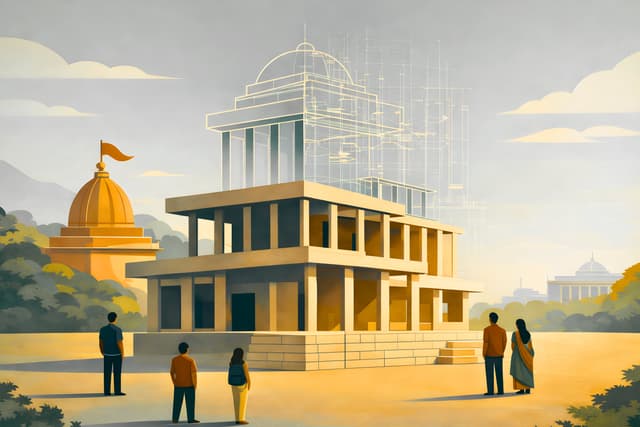
The eruption of protests among general category (GC) students over the new University Grants Commission (UGC) equity regulations speaks poorly of the kind of thinking that goes on in the supposedly "Hindutva-oriented" government of Narendra Modi. In particular, it shows Union HRD Minister Dharmendra Pradhan, who has to own up to these guidelines, in a very poor light. Either he is complicit, or he was sleeping on the job.
It is pointless to mouth political slogans like batenge to katenge and ek hain to safe hain when actions like the UGC guidelines achieve the exact opposite. These guidelines will not only promote inter-caste conflict, but will do nothing to eliminate the real discrimination that some castes face, whether in society or on campuses.
It is nobody's case that discrimination is a thing of the past, but it is counter-productive to pretend that discrimination will end by tilting the scales against GCs.
As this Swarajya report points out, the guidelines, which single out GC students for exclusion from the anti-discrimination provisions and lack reasonable safeguards against false accusations of discrimination, did not come all of a sudden.
An earlier draft was more balanced, and it was at the insistence of judicial activists that the provisions that were supposed to end discrimination ended up seeking to put only one category of students in the dock.
At the broader level, this failure is not just that of the government, but all Hindutva organisations in general, from the Vishwa Hindu Parishad to the Rashtriya Swayamsevak Sangh and others claiming to fight for the unification of Hindus.
The Hindutva movement is not just about reclaiming some of the critical temples demolished and vandalised under Islamic rule, but the elimination of internal caste-based discrimination. The idea is that once we accept the broader Hindu identity as central, we can whittle down narrow caste-based conflicts that have bedevilled us.
Babasaheb Ambedkar sought the annihilation of caste, but that is a pointless goal when all our affirmative action programmes are based on caste identities. Moreover, caste is not just about discrimination. It is about community and social capital. When the state cannot step in to help all those in need of it, it is the community that can help. Caste and religious identities, if not used for excessive political polarisation, can be positive forms of community.
The problem with Hindutva organisations is not that they lack sincerity in what they believe in, but that they are not doing practical things on the ground to help fellow Hindus, especially those left behind by progress.
Three examples.
One, what stops the VHP or the RSS or any Hindutva organisation from setting up national, regional, or local caste arbitration councils to defuse any caste conflicts before they get out of hand?
Two, the poor need economic advancement. In the emerging gig economy, it makes no sense to expect all people to be accommodated in corporate or government jobs. This means they need guidance and support to develop skills, raise loans, and set up small businesses. Why can't Hindutva organisations step in to plug the last-mile gap that prevents people from doing what they can to help themselves? In fact, if they do this, they can expect these same people to contribute to the organisations that help them. Not for nothing does the Chanakya Sutra say, dharmasya moolam arthah. All dharma is rooted in economic strength.
Three, the poor also need support to perform their religious rites. If they are left to the machinations of avaricious priests, they are more likely to lapse as Hindus and open themselves up to conversion. What stops a VHP from creating a basic training programme for priests and setting basic guidelines for how much they can charge for specific services? If these charges are not enough to allow the priests to make ends meet, they can be subsidised by charitable foundations. What, again, stops Hindutva organisations from setting up self-governing organisations for monitoring the priesthood and preventing malpractice?
The real problem with Hinduism is not that it lacks the ideas for reform, but that it has simply not bothered to create the institutional framework needed to ensure that reforms get done. Reform is not just about the government. It is about how society identifies its problems and sets up mechanisms for change.
Centuries ago, Adi Sankaracharya, with practically no backing, set up religious mutts in four corners of India. Many other modern sanatanis, from Swami Vivekananda to Swami Dayananda Saraswati, set up institutions to carry their work forward.
India needs more Hindu institutions to take society forward. Hindutva cannot be reduced to a caricature where it will be defined by its enemies by stray incidents involving the bashing up of pastors during Christmas or the lynching of cattle thieves.
Coming back to the UGC guidelines, the government must clearly review them and put out a more balanced one, and Hindutva organisations must go to the campuses and bring both the angry GC students and OBC/SC/ST students together and work jointly towards compromise and unity.
Note: The article first appeared on the author's blog.
Jagannathan is former Editorial Director, Swarajya. He tweets at @TheJaggi.
 Join our