Infrastructure
Why India's Chaotic Streets Fail Us, And The Teen Trying To Fix Them
Adithi Gurkar
Dec 01, 2025, 12:44 PM | Updated 01:49 PM IST
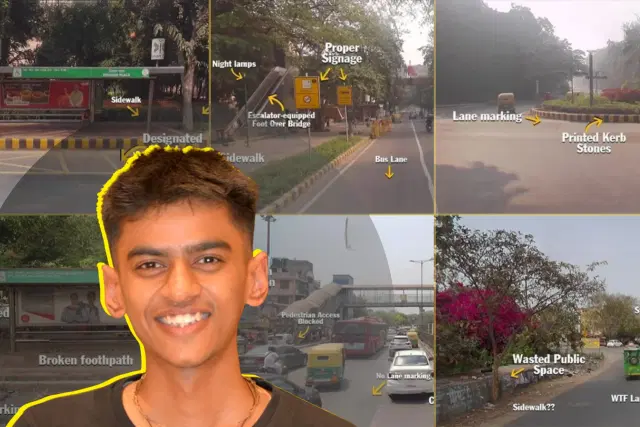
On a hot afternoon in Gurgaon, as commuters inch through yet another traffic snarl, nineteen-year-old Prince Kushwah surveys the chaotic streets with the focused attention of someone who has spent countless hours studying their dysfunction.
The young urban planning enthusiast, who operates under the handle Street Logic on Instagram, has built a 41,000-strong community around a deceptively simple premise: that Indian streets could be safer, more efficient, and infinitely more livable—if only we designed them properly.
It began as a personal passion project. Born from Prince's love of walking and frustration with India's hostile pedestrian infrastructure, it has evolved into an influential voice in urban design conversations. His Instagram reels, grounded in real-world examples and on-ground analysis, simplify complex urban planning concepts for an audience hungry for change.
"I love walking a lot, but walking on Indian roads, within most Indian cities, seems like a risk," Prince explains. "The sad reality today is that most Indians do not know where it is that they should walk. People often end up walking on roads, often forgetting the concept of footpaths. The sad reality is that many do not even know the difference between a drain cover and a footpath. India was lacking in this kind of awareness. That is where my content comes in and tries to educate people on such subtleties and nuances."
Ask Prince about the most pressing issue plaguing Indian cities, and his answer cuts through to the fundamental flaw.
"When we talk about Indian cities, the first thing that comes to mind is the long hours of life often lost to commute amidst heavy traffic. However, the core of the issue lies in our inability to properly segregate all the entities on road."
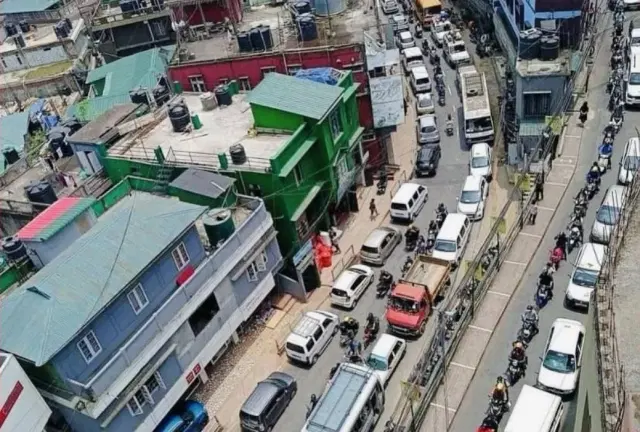
For instance, he notes, take any busy road in India—private vehicles, public buses, school vans, hawkers, vendors, cyclists and pedestrians all crowd into one single road.
"Footpaths need to be reserved only for pedestrian movement, the bus lane should only cater to buses while private vehicles can move in the other two lanes, something Singapore does incredibly well."
The Public Transport Paradox
This problem of segregation connects directly to what Prince sees as India's deeply troubled relationship with public transport. The country's population of 1.4 billion is routinely invoked as an alibi for traffic chaos, but he dismisses this explanation with barely concealed frustration.
"India's population is often cited as an excuse to justify the traffic, however, this is not true. Even China has a lot of population. The difference between China and India is that Indians are often shamed for using public transport. Owning and travelling in a private vehicle is a sign of prestige."
The depth of this stigma was laid bare when Karnataka's Deputy Chief Minister, D K Shivakumar candidly noted that men in his state would prefer to buy cars rather than use public transport, since those without cars face difficulties in the marriage market.
The consequences manifest in policy decisions that seem to actively undermine public transit. "Indore is in the process of removing the BRTS system (Bus Rapid Transit System corridor) which served as its dedicated bus route. Kolkata has also decided to discontinue its trams. All these developments are very unfortunate."
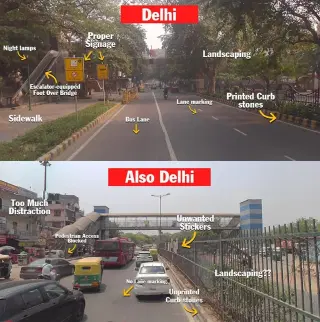
When asked to identify Indian cities that serve as positive examples, Prince points to Chandigarh, Jaipur, Bhubaneswar, and Lutyens' Delhi. His admiration stems from their commitment to fundamental design principles that most Indian urban centers have abandoned or never embraced.
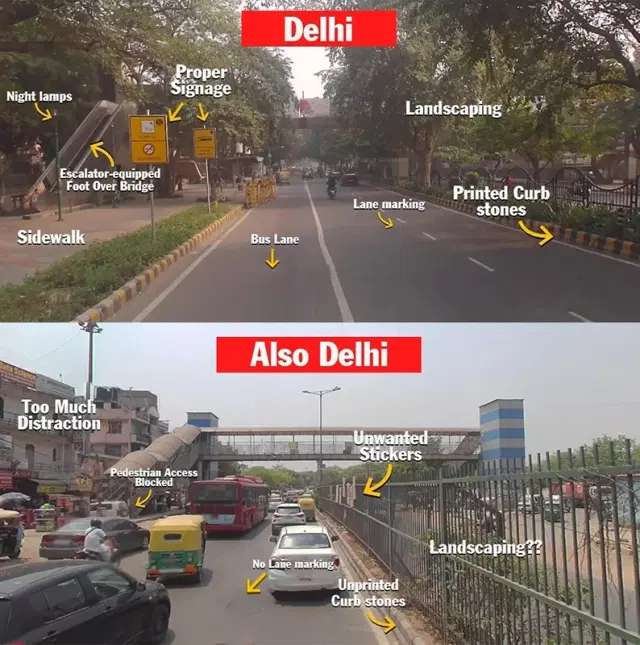
"When the British designed Lutyens' Delhi they operated with a simple mindset to keep things natural and ensure smooth flow of traffic by providing lanes for cars with three lanes in each direction of the roads accompanied with proper footpaths."
He contrasts this with the typical Indian city where "we have two lanes in each direction and post an intersection it transforms into three and further develops again into two lanes. Such designs often lead to bottlenecks. The cities I mentioned also have very beautiful landscapes."

A Breakthrough Project
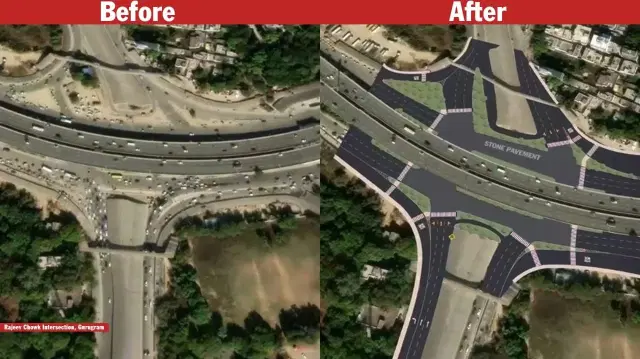
This expertise in identifying and solving urban design problems found its most significant real-world application when Prince posted a reel redesigning Gurgaon's notoriously congested Rajiv Chowk intersection.
The Raahgiri Foundation, a non-profit employed by the government, reached out almost immediately. What followed was a long-term collaboration and validation that his instincts matched professional planning standards. The team was pleased to discover Prince's designs were almost identical to their own planning.
"This particular intersection was a three-level intersection, with a flyover, an underpass and a grade (surface) level. It was highly congested due to office hours. The problem lay in the design. There was no landscape, or footpath, lack of signage and crosswalks added to the problem."
His methodology was empirical and patient. "In order to figure out a solution I went to the intersection and realized that vehicles were flowing in from all directions and after spending about two hours there, I discovered which side has more traffic count and based on this data I was able to redesign the space."
The intersection presented multiple, overlapping challenges. "Awkward angles, heavy traffic and a significant number of pedestrians were the characteristics of this intersection. The entry and exit points were placed too close to each other causing congestion. Additionally, very few people used the underpass resulting in too many vehicles taking the narrow main road instead."
His recommendations were surgical and data-driven. "I recommended increasing the distance between the entry and exit points so that it proceeds all the way to the main road and meets the existing non-motorised transport, which is largely abandoned and used only by a few due to poor connectivity. This would help in widening the road. I then recommended blocking direct access and instead providing a dedicated smoother entry route for the residents of a nearby village to further reduce the congestion."
The Rajiv Chowk project exemplifies Prince's broader critique of how Indian authorities approach traffic problems. Among urban planning fallacies, few frustrate him more than the reflexive impulse toward road widening. "The governments in India seem to believe that the solution to traffic problems is to simply widen the road. However, there is a concept in urban planning that states that whenever you widen a road, it simply attracts more traffic."
He points to another road in Gurgaon as evidence that alternative approaches can work. "The Sanath road was to be redeveloped, and the Gurugram Metropolitan Development Authority intended to widen the road from one lane to three lanes in each direction but the Raahgiri foundation intervened and made one lane in each direction and provided for proper footpaths, cycle tracks and green landscapes."
The intervention was grounded in careful analysis. "This was done after a detailed study of the traffic data which revealed that since it was an industrial area with a lot of corporate offices there is more cycle and pedestrian traffic than that of cars. Post the transformation, the road is functioning much more efficiently."
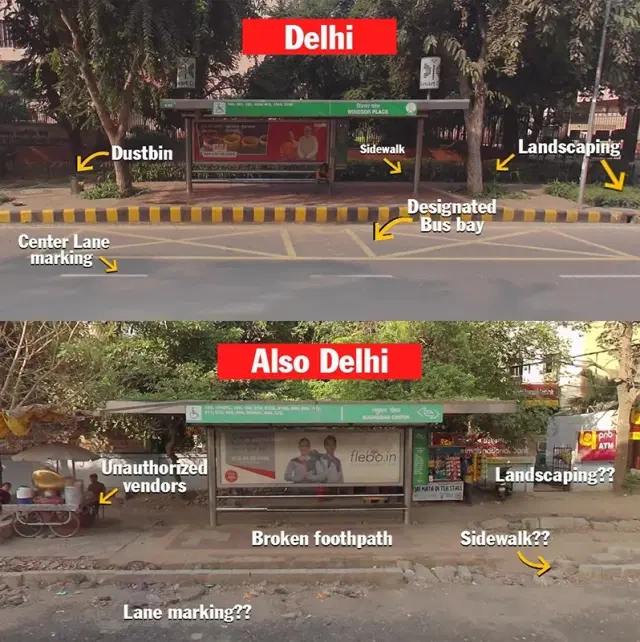
When confronted with India's harsh tropical climate as an obstacle to walking, Prince offers a counter-argument rooted in his belief that infrastructure shapes behaviour more than weather does. "If you give people space to walk, they will walk. It's a simple argument but I believe it. This is best illustrated in places like Dubai, which suffer from hot climates themselves. Shades and street furniture can be implemented such as waiting areas for bus stops, skating zones, dustbins and trees."

His approach to reimagining Indian streets is both methodical and comprehensive, addressing every element that shares road space.
"Let us take an example. There is a road with three lanes. First, we need to reserve the footpaths for walking and the adjacent space for cycling. Now these two entities are eliminated from the road. Then there is the bus lane, a lane reserved exclusively for buses within the three lanes. Now we are left with private vehicles and auto rickshaws that can exist in the other two lanes."
He goes further, proposing a radical restriction: "I would strongly recommend the restriction of all autorickshaws and e-rickshaws pick up and drop points to be only concentrated around the metro stations. Their parking and halting should only occur here and not randomly on the road as it is today."
When questioned whether India's planning failures stem from funding constraints, lack of awareness, or absence of political will, Prince offers a pragmatic assessment that places responsibility squarely on public demand. "It's a mix of all. The government will implement proper planning if people make it a core issue and demand it. Today this is a central ask of only a small percentage of the vote bank."
Beyond Traffic Counts
Gangtok earns Prince's special praise for demonstrating that civic sense and rule-following are not beyond Indian cities. "People there have very good civic sense when compared to the rest of the nation. People drive in proper lanes and they have good lane markings on the roads and people actually follow rules." This observation leads him to challenge the widespread assumption that Indian drivers are inherently undisciplined. The real culprit, he argues, is infrastructure failure.
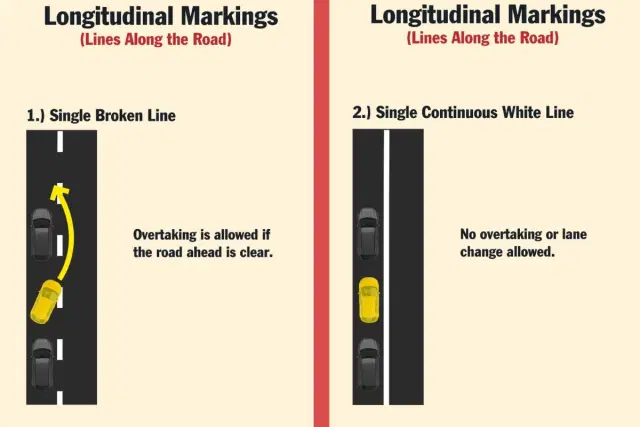
"The major problem is that in India there are no clear lane markings to begin with. Only for a few kilometers do these markings exist, after which the roads are filled with potholes or dug up roads for maintenance works or metro/flyover/underpass constructions. If people are provided with proper lanes, people will drive within them."
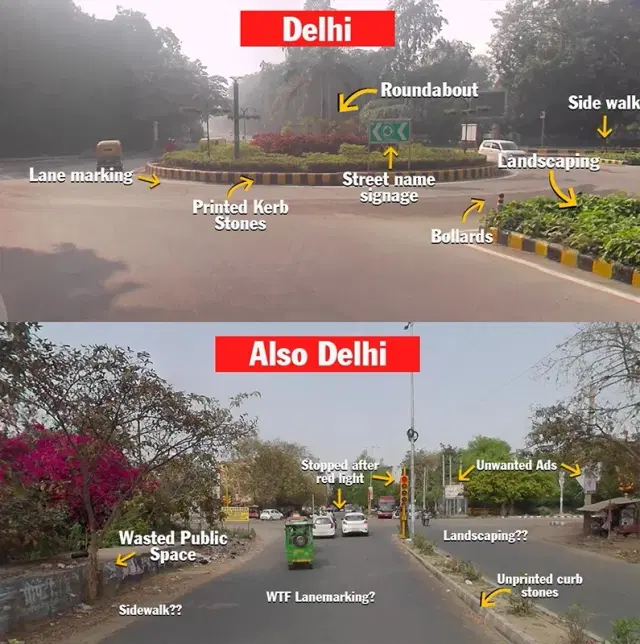
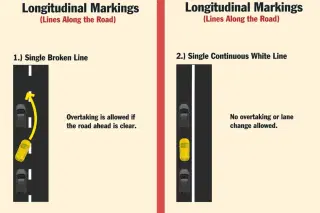
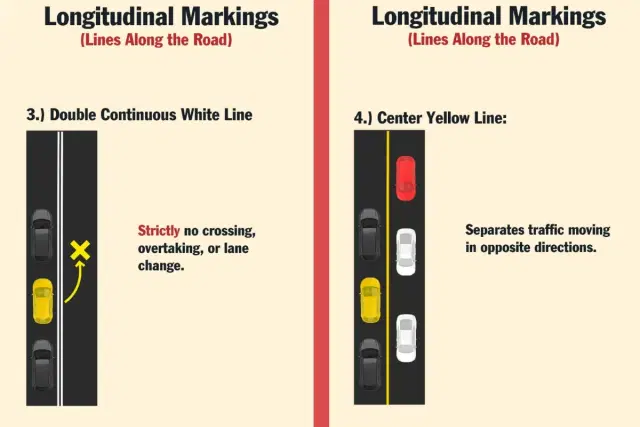
Lutyens' Delhi proves his point. "Within a 10-kilometer radius area, there are lane markings going through right from the start to the end and people are actually driving in them. The Indian Road Congress rules make lane markings mandatory but contractors flake on the responsibility as a cost-cutting measure. They state that if it is a busy road then the markings need to be made with dotted lines, if it is a mountainous road then two continuous lines are to be used."
Prince's diagnosis of Indian road design crystallizes around three competing priorities, and he is unsparing in his assessment of which ones prevail. "When it comes to roads in general we have a combination of three factors at play which are safety, cost, and traffic. India unfortunately prioritizes cost and traffic over safety. Add to this the Indian tendency to hurry, this deadly combination leads to a lot of accidents."
The consequences of this reactive approach are visible everywhere. "Most of India is designed like this. Actually nothing is actually designed. People just start living and expanding settlements and the roads are built as an afterthought. Gurugram is a perfect example of this. We saw that the recent monsoon pretty much drowned the whole city and it came to a standstill for four hours. People started building high rises first and after that did road construction begin."
This haphazard approach has created an insidious feedback loop between poor infrastructure and the vehicles Indians choose to drive. "The driving force (pun intended) behind cars getting bigger is the government. When you don't provide good roads, people are forced to buy better and bigger cars. In the Netherlands people own small cars and in fact people prefer to ride bicycles. The same is the case in Japan. This leads to an increase in pollution thanks to bigger engines."
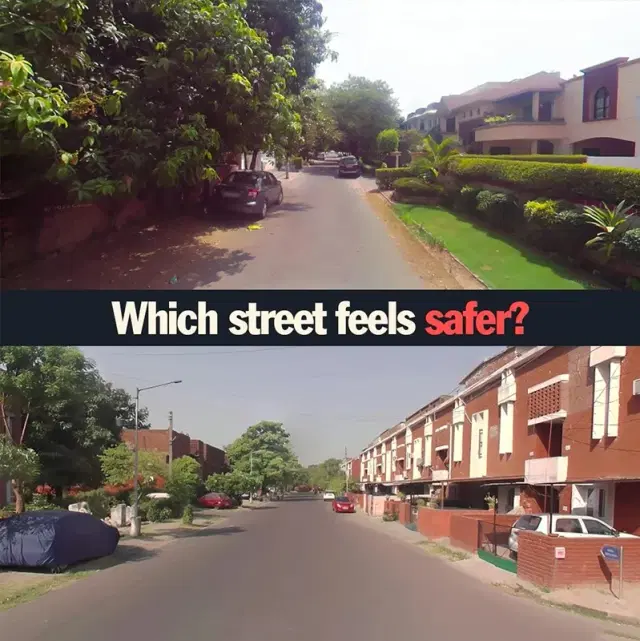

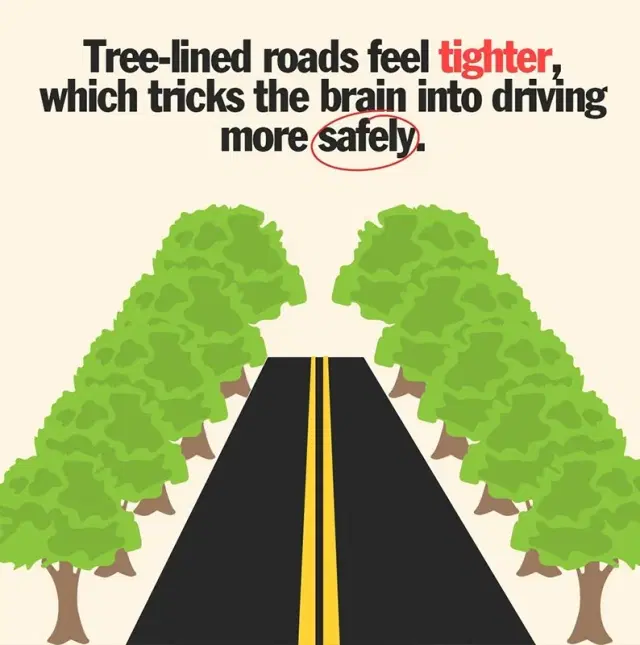
Prince finds inspiration not just in planned interventions but also in nature's own design wisdom. Trees, he argues, serve a dual function that goes beyond aesthetics or environmental benefits.
"Tree-lined roads feel tighter which tricks the brain into driving more safely. They provide for optical narrowing, as the trees visually compress the road making drivers instinctively more careful. Additionally it acts as a barrier between the cars and pedestrians providing them safety."
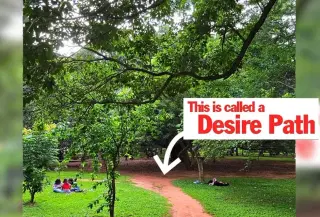
Even the unplanned paths that emerge organically in cities offer lessons for urban planners. "Desire paths are usually formed at underdeveloped areas where sidewalks are lacking, thereby forcing people to take an alternate route. This slowly develops into a defined path itself. They can be indicators as to where the designer can place the footpath as this is where people prefer to walk."

On the subject of roundabouts, Prince offers measured enthusiasm tempered by an understanding of their limitations.
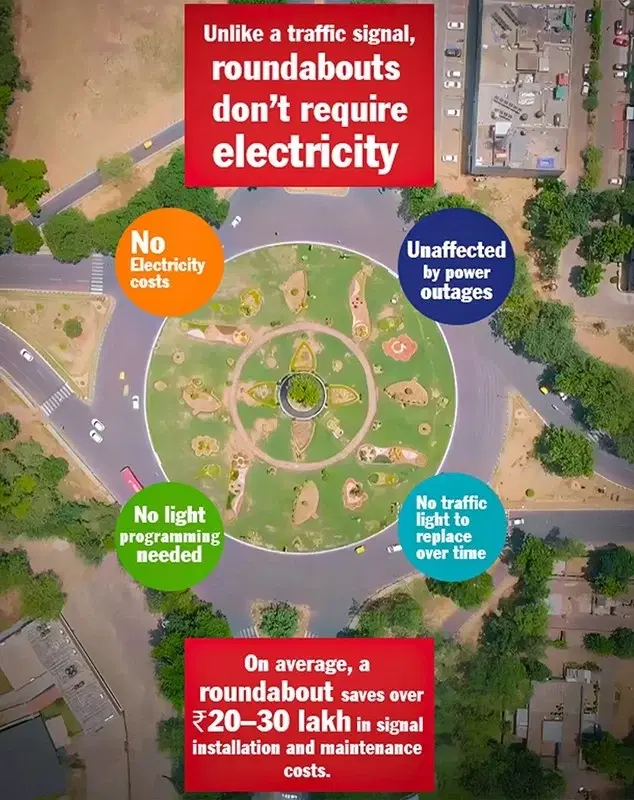
"Roundabouts are a very European concept, so in India they were essentially a British invention. They work wonderfully well in areas where there is less traffic count and having just two lanes in each direction. They can reduce crashes up to 37 per cent compared to traditional intersections. This can be seen in how Chandigarh is designed. They don't require the use of electricity or light programming."
But context matters. He continues, "however, when the traffic count increases, and three lanes begin to form in each direction, the roundabout no longer helps and one is forced to proceed to the run-of-the-mill four-leg intersections with traffic lights."
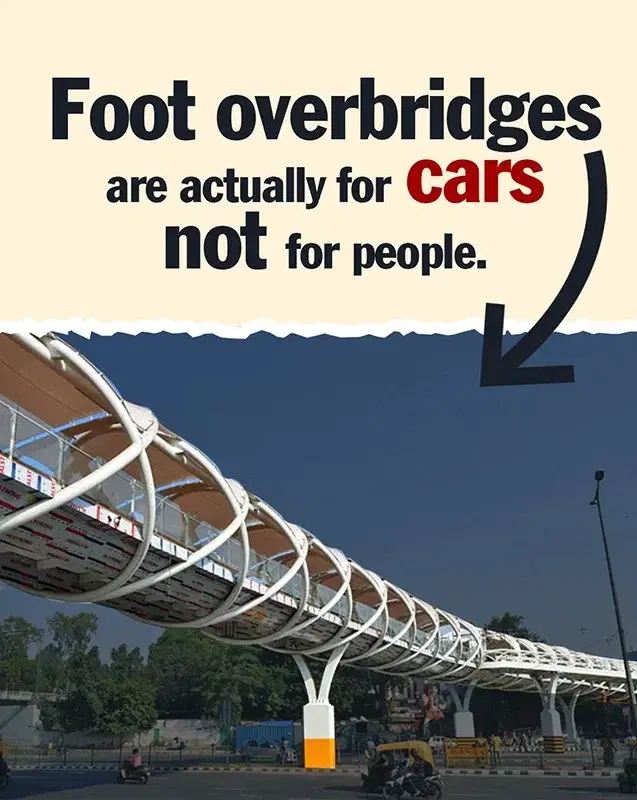
His stance on underpasses and foot overbridges is less equivocal, reflecting a pedestrian-first philosophy that challenges car-centric infrastructure. "As a pedestrian, I am not a big fan. They are designed for the convenience of cars, so that cars don't have to stop. They force people to take the long way up and then down instead."
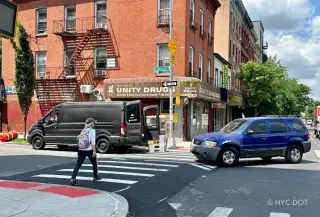
Yet he acknowledges trade-offs. "In places of heavy traffic count, unfortunately this is the only solution, but in other areas raised crosswalks provide a way out. These crosswalks are typically slightly higher than normal roads and act as a brake for car traffic."

Despite his many criticisms of Indian urban infrastructure, Prince acknowledges one unqualified success story. "The Delhi metro is the longest and the largest metro in India and sometimes works even better than the Seoul metro in South Korea. It is extremely well connected. Its platform screen doors protect passengers from inhaling PM10 and PM 2.5 particles that are released by the trains, which bring along with them the air pressure."
Yet even world-class infrastructure cannot compensate for failures in other areas of the system. Prince identifies the country's approach to driver licensing as a fundamental problem that undermines all other efforts at road safety.
"If we can fix our driving schools and RTOs then we can fix most of the problems faced on Indian roads today," he states, lamenting the corruption and under-the-table deals that enable citizens to acquire licenses without ever attempting the test.
Similarly, inadequate signage compounds the challenges drivers face. "Signages need to be used adequately at the right places. Signages of bottlenecks are used in very few areas in Delhi. This could prove to be very useful."
Prince is deliberate about which international models India should study, rejecting comparisons that ignore climate and contextual differences.
"India needs to be compared to countries like Singapore rather than western European countries like the Netherlands which have much nicer weather. Though Singapore does not have a comparable population, it follows what is termed as transit-oriented development, which means the cities are planned and designed around the transport needs and not the other way round. The roads come first, post that the zoning occurs."
As India accelerates toward infrastructure modernization, investing billions in highways and expressways, Street Logic's modest proposals represent a countercurrent: simple in concept but radical in implication.
In a country where urban planning has long been reactive rather than proactive, where roads follow settlement rather than guide it, Prince Kushwah suggests something quietly revolutionary: that Indian cities might become both more livable and more efficient when we design for people first, and cars second.
Whether his vision will influence policy or remain an Instagram curiosity may ultimately depend less on urban planning theory and more on whether enough citizens demand it loudly enough to move the political needle.
Adithi Gurkar is a staff writer at Swarajya. She is a lawyer with an interest in the intersection of law, politics, and public policy.
 Join our