Karnataka
Immovable Chief Minister: Why Congress Cannot Remove Siddaramaiah
Deviyani G
Dec 06, 2025, 03:17 PM | Updated 03:17 PM IST
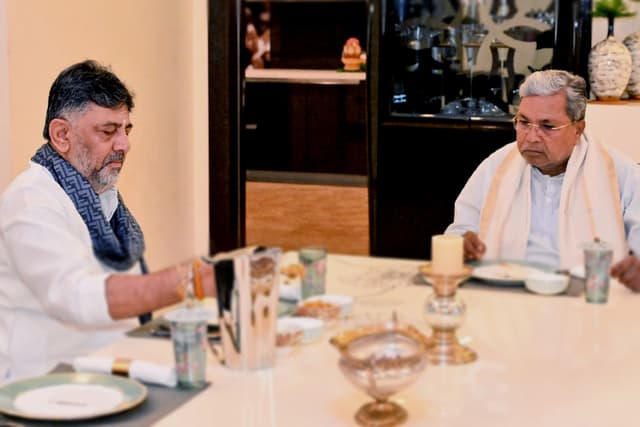
Last Saturday's smiling photo-op between Siddaramaiah and D.K. Shivakumar convinced nobody. The choreographed unity, the rehearsed lines about letting the "High Command decide". All theatre.
But the real story isn't about two politicians fighting over a chair. It's about why one of them has become politically untouchable, insulated from any meaningful challenge despite the other's deep pockets and supposed organisational strength.
While a power-sharing arrangement of 2.5 years each has always been in DKS's mind, Siddaramaiah's intention from Day One of his second innings has been to remain CM for the full five years.
As Karnataka's winter assembly session begins December 9th in Belagavi, with Siddaramaiah racing toward January 6th to surpass D. Devaraj Urs's record as the state's longest-serving CM, the High Command confronts an uncomfortable truth: they cannot remove him.
Not because he's defiant. Because he controls something more powerful than party machinery or fundraising networks – he commands the social coalition that claims to represent Karnataka's demographic majority.
The Numbers Game: A Census Nobody Quite Trusts
Understanding Siddaramaiah's fortress starts with understanding Karnataka's social arithmetic – or rather, what he claims that arithmetic to be, based on leaked estimates from the state's long-awaited and perpetually controversial caste census.
The leaked data from the report submitted to the government in 2024 suggests a breakdown that conveniently validates every political argument Siddaramaiah has made for three decades:
Other Backward Classes (OBCs): Approximately 70% of the population, which includes Muslims
Scheduled Castes (SCs): 18.2% (about 1.09 crore people)
Muslims: 12.87% (about 76.99 lakh people)
Scheduled Tribes (STs): 7.1% (about 43.81 lakh people)
Kurubas: 7.31% (about 43.72 lakh people)
Meanwhile, the traditionally dominant castes – Lingayats at around 11% and Vokkaligas at approximately 10.3% – represent a numerical minority.
The caste census isn't just data – it's a political weapon. And Siddaramaiah holds it, unreleased, while using leaked estimates to justify every policy decision.
Whether these numbers accurately reflect Karnataka's demographics or represent convenient political arithmetic remains an open question that nobody can definitively answer because the full census hasn't been officially published.
What's undeniable, however, is that Siddaramaiah has built his entire political fortress on the AHINDA coalition – Alpasankhyataru (Minorities), Hindulidavaru (Backward Classes), and Dalitharu (Dalits).
Even if we assume the most conservative estimates, AHINDA still represents somewhere between 66-70% of Karnataka's population. That's not just a vote bank. That's demographic dominance.
Siddaramaiah's Three-Decade AHINDA Project
While D. Devaraj Urs coined the AHINDA term in the 1970s, it remained largely rhetorical until Siddaramaiah transformed it into an organised political force. He didn't hijack someone else's coalition. He built it from Congress's raw materials, sustained it through his political career, and made it electorally decisive.
His first tenure as Chief Minister (2013-2018) established the template. In his maiden 2013 speech, he declared that reservation in education and jobs would be offered based on a comprehensive socio-economic survey – the caste census that's now complete. The 2015 report submitted to the government in 2024 is sitting like a loaded weapon.
Back in August 2021, two years before the 2023 elections, Siddaramaiah announced he would launch the AHINDA movement across Karnataka, positioning himself to "emerge as the leader of oppressed communities."
He met with former ministers who'd championed AHINDA earlier – HC Mahadevappa and CM Ibrahim – essentially inheriting a legacy and transforming it into contemporary political machinery.
But here's where Siddaramaiah's craftiness shows: He used Congress loyalist DKS's organisational muscle, adopted Congress's own AHINDA framework, captured the party's traditional voters, and built a fortress against the Congress High Command using Congress's own resources.
The scheme rollout wasn't just welfare distribution – it was strategic coalition maintenance with tangible budget numbers:
For Minorities: Four percent reservation for Muslims in government contractor quotas for civil works valued up to ₹1 crore, restored immediately after BJP removed this quota before 2023 elections. ₹60 crore allocated for reviving pre-matric scholarship schemes for minority students after central government discontinued them. Upgraded 62 minority Morarji Desai Residential Schools into integrated schools covering grades 6-12, benefiting around 13,000 students with ₹30 crore allocated.
For Scheduled Castes/Tribes: ₹42,018 crore allocated in 2025 budget toward Karnataka Scheduled Castes Sub-Plan and Tribal Sub-Plan – ₹29,992 crore for SC, ₹12,026 crore for ST. Increased reservation for SC, ST contractors in public works projects to ₹2 crore, extended reservation in procurement of goods and services up to ₹1 crore.
For Backward Classes, Including His Own Kuruba Community: Recommended ST status for Kurubas to the Union Government, with 8 million Kurubas currently under OBC Category 2A sharing 15% quota with 104 other castes. Siddaramaiah publicly stated that if Kurubas get ST status, "the overall ST quota must be increased" – ensuring his community's elevation doesn't come at the expense of existing ST communities.
Each announcement reinforced the same message: Siddaramaiah delivers for AHINDA.
How to Topple Your Own Government and Emerge Stronger: The 2020 Blueprint
Here's a political lesson the Congress High Command seems determined to forget: In 2020, sixteen MLAs decamped to Mumbai, effectively collapsing the Congress-JD(S) coalition government in Karnataka. Thirteen of those legislators were Siddaramaiah loyalists.
When pressed, rebel MLA Shivaram Hebbar didn't bother with elaborate justifications – he simply stated they "followed Siddaramaiah's advice."
The delicious irony? Siddaramaiah wasn't some backbencher orchestrating rebellion from the margins. He held the position of Coordination Committee Chairman – literally the person tasked with keeping the coalition functional. Instead, he systematically dismantled it from within.
The fallout was surgical. Dr. Parameshwar and Shivakumar lost their ministerial positions and influence. Meanwhile, Siddaramaiah transitioned smoothly into the Leader of the Opposition role, emerging as Karnataka Congress's most powerful voice despite his party losing power.
Political circles openly acknowledged what had transpired: Siddaramaiah chose opposition over remaining a marginalised minister in a coalition where real authority resided elsewhere.
This move reveals something essential about Siddaramaiah's political instincts. He recognised that Congress's institutional paralysis created room for manoeuvre. The party wouldn't – couldn't – punish him because decisive action requires organisational coherence they simply don't possess.
Their inability to enforce consequences became his operating space. Where others saw recklessness in collapsing their own government, Siddaramaiah saw strategic repositioning. And he was proven right.
The Cracks in the AHINDA Fortress Nobody Wants to Discuss
But here's where Siddaramaiah's AHINDA messiah image starts showing fissures. While he projects himself as representing all these communities, tangible benefits have gone primarily to Kurubas – his own community at 7.31% of the population.
The other communities within AHINDA – Madiwala, Vishwakarma, Kumbara, Ganiga, Golla, Besta, Uppara – saw rhetorical acknowledgment but minimal tangible focus compared to what Kurubas received.
Union Minister HD Kumaraswamy directly challenged Siddaramaiah in April 2025, asking him to reveal the exact distribution of jobs and educational seats among the 101 communities in Category 2A, accusing him of disproportionately favouring Kurubas.
The Karnataka Backward Caste Federation warned that various backward castes like Agasa, Savita Samaj, Tigala, Ediga, Kuruba, Devanga weren't getting adequate reservations, revealing tensions within the supposed AHINDA unity.
The most damaging allegation exposes how Siddaramaiah's guarantee schemes are being funded: BJP accused the Karnataka government of diverting ₹11,896.84 crore from the ₹42,017.51 crore reserved under the Scheduled Caste Sub-Plan toward implementing guarantee schemes.
In previous years, ₹11,114 crore in 2023-24 and ₹14,282.38 crore in 2024-25 from SC/ST welfare funds were already diverted to guarantee schemes that benefit everyone, not just AHINDA communities.
This means AHINDA won't necessarily shift en masse if Siddu breaks away or if the High Command finally grows a spine. The coalition has cracks. The problem is nobody in Congress leadership has the courage to exploit them.
Why D.K. Shivakumar Remains Perpetually Outside the Door
Let's be brutally honest about what D.K. Shivakumar brings to the table: money. Lots of it. His fundraising keeps Karnataka Congress financially viable. He's essentially the party's ATM, bankrolling operations, campaigns, and the general infrastructure that keeps the show running.
His Vokkaliga base? Even that's more complicated than it appears. DKS has some sway with Vokkaligas, but even there his influence is largely limited to the Kanakapura region. In the Old Mysore Region (OMR), he has to compete with the JD(S), which has deeper Vokkaliga roots through the Deve Gowda family.
Vokkaligas at 10.3% of the population are already a limited base – and DKS doesn't even command all of them.
Compare that to Siddaramaiah's claim on 66-70% of Karnataka's population through AHINDA. It's not even a contest. Shivakumar has money and limited regional caste influence. Siddaramaiah has the demographic majority – or at least claims to represent it convincingly enough that challenging him feels like electoral suicide.
This is how Siddaramaiah wields the AHINDA base like a political mace, keeping DKS perpetually hovering around the CM's chair – close enough to hope, far enough to suffer.
The High Command stands paralysed between rewarding their most loyal party worker and deep-pocketed financier DKS versus alienating Siddu who controls (or claims to control) the vote base that actually wins elections.
The result? DKS remains the eternal second-in-command, always next in line, never actually arriving.
The High Command That Can't Command Anything
The Congress High Command appears extraordinarily weak – as evidenced by what happened in Chhattisgarh and Rajasthan. Any Chief Minister seems ready to defy them, secure in the knowledge that the party leadership lacks both spine and strategy.
In Chhattisgarh, rumours of a "two-and-half-year power-sharing formula" between Bhupesh Baghel and T.S. Singh Deo circulated for years, supposedly promised by Rahul Gandhi. It never materialised.
In Rajasthan, the Ashok Gehlot versus Sachin Pilot tensions simmered and occasionally exploded, with the High Command issuing statements and achieving nothing.
Karnataka follows the same script. While Rahul Gandhi and KC Venugopal reportedly favour allowing Siddaramaiah to complete his full term, Sonia Gandhi, Priyanka Gandhi Vadra, and AICC general secretary Randeep Singh Surjewala appear open to installing Shivakumar. This internal split at the highest level guarantees continued paralysis.
It's hard to find a replacement for Siddaramaiah who has served as Congress's appeal to the OBCs of the state. Leaders like Parameshwar and Satish Jarkiholi sometimes appear as contenders, but notice something clever: Siddaramaiah often plays with these names as alternatives to himself rather than alternatives to DKS.
This strategic misdirection keeps High Command attention dispersed, prevents any clear succession plan from forming around Shivakumar.
What Saturday's Photo-Op Actually Revealed
The smiling pictures last Saturday weren't about resolving anything. They were about maintaining the fiction that Congress still functions as a coherent organisation with decision-making capability.
Siddaramaiah at 77 has age working against extended tenure, yet reports indicate he believes his position has only strengthened. Karnataka Home Minister Parameshwar publicly stated that Siddaramaiah would lead the party in 2028 elections – essentially announcing the death of any power-sharing formula.
The supposed 2.5-year arrangement exists in Shivakumar's memory and DKS's supporters' hopes. In Siddaramaiah's plans? It never existed. From Day One, his intention has been to remain CM for the full five years.
The High Command's supposed "assurance" to DKS in 2023 was either never given with any seriousness, or was given knowing it would never be enforced.
When asked about elevation to CM, Shivakumar gave a cryptic response: "Efforts might fail, but prayers never do" – the political equivalent of acknowledging he has no institutional pathway to power.
The Fortress Built on Contested Ground
As the winter session approaches and Siddaramaiah eyes the record books, the real story isn't whether he'll give up power voluntarily (he won't). It's that Karnataka's Chief Minister has built a political fortress on demographic claims that remain conveniently unverifiable, coalition unity that shows visible cracks, and organisational paralysis at every level above him.
The High Command can't remove him – not because he's irreplaceable, but because they can't make difficult decisions about anyone. DKS can't challenge him – not because Siddaramaiah is invincible, but because money and limited regional caste influence can't compete with claims of representing 66-70% of the population.
The AHINDA coalition as an organised, mobilised, electorally decisive force? That's Siddaramaiah's creation. Whether it remains unified, whether all its constituent communities genuinely benefit, whether the demographic numbers are accurate – these are open questions.
But in politics, perception often matters more than reality. And Siddaramaiah has spent three decades building the perception that he is AHINDA and AHINDA is him.
Until someone in Congress leadership develops the courage to test whether that perception reflects reality, Siddaramaiah remains untouchable.
The numbers might lie. The coalition might fracture. The census might be contested. But until the High Command finds its spine, none of that matters.
Siddaramaiah understands what they don't: in a party paralysed by indecision, the leader willing to simply stay put and dare anyone to move him wins by default.
 Join our