Kerala
How A Century-Old Sunni Body's 'Warning Against Political Islam' Revealed The Fault Lines Within Kerala's Muslims
Swarajya Staff
Feb 27, 2026, 06:32 PM | Updated 06:32 PM IST
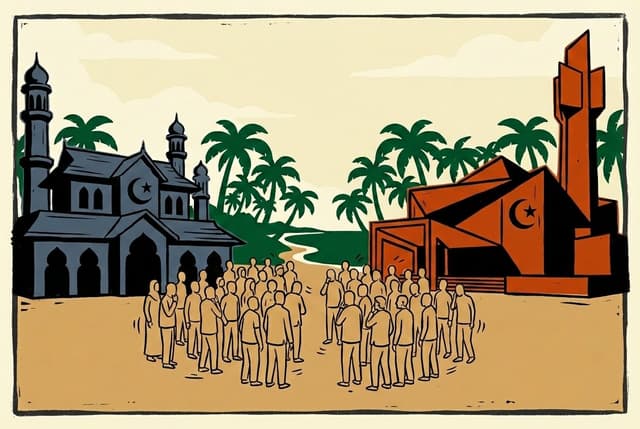
On 7 February 2026, at the valedictory ceremony of its centenary celebrations in Kasaragod, the Samastha Kerala Jam'iyyathul Ulama — the most powerful Sunni Muslim organisation in Kerala — chose to draw a line in the sand.
A resolution, adopted before a crowd of thousands, warned against "pan-Islamist extremist ideologies" that seek to undermine Islam's peaceful character. It accused a certain strain of thought — rooted in the ideas of Abul A'la Maududi — of misleading Muslim youth through "emotionally charged rhetoric that subtly promotes the idea of theocracy and the dangerous concept of political Islam."
The target was unmistakable even though it went unnamed: Jamaat-e-Islami Hind.
One Muslim organisation publicly denouncing another Muslim organisation. In Kerala. This is not a Sunni-versus-Shia affair — both Samastha and the Jamaat draw from the Sunni tradition. And these two had, as recently as last year, found themselves on the same side of political barricades as part of the Congress-led United Democratic Front. So what drove Samastha to fire this shot?
The answer lies in a power struggle decades in the making — one that is reshaping the political representation of Kerala's Muslims, drawing both the Congress and the Communist Party of India (Marxist) into its orbit, and slowly eroding the dominance of the traditional religious establishment. To understand the resolution, you must first understand the two organisations it pits against each other.
Samastha was founded in 1926 in Kozhikode (then Calicut), making 2026 the year of its centenary. But its roots go much deeper. For centuries, the Ponnani belt in Malabar has been the spiritual heartland of Kerala's Muslims. Scholars from this region — trained in the Shafi'i school of Sunni jurisprudence, steeped in Sufi traditions — served as the community's religious guides, teachers, and arbiters of disputes. When new ideological currents inspired by Wahhabism and the thoughts of Jamaluddin al- Afghani and Muhammad Abduh began reaching Kerala in the early twentieth century, the traditional scholars felt their authority waning. They organised. The result was Samastha.
Over the next hundred years, Samastha built a vast institutional empire. It controls and guides an estimated 10,000 to 11,000 madrasas — one of the largest religious education networks in South India. It supervises mosque administration, issues statements, runs higher Islamic learning centres, and shapes community opinion across the state. Its political wing is the Indian Union Muslim League (IUML), which has been a fixture in Kerala politics since independence. Samastha is, in essence, the establishment — the body that tells Kerala's Muslims what is doctrinally correct, who runs the mosques, and what the community's political interests are.
The key thing to understand about Samastha is that, for all its conservatism, it has historically kept religion and politics in separate compartments. It controls the mosques and the madrasas; the IUML handles the elections and the legislatures. The scholars issue guidance; the politicians do the wheeling and dealing. This division of labour reflects, in part, the Sunni-Shafi'i tradition's emphasis on established scholarly authority over individual interpretation.
Jamaat-e-Islami is a fundamentally different creature. It was founded in Lahore in 1941 by Abul A'la Maududi, a journalist and Islamic theorist who believed that Islam was not merely a set of worship practices but a complete system of governance. Maududi's central idea — Hakimiya — held that sovereignty belongs to God alone, not to the people. Democracy, being an ideology that places sovereignty with the electorate, was therefore incompatible with Islam in its pristine form. The goal was Iqamat-ud-Din: the establishment of an Islamic way of life across every domain — politics, law, economics, social relations. Everything.
After the Partition of India, the Indian branch reconstituted itself as Jamaat-e-Islami Hind in 1948. Its Kerala chapter was established the same year by V.P. Muhammad Ali, who had been drawn to Maududi's ideas while studying in Umarabad. The Indian government banned the Jamaat twice — once during the Emergency (1975–77) and again in 1992 under the Unlawful Activities (Prevention) Act, though the Supreme Court reversed the second ban.
Over the decades, the Jamaat has undergone a partial public transformation. It facilitated the establishment of the Welfare Party of India in 2011 as a political platform, and its leaders now speak the language of constitutionalism, pluralism, and social justice. But the ideological DNA remains. As recently as January 2026, a Jamaat leader in Kerala, Shaikh Muhammed Karakunnu, posted on Facebook asking whether a true believer could reject the idea of an Islamic Republic, describing the Prophet Muhammad as its founder and Medina as its capital. The post came barely weeks before the Samastha resolution.
In Kerala, the Jamaat punches well above its weight. Nationally, it has an estimated 6,000 core members, 29,000 workers, and over 300,000 active sympathisers — numbers that are modest on paper given India’s 200 million Muslims but backed by exceptional organisational discipline, welfare networks, and media savvy. Its student wing, the Students Islamic Organisation (SIO), is especially active on campuses, and its youth arm, the Solidarity Youth Movement, has emerged as one of the most visible mobilisers of young Muslims in the state.
It is through the student and youth wings that the Jamaat most directly threatens Samastha's hold. The SIO and Solidarity have proven adept at picking up emotionally charged causes — particularly the Palestinian issue — and turning them into platforms for ideological recruitment. In October 2023, the SIO organised an event called "Hamas Square" in Malappuram, where participants voiced support for Hamas. The Solidarity Youth Movement hosted a rally at which former Hamas chief Khaled Mashal addressed attendees via video, and which ran under the banner of "Uproot Bulldozer Hindutva and Apartheid Zionism." In 2024, when Hamas leader Yahya Sinwar was killed by Israeli forces, the SIO conducted funeral prayers in Kerala. In 2025, the Jamaat declared "Palestine Day" to be observed every Friday in the state.
Samastha, by contrast, has always been more measured. It opposed the Popular Front of India (PFI), it has issued calls against extremism, and its scholarly authority has historically served as a sort of firewall against radical tendencies within the community. But measured does not translate into exciting — not for a generation of young Muslims who are digitally native, globally connected, and drawn to the Jamaat's more assertive, identity-driven politics.
The rivalry is thus both theological and political. Theologically, Samastha insists on adherence to the Madhhab tradition — the established schools of jurisprudence — and views Maududi's ideas as a dangerous deviation that collapses the distinction between religion and politics. Politically, the Jamaat represents a direct challenge to the IUML's monopoly as the voice of Kerala's Muslims, roughly 26.5 per cent of the state's population.
What makes the situation explosive is the willingness of both the Congress and the CPI(M) to court the Jamaat for electoral gain — each while accusing the other of doing exactly the same thing.
The most recent flashpoint came during the 2025 Nilambur Assembly by-election, when the Welfare Party openly announced its support for the Congress-led UDF candidate. The IUML was furious. The Catholic Congress, a UDF ally, called the alliance an “open challenge to Kerala’s secular democratic traditions.”
But the Congress leadership, led by Leader of the Opposition V.D. Satheesan, brushed aside objections, arguing that the Jamaat had renounced its theocratic ambitions and that its support was "purely political."
Satheesan went further just a day before the Samastha resolution was passed, stating publicly that the UDF would accept the Jamaat's support in the 2026 Assembly elections. It was, in part, this statement that prompted Samastha to act — a signal that the traditional religious establishment would not stand by while its political ally normalised an ideological rival.
The CPI(M), meanwhile, seized on the resolution as ammunition, with State Secretary M.V. Govindan accusing the Congress of "whitewashing communal extremist forces." Chief Minister Pinarayi Vijayan, speaking at the very same Samastha centenary event, urged secular-minded people to unite against theocratic tendencies. The irony is rich: the Jamaat had for decades been closer to the Left, supporting CPI(M) candidates in elections. It was only after the Jamaat shifted its allegiance to the UDF that the Left suddenly discovered its "extremist" character.
To give a sense of the spectrum within which all this operates: in July 2023, during a Muslim Youth League rally in Kanhangad, Kasaragod — a rally organised by the IUML's own youth wing — members were caught on camera raising slogans threatening to hang Hindus in front of temples and burn them alive. Over 300 people were booked. If this is the organisation the Congress considers its "secular" ally, the Jamaat — which openly speaks the language of Iqamat-ud-Din and whose cadre marches under Palestinian flags while calling for the "uprooting" of Hindutva — represents a further step along the same trajectory.
The Samastha resolution is, in many ways, a defensive manoeuvre by an institution that senses its century-old grip loosening. The traditional model — Samastha controls theology, the IUML controls politics, and the two together manage the community — is under strain from multiple directions. The Jamaat offers a more ideologically integrated package: religion as politics, politics as religion, with no artificial separation. For young Muslims navigating questions of identity in a globalised world, this package can feel more coherent than Samastha's compartmentalised approach.
The question for Kerala — and for India — is what the Congress and the Left intend to do about this. Both have demonstrated a pattern of engaging with the Jamaat when it suits their electoral arithmetic, then feigning shock when its ideological positions become publicly inconvenient. The Nilambur by-election showed the Congress is willing to displease the IUML in order to not alienate a section of Muslims that the Jamaat influences. The Jamaat, for its part, wants the alliance because it lacks the ground-level electoral machinery that the Congress can offer — even if it has the mobilisation capacity and ideological energy.
But the real story is not the political hypocrisy — it is what lies beneath it. What the national reader should take away from this episode is that the traditional hold of organisations like Samastha over Kerala's Muslim community is weakening. New voices — more ideologically ambitious, more globally connected, more willing to blur the line between religion and politics — are rising. The IUML, for all its flaws, at least operated within a framework where religious authority and political authority occupied distinct spaces. The Jamaat does not recognise that distinction.
Samastha is resisting. It has the institutional depth, the madrasa network, the scholarly prestige. But institutions that have been around for a century can also be slow to adapt. The question is not whether the resolution was justified — it clearly was, for the Samastha, on theological and political grounds. The question is whether it will be enough. Whether the firewall holds. Whether the next generation of Kerala's Muslims will look to Ponnani's centuries-old scholarly tradition for guidance, or to the ideological framework that was born in a meeting hall in Lahore in 1941.
That question remains open. And its answer will shape not just Kerala, but India's politics for years to come.
 Join our