Kerala
What Kerala Model? No Party In The State Has A Plan For Impending Economic Meltdown
Venu Gopal Narayanan
Dec 04, 2025, 02:29 PM | Updated 02:29 PM IST

Kerala is presently seized by a bout of intense electioneering, for local body polls due within a fortnight. These polls are a precursor to assembly elections scheduled for next summer. The fate of the states hangs in balance.
The Communist government of Chief Minister Pinarayi Vijayan would have you believe that 'all is well'. Life is beautiful in God's own country. Without directly disputing this, the Congress-led opposition say they can do much better for the state, without actually defining what they intend to do.
The Bharatiya Janata Party (BJP), very much still a fringe player in Kerala politics, disagrees with both the Left and the Congress. But it has yet to come out with a concrete action plan, and is still plugging 'development issues' as its core theme.
Consequently, we are in a curious situation where none of the political parties have clearly identified the problems facing the state, devised scientific solutions for these, prepared recovery plans, or disseminated these key truths to the public. Instead, they run in circles, sniping endlessly at each other, in a flux of constant cavil, turning truths into a deafening din of white noise.
What, then, is the current situation in Kerala? Simply put, the state is bankrupt, its meagre infrastructure is crumbling and in need of urgent repair, unemployment is rife, manufacturing is a pipe dream, agricultural production remains un-mechanised for the most part and restricted primarily to two districts, tax revenues are stagnating, growth, investment, and industry aren't happening, and the deep debt trap it is stuck in foretells fiscal ruination.
The only thing preventing the state from collapsing completely is private spending within the state of foreign remittances from abroad.
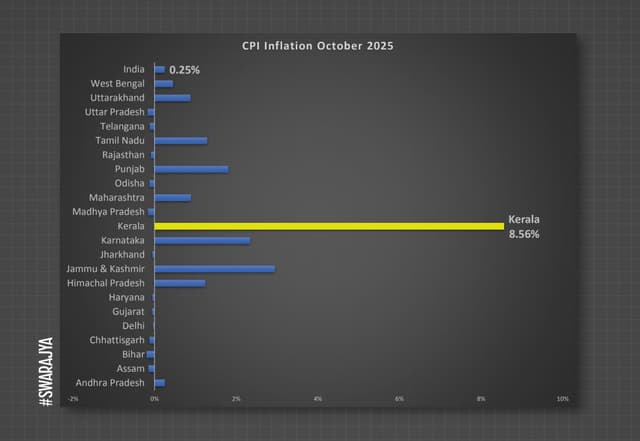
At a time when the inflation rate in India is at its lowest, 0.25 per cent, inflation in Kerala this month is at a staggering 8.6 per cent. And to make matters worse, tourism, a major source of income for many Malayalees, recorded its worst peak month in memory this November.
Occupancy rates in hotels and resorts, which should have been up at 70–75 per cent in peak season, slumped despondently to 40 per cent. The ripple impact of that slump on the rest of the tourism sector can only be imagined.
To put the gravity of the matter in stark perspective, look at a chart of current inflation rates in major states below. The divergence of Kerala from the rest of the country is stunning. No other state even comes anywhere close. The inflation rate in most states is under 2 per cent.
It is, in fact, negative in many states, most of which are governed by the BJP: Gujarat, Uttar Pradesh, Haryana, Chhattisgarh, Assam, Rajasthan, Madhya Pradesh, Bihar, and Delhi.
Next is a cross-plot of the current inflation rate against the quality of public expenditure for 2024, as evaluated by the NITI Aayog using a whole host of fiscal parameters. Kerala ranks at the bottom along with Punjab (no surprise there).
Look at the gap between Kerala and the rest of the country. Look at Madhya Pradesh, which leads the pack in focussed, disciplined, meaningful public expenditure. Again, we see that Kerala occupies a forlorn quadrant on its own.
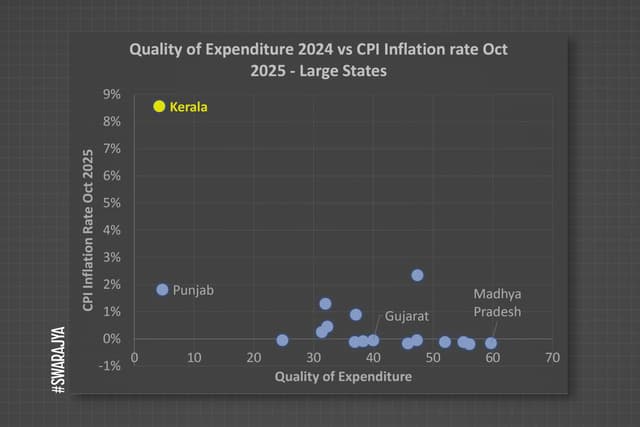
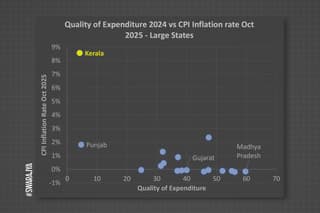
Next is a cross-plot of the current inflation versus a ratio of a state's debt to its Gross State Domestic Product (GSDP) in 2024. Note lonely Kerala in yellow.
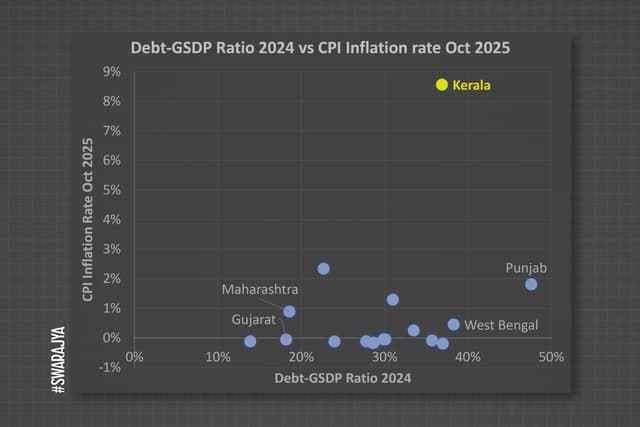
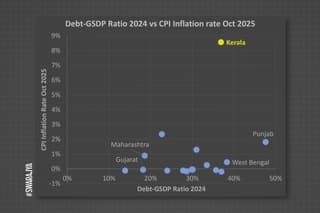
This is a vital chart because it quantifies the magnitude of the financial burden upon Kerala. At 37 per cent, the debt load is so heavy on Kerala, that there is very little left in the state treasury for capital expenditure. At the same time, in contrast to the other two worst performers, West Bengal and Punjab, a crippling inflation rate means that the Kerala government will remain painfully inclined to indulge itself in a welfarism it simply cannot afford, so as to offset rising costs and preserve its vote base.
This is suicidal economics: borrowing to repay past debts and paying for sops simultaneously, while creating fresh debts, leaving Kerala without the wherewithal to invest in revenue-generating infrastructure.
Last is a cross-plot of two other NITI Aayog metrics: the debt index of a state versus its debt sustainability in 2024. For both parameters, the lower the value, the more indebted it is, and the more incapable it is of servicing its debts.
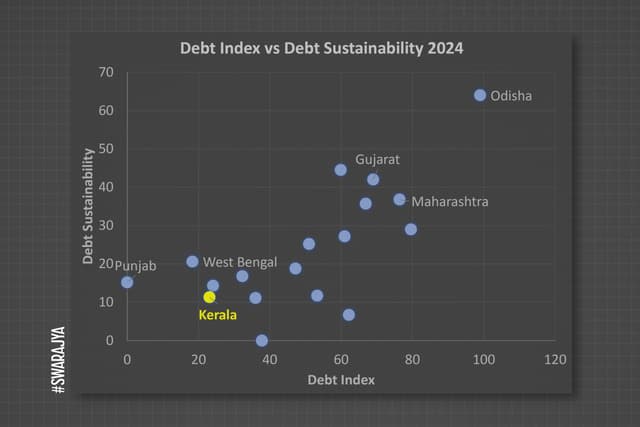

For once, Kerala is not at the bottom of the pile. For once, it can enjoy the camaraderie of other fiscal trainwrecks like West Bengal and Punjab. Pinarayi Vijayan's government may find some solace here, in a race for the wooden spoon.
To understand just how bad the financial situation is, compare Kerala with stellar performers like Maharashtra, Gujarat, and, surprise, surprise, Odisha, the leader of the pack.
Unfortunately, neither the Communists or the Congress, nor their allies, will talk about these metrics because they are jointly responsible for the mess Kerala is presently in. And if questioned, they will argue by pointing to Kerala's pole position on the human development indices rankings (HDI).
Ask them about foreign direct investment (FDI), or any private investment of any material kind in the state, and they will trot out hoary investment figures that won't stand scrutiny. This is spurious argumentation at its very worst. The mainstream media is no better in Kerala because this topic has been conveniently abjured in favour of that eternal ratings minter: political mudslinging.
Consequently, it is incumbent upon the BJP to force a narrative shift from politics to policies. People need to understand the gravity of the fiscal situation at hand, and the consequences of allowing this situation to fester any further. They have to be shaken out of their stupor (admittedly, contentment levels in Kerala are high so this will not be an easy task for the BJP). They have to understand that HDI is not equal to FDI.
Yet for all that, Malayalees are both shrewd and smart. Show them which side of their bread is buttered and they will listen. Ideally, the BJP should have brought out a white paper on the state's finances well over a year ago, followed by an exit strategy from the debt trap.
That exercise would have allowed them to present constructive criticism and options in a cogent manner to the electorate; a new narrative which stands apart from the prevailing white noise, and resonates with the people's needs.
There is still some time left. This can be done. Thus, in the final analysis, the question of whether Kerala continues to hurtle along an alarming path to fiscal Armageddon, or not, is essentially a function of when the BJP finally gets its act together.
Venu Gopal Narayanan is an independent upstream petroleum consultant who focuses on energy, geopolitics, current affairs and electoral arithmetic. He tweets at @ideorogue.
 Join our