Legal
Hooked To A Loop: Why Ilaiyaraaja's Copyright War Refuses To End
K Balakumar
Nov 28, 2025, 01:01 PM | Updated 01:01 PM IST
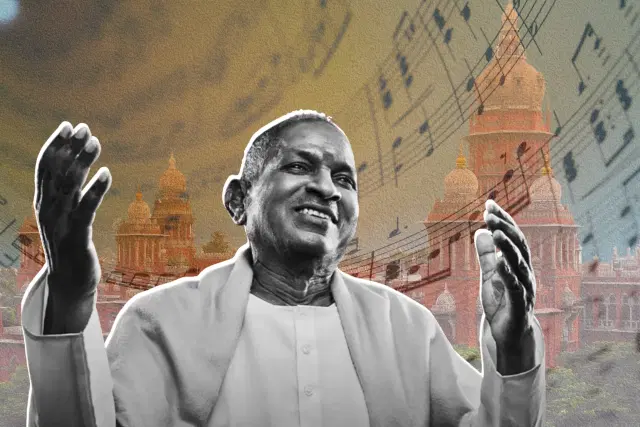
The halls of the Madras High Court (and elsewhere, too) have now become a familiar stage for a drama as compelling as any scripted for the silver screen. The protagonist is Isaignani Ilaiyaraaja, the musical titan whose compositions have defined the cinematic landscape of India for five decades. The antagonists are mostly a shifting cast of record labels, film producers, and streaming giants. The plot is a high-stakes battle for ownership and control over a treasure trove of more than 4,500 songs.
Just this week, the maestro filed a civil suit against the producers of the hit Tamil film Dude for using his compositions without permission. This latest legal salvo is a continuation of the protracted campaign that has the potential to reshape the Indian music industry's understanding of copyright. It is a battle with passionate arguments on both sides, and one that is destined to repeat itself until the central legal knot at its heart is definitively cut.
At the core of the dispute is a fundamental disagreement over who owns a film song. For decades, the industry operated on a 'work-for-hire' model. A film producer signed up a composer, paid him a lump sum, and in return, became the first owner of the copyright for every piece of music created for the film. The producer then sold these rights to audio labels (say Echo, HMV or Sony). Under this old regime, once the composer was paid, their financial claim to the work essentially ended.
Is there a legal distinction between the copyright in the final 'sound recording' and the copyright in the 'musical work'? Well, this argument got a massive boost from the Copyright (Amendment) Act of 2012. This landmark legislation was designed to protect artists, as it introduced an 'inalienable right to royalty' for authors of literary and musical works. It meant that even if a composer assigned his or her rights to a producer, he or she retained a right to receive royalties whenever their song is utilised in new ways.
The crucial, multi-crore question that remains unanswered by a higher court is whether this 2012 law applies retrospectively to agreements made in the 1970s, 80s, and 90s. Ilaiyaraaja's camp says yes, the recording companies say no.
The Case of the Composer
Ilaiyaraaja's long-running dispute is with Echo Recording Company and, through it, Sony Music and other assignees of his catalogue. Echo acquired rights from film producers to thousands of sound recordings featuring his compositions. Sony later acquired a large block of this catalogue, over 500 film albums, and has been monetising them on digital platforms and social media, and, of course, selling them to new filmmakers if they want to.
The pro side of Ilaiyaraaja's crusade is the powerful narrative of artist empowerment. His camp argues that for too long, creators were given a raw deal, paid a pittance while producers and labels reaped fortunes from their work, especially with the advent of new technologies. In the digital era, where a classic song can generate a perpetual stream of revenue on platforms like Spotify and YouTube, a one-time payment made back in, say 1985, seems woefully inadequate and unjust now.
Ilaiyaraaja's stance is that he remains the author and first owner of the underlying musical works, that labels never got a clean assignment from him personally, and that they cannot commercially exploit his compositions or greenlight re-uses without his permission and royalty. (That he was short-changed by his 'friends' to whom he gave the cassette rights in the then commercially innocent times is another story, but one which is still casting a shadow in the present case).
Ilaiyaraaja is fighting not just for money, but for the larger principle that the creator should have a say in how his or her work is used. But as of now, he seems a lone warrior taking on powerful corporate interests to establish a precedent that could benefit all creators.
The Industry's Predicament
The recording companies and producers have their line of defence.
They contend that they purchased the rights to these songs legally and in good faith, based on the laws prevalent at the time. Producers took financial risks on films, and the music rights were a key asset they relied upon to recoup their investments. To declare those decades-old contracts void or subject to new, retroactive royalty claims is seen by them as a commercial disruption that undermines the sanctity of contracts.
Another line of their argument is the 'chilling effect.' If using a classic song in a new film or a remix requires an expensive negotiation with the composer himself, many filmmakers might simply choose to avoid it. This could, paradoxically, lead to that music being heard less.
In this context, it has to be pointed out that since technically the rights of the songs are deemed to be with the labels as of now, present day producers and directors (who want to feature Ilaiyaraaja's songs in their films) have 'got' the permission from music companies rather than the maestro himself. They claim that their intention is not to bypass the composer, just that they are sticking to the law and rights as they exist on paper today.
In general, the industry argues that a stable, predictable licensing regime, which they believe they had, is essential for business. The current state of flux creates uncertainty, and that is bad for both investment and creativity.
The Never-Ending Legal Loop
In a 2019 verdict in the foundational case against a group of music labels, including Malaysia-based Agi Music, Echo Recording of Chennai, Unisys Info Solution of Andhra Pradesh and Giri Trading Company of Mumbai, a single judge of the Madras High Court recognised Ilaiyaraaja's 'special moral rights' over his melodies but stopped short of granting him full financial ownership of the sound recordings. That decision, for the record, is under appeal.
In ongoing hearings related to the appeal, the High Court has also added a new flank, by observing that while Ilaiyaraaja owns the melody rights, he may not be able to claim exclusive ownership of the entire song, as it involves other creators like lyricists and singers.
On the other side, the court has also ordered Sony Music to submit details of revenue earned from the commercial exploitation of these songs, with all future commercial transactions depending on the appeal's outcome.
The larger truth is, until a division bench of the High Court or, inevitably, the Supreme Court, delivers a final, binding judgment on the core issues, particularly the retrospective applicability of the 2012 Amendment and the precise interplay between the rights of the composer of the musical work versus the owner of the sound recording, the lawsuits will continue.
Ilaiyaraaja has made it clear he will not back down. He has the resources and the resolve to fight for what he believes is rightfully his. Therefore, every time a director decides to use a nostalgic track like Kanmani Anbodu or Vaa Vaa Pakkam Vaa in a new venture (after getting the rights from the music label or the film producer but not from him), they are effectively inviting a legal notice. The Dude case is just the latest episode in this long-running serial.
 Join our