Legal
Kesavananda Bharati: The Case That Redefined Balance Of Power In India
Kritant Mishra
Nov 08, 2025, 09:34 AM | Updated 09:34 AM IST
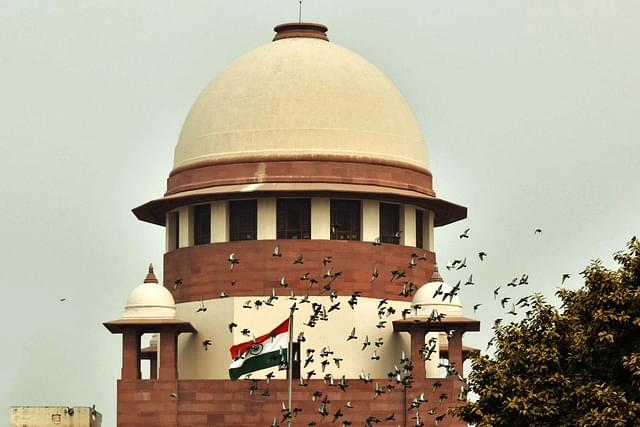
It has been more than five decades since the Supreme Court delivered its landmark judgment in the Kesavananda Bharati v. State of Kerala (1973) case, often regarded as the most monumental decision in the history of the Apex Court.
The case and its subsequent judgment continue to resonate in public discourse on constitutional jurisprudence. As such, it warrants a brief overview.
The core of the Kesavananda Bharati judgment is the “basic structure” doctrine, which posits that Parliament’s power to amend the Constitution is not unlimited. While Parliament can amend various parts of the Constitution, it cannot alter or destroy its “essential features” or “basic structure”.
This doctrine acts as a safeguard against the usurpation of the Constitution and was uniquely formulated by the Supreme Court. All constitutional amendments enacted after 24 April 1973, the date of the judgment, are subject to this “basic structure” filter.
Context and Related Cases
The judgment was delivered during the mid-1970s, against the backdrop of a power struggle between the judiciary and the legislature. The judiciary, once considered the weakest branch of the state, saw its influence profoundly transformed by this decision. It must be noted that the Kesavananda Bharati case did not arise in isolation but was the culmination of earlier conflicts over Parliament’s amending power.
Shankari Prasad v. Union of India (1951): The Supreme Court unanimously held that “constitutional law, which is made in exercise of constituent power,” was distinct from “ordinary law,” and thus constitutional amendments could not be reviewed by courts under Article 13(2), which prohibits laws abridging fundamental rights.
Sajjan Singh v. State of Rajasthan (1964): This case upheld Parliament’s right to amend fundamental rights. However, two dissenting judges expressed doubts about the Shankari Prasad view and “sowed the seeds for the basic structure doctrine” by referring to the “permanency of the basic features of the Constitution”.
I.C. Golak Nath v. State of Punjab (1967): By a narrow 6:5 majority, the Supreme Court reversed previous rulings, stating that constitutional amendments were “law” under Article 13, and therefore fundamental rights were inviolable and could not be taken away or abridged by Parliament.
The Court applied the American doctrine of “prospective overruling,” meaning its decision would apply only to future amendments. This judgment faced criticism for its reliance on political philosophy rather than legal principles.
To nullify Golak Nath, Parliament passed the Twenty-fourth Amendment Act, 1971, which inserted Article 13(4) to expressly exclude constitutional amendments from the ambit of Article 13. This was intended to restore Parliament’s unfettered power to amend the Constitution, including fundamental rights.
Additionally, the Twenty-fifth Amendment (1971) gave precedence to certain Directive Principles over fundamental rights, and the Twenty-ninth Amendment (1972) added more land reform laws to the Ninth Schedule, insulating them from judicial review.
The Petition and the Supreme Court’s Verdict
His Holiness Swami Kesavananda Bharati challenged Kerala’s land reform legislation, which affected his religious institution’s property. He also contested the constitutional validity of the Twenty-fourth, Twenty-fifth and Twenty-ninth Amendments.
The petitioners argued that Parliament could not alter the “cardinal principles” of the Constitution, while the government maintained that Parliament’s amending power under Article 368 was limitless. A thirteen-judge bench heard the case for nearly five months, the longest in the Court’s history. The judgment, almost 800 pages long, was delivered with eleven separate opinions. The majority, by a narrow 7:6 vote, made several key rulings:
The Twenty-fourth, Twenty-fifth (except for the clause ousting courts’ jurisdiction) and Twenty-ninth Amendments were held valid.
The Golak Nath judgment was overruled.
While there were no implied limitations on Parliament’s amending power under Article 368, the Court declared that Parliament could not use this power to alter or destroy the “basic structure” or essential features of the Constitution.
This doctrine empowered the Supreme Court to review and invalidate any constitutional amendment that compromised the Constitution’s fundamental features.
Defining the “Basic Structure”
There was no single, exhaustive list of what constituted the basic structure. Different judges in the majority identified various elements, often drawing from the Preamble, fundamental rights and directive principles.
According to Chief Justice Sikri, these included the supremacy of the Constitution, republican and democratic government, secular character, separation of powers and federal character.
Justices Shelat and Grover added the dignity of the individual, secured by fundamental rights, the mandate for a welfare state in the directive principles, and the unity and integrity of the nation.
Justices Hegde and Mukherjea included the sovereignty of India, democratic character, unity of the country, essential individual freedoms and the mandate for a welfare state and egalitarian society.
Justice Jagmohan Reddy’s list comprised a sovereign democratic republic, parliamentary democracy and the three organs of the state. The fluidity of this definition allows judges to interpret and mould the “basic structure” in future cases, ensuring that the “stability of basic values is tinged with a little flexibility”.
Impact and Criticism
Protection of Democracy: The Kesavananda Bharati judgment is credited with protecting the Indian state from totalitarian rule, military coups and a shift towards an overly socialist direction by ensuring that Parliament could not fundamentally change the nation’s core principles.
Judicial Supremacy: It broadened the scope of judicial review, establishing the judiciary as the ultimate arbiter of constitutional interpretation in India.
Criticisms: Critics argued that the “basic structure” doctrine is not explicitly mentioned in the Constitution and runs contrary to the original intent of its framers, with some describing it as an “attempt to rewrite the Constitution”. The judgment’s length and lack of unanimity on the definition of the basic structure also led to uncertainty and accusations of being counter-majoritarian, vesting “inordinate power” in an unelected judiciary.
Subsequent Developments
Supersession and Emergency: The immediate aftermath of the judgment saw attempts by the Indira Gandhi government to undermine judicial independence, including bypassing senior judges in Chief Justice appointments.
The subsequent Emergency (1975–1977) led to the Constitution (Thirty-ninth Amendment) Act, 1975, which sought to place the Prime Minister’s election beyond judicial scrutiny. However, the Supreme Court, even with judges who had dissented in Kesavananda, applied the basic structure doctrine to strike down this amendment in Indira Nehru Gandhi v. Raj Narain (1975).
Forty-second Amendment and Minerva Mills: The Constitution (Forty-second Amendment) Act, 1976, passed during the Emergency, attempted to nullify the basic structure doctrine. In Minerva Mills v. Union of India (1980), the Supreme Court unanimously struck down these amendments, firmly re-establishing the basic structure doctrine and the judiciary’s role in limiting Parliament’s amending power. This case marked the beginning of judicial supremacy in India.
I.R. Coelho v. State of Tamil Nadu (2007): This case further clarified that even laws placed in the Ninth Schedule, meant to be immune from judicial review, after the Kesavananda decision, would be subject to the basic structure test, particularly concerning fundamental rights.
In essence, Kesavananda Bharati v. State of Kerala (1973) fundamentally reshaped Indian constitutional law by introducing the Basic Structure Doctrine, ensuring that while the Constitution could evolve, its core identity as a democratic, republican and “secular” framework could never be dismantled by the legislative branch.
Kritant Mishra is a Public Policy Consultant and head of an NGO. He is interested in debate around the Constitution, Law, and Policy. His X Account: @YourGandhiBro
 Join our