Legal
Who Will Preside Over Speaker's Removal Proceedings? A Constitutional Lacuna No One Is Discussing
Anmol N Jain
Feb 13, 2026, 07:00 AM | Updated Feb 12, 2026, 11:53 PM IST
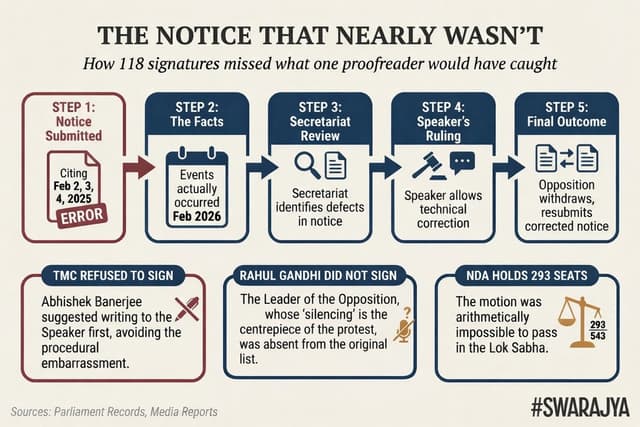
On Tuesday afternoon, 118 Members of Parliament submitted a notice to remove Lok Sabha Speaker Om Birla from office. The notice cited four incidents of alleged partisan conduct: denial of speaking time to the Leader of Opposition, suspension of eight MPs, permission for personal attacks on former Prime Ministers, and false allegations against Congress MPs. The dates cited for these incidents were February 2, 3, and 4 of 2025. The events had occurred last week, in February 2026.
The Lok Sabha Secretariat identified the defects. Under the rules, the notice could have been rejected outright; instead, Speaker Birla directed his officials to allow the opposition to correct the errors and proceed. The opposition withdrew the original notice, rectified the dates, and resubmitted.
Whether this was the result of copying from an outdated template or simple carelessness remains unclear; what is clear is that 118 signatories affixed their names without catching the error.
The Trinamool Congress, ostensibly part of the INDI Alliance, refused to sign altogether. Abhishek Banerjee had suggested the coalition write to the Speaker first and allow him time to respond before escalating; Congress ignored this.
Rahul Gandhi, the Leader of Opposition whose alleged silencing forms the centrepiece of the motion, also did not sign. Congress sources explained that it would be improper for the LoP to endorse a petition for the Speaker's removal in a parliamentary democracy. Neither the largest regional ally nor the principal aggrieved party lent their names to a motion filed on their behalf.
Birla then stepped aside from the Chair on "moral grounds," though the Constitution did not require him to do so at this stage. The discussion is now expected on 9 March, when Parliament reconvenes after recess.
A notice alleging constitutional impropriety, corrected by the very Speaker it accuses of partisanship. The date error is an embarrassment, but it is also symptomatic of a deeper pattern: an opposition that is incoherent, uncoordinated, and incapable of the basic parliamentary discipline that serious politics demands.
What has gone almost entirely unnoticed is that this motion has also exposed a constitutional lacuna that the opposition, of all parties, should have been the first to identify and press. They have not.
What's The Constitutional Lacuna
To understand the problem, one must begin with what the Constitution actually says.
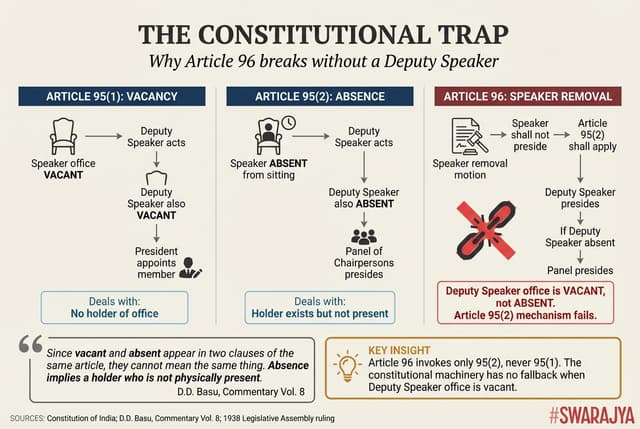
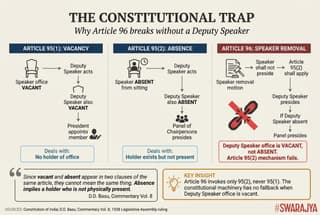
Article 96 governs proceedings when a resolution for the Speaker's removal is under consideration. Clause (1) is explicit: the Speaker "shall not, though he is present, preside." In his place, the provision states, "the provisions of clause (2) of article 95 shall apply" as if the Speaker were absent.
What does Article 95 say? It draws a careful distinction between two concepts: vacancy and absence.
Clause (1) deals with vacancy: if the Speaker's office is vacant, the Deputy Speaker performs its duties; if the Deputy Speaker's office is also vacant, the President appoints a member to act.
Clause (2) deals with absence: if the Speaker is absent from a sitting, the Deputy Speaker acts; if the Deputy Speaker is also absent, a person determined by the rules of procedure presides. This is usually someone from the Panel of Chairpersons, a group of members nominated by the Speaker under Rule 9 to preside over sittings when needed.
This distinction is critical. Article 96 invokes only Clause (2) of Article 95, not Clause (1). It treats the Speaker's recusal during a removal motion as equivalent to absence, not vacancy.
The chain Article 96 contemplates for a Speaker's removal is therefore straightforward: the Deputy Speaker presides; if the Deputy Speaker is absent, the Panel of Chairpersons presides.
But the Deputy Speaker's office is not merely absent. It is vacant. It has been vacant since mid-2019, when M. Thambidurai's term ended with the 16th Lok Sabha. The entire 17th Lok Sabha, five full years, had no Deputy Speaker. The 18th Lok Sabha, constituted in June 2024, has continued the pattern. The post has now been vacant for nearly seven years.
D.D. Basu, India's preeminent constitutional commentator, addressed precisely this distinction in Volume 8 of his Commentary on the Constitution of India. His reasoning was clear: since vacant and absent appear in two clauses of the same article, they cannot and do not mean the same thing. Absence implies that there is a holder of the office who is not physically present; when there is no Deputy Speaker at all, it cannot be said the Deputy Speaker is absent.
A 1938 Legislative Assembly ruling he cited confirmed that "absence means physical absence from the House."
The implication creates a constitutional grey zone. If Basu's interpretation holds, the Panel of Chairpersons cannot constitutionally preside when the Deputy Speaker's office is vacant. Multiple parliamentary references state this clearly: "A member of the Panel of Chairpersons cannot preside over the House when the office of the Speaker or the Deputy Speaker is vacant."
In such cases, the President must appoint a member to perform the Speaker's duties under Article 95(1). The problem is simple: Article 96 points to Article 95(2), a provision designed for absence, not vacancy. It assumes a Deputy Speaker exists. When none does, 95(2) simply has nothing to offer. The mechanism does not function.
A First
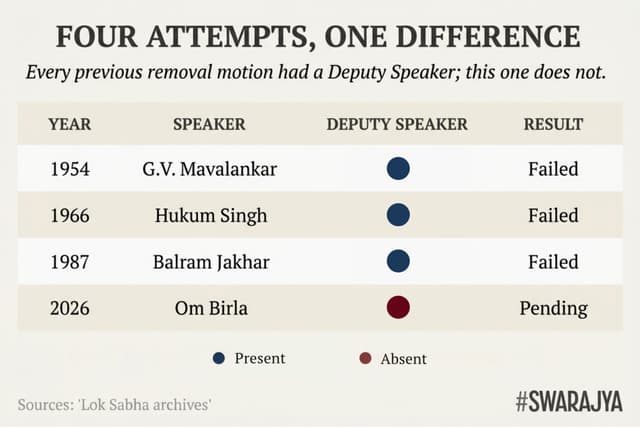
This scenario is unprecedented. Three previous Speaker removal attempts (against G.V. Mavalankar in 1954, Hukum Singh in 1966, and Balram Jakhar in 1987) all occurred when a Deputy Speaker was in office. None succeeded, but the procedural machinery was intact. This is the first time a Speaker removal motion has coincided with a vacant Deputy Speaker's office.
In practice, a member of the Panel of Chairpersons is occupying the Chair. The Lok Sabha Secretariat is proceeding as if Article 95(2) operates normally.
The motion will come up on 9 March, be debated, and almost certainly fail on numbers: the NDA holds 293 seats, and the motion requires an effective majority. Who presides on that day remains to be seen, but the constitutional basis for the Panel presiding over a Speaker removal motion when the Deputy Speaker's office is vacant is, at minimum, contestable.
A Rudderless Opposition?
Now, the opposition has had one significant opportunity to force this issue. In June 2024, when the 18th Lok Sabha convened, Defence Minister Rajnath Singh called Congress President Mallikarjun Kharge seeking support for Om Birla's re-election as Speaker. Kharge offered to support Birla on one condition: a commitment to give the Deputy Speaker's post to the opposition, per longstanding convention. Rajnath Singh said he would call back. He did not.
The opposition's response was to field K. Suresh against Birla for the Speakership itself, forcing the first contested Speaker election since 1976. Birla won. The Deputy Speaker's post remained unfilled. The opposition abandoned the issue.
No formal motion demanding the Deputy Speaker election was ever moved on the floor. The Supreme Court PIL challenging the vacancy, Shariq Ahmed v. Union of India, was filed by a Supreme Court advocate, not by any opposition party or MP; it has been pending since 2023 with no final judgment. The issue surfaced periodically in statements and press conferences, then faded.
The opposition found time to disrupt Parliament over Manipur, insisting the Prime Minister personally make a statement even after the government offered a discussion with the Home Minister replying. They stalled proceedings over Pegasus, the Adani indictment, the concocted Amit Shah–Ambedkar controversy, among others. But they did not find the time or the strategic sense to secure a constitutional office that has been vacant for seven years.
Now they have filed a motion that triggers Article 96, which contemplates a Deputy Speaker presiding. There is none. Someone from the Panel of Chairpersons may preside instead, under a constitutional interpretation that is questionable.
The opposition could have seized on this. They could have argued that the ruling party's refusal to elect a Deputy Speaker for seven years has created unprecedented constitutional ambiguity. They could have turned the government's procedural intransigence against it.
They have done none of this.
What Now?
The motion will fail. No Speaker has ever been removed through this process, and the NDA's majority makes the outcome arithmetically certain.
But buried in this episode is a constitutional paradox that deserves attention independent of political theatre. Article 96 contemplates a Deputy Speaker. Article 93 mandates the House elect one "as soon as may be." Rule 8 of the Rules of Procedure and Conduct of Business in Lok Sabha gives the Speaker the power to fix the date for that election. For seven years, that did not happen.
Both sides have treated the post as a bargaining chip rather than a constitutional office: the opposition wanted it but never made it non-negotiable; the ruling party withheld it because it could.
Now the machinery of Article 96 is being tested in conditions its drafters never anticipated. A Panel member nominated by the very Speaker facing removal may well preside over proceedings to remove him.
An opposition that cannot proofread a notice, cannot coordinate signatures across its own alliance, and cannot agree on whether the Leader of Opposition should sign a motion about his own silencing, has triggered a constitutional question it does not seem to know exists. The ruling party, which has refused to hold a Deputy Speaker election for seven years, stands to benefit from that very vacancy.
Both sides will move on after 9 March. The constitutional gap will remain.
Anmol N Jain is a writer and lawyer with a background in International Relations, Political Science, and Economics. He posts on X at @teanmol.
 Join our