Newsletters
India Has A Boutique Military In An Industrial-Warfare World
Swarajya Staff
Mar 09, 2026, 05:50 PM | Updated 05:50 PM IST
The Gap Remains
When India launched Operation Sindoor, deploying cruise missiles, ballistic missiles, hypersonics, and Israeli-built loitering munitions against Pakistani targets, the results were impressive enough to reshape the way Delhi talks about war. The strikes were precise, the escalation was controlled, and the message, that India could impose punishment at range without mass mobilisation, was received clearly in Islamabad and beyond.
Lieutenant General Adosh Kumar, the Director General of Artillery, spoke late last year of long-range precision strikes creating "devastating effects," and the institutional consensus that followed was easy to read: non-contact warfare, in India's telling, had arrived as doctrine.
Against Pakistan, this confidence is not misplaced.
A nuclear dyad constrains full-scale war but does not eliminate the appetite for retaliation, and stand-off strike gives Indian policymakers something they have long lacked, which is the flexibility to punish the Pakistan Army below the nuclear threshold, with small strike packages, brief exchanges, and an escalation ladder whose rungs are reasonably well understood. A handful of precision systems can do the job without depleting India's stockpiles, and in a confined problem of this kind, precision at range is genuinely preferable to attrition at contact.
The trouble is that India's defence establishment appears to be universalising a lesson that is, in reality, Pakistan-specific. The adversary that actually threatens India's territorial integrity is not Pakistan but China, against whom the elegant architecture of non-contact warfare would become brittle almost immediately.
China is not a "peer competitor" in the comforting sense that implies rough symmetry. The People's Liberation Army Rocket Force fields an enormous arsenal of ballistic, cruise, and hypersonic missiles, backed by hardened launch infrastructure, distributed production facilities, and an industrial base embedded within the world's largest manufacturing economy.
In missile inventories, manufacturing scale, air-defence layering, and the capacity for industrial mobilisation, Beijing operates at a level that dwarfs India's by an order of magnitude that is difficult to close and easy to underestimate.
A confrontation with China, unlike a punitive exchange with Pakistan, would not consist of symbolic salvos across a managed escalation ladder. Beijing has the capacity to target airbases, logistics hubs, ports, and command nodes across India's strategic depth simultaneously, layering missile fire with cyber operations, space denial, and electronic warfare.
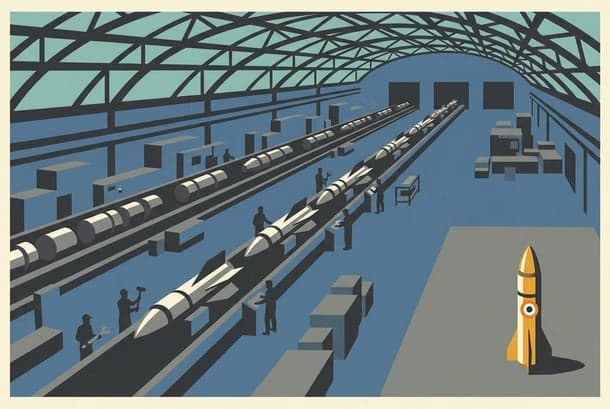
A stand-off exchange of this kind would be not a demonstration but a war of attrition, and wars of attrition are won not by the side with the better missile but by the side that can replace the ones already fired. India, as things stand, cannot. What it does is buy a few dozen of each type at a time, and even when procurement comes from domestic suppliers, numbers stay modest, producing capability without mass, and deterrence by demonstration rather than by depth.
The evidence from the Gulf
That this is not an abstract concern has been made painfully visible in the skies over West Asia, where the arithmetic of stand-off warfare is being stress-tested in real time.
As Iranian ballistic missiles arc across the Gulf, Israel and the United States are carrying out sustained air strikes on Iranian military assets, leadership, and nuclear infrastructure, while Tehran responds with salvos of hundreds of missiles and Shahed drones, relying on range and volume to impose costs in return. The question these exchanges expose is not who fires first but who can keep firing after the first week, and the second, and the third.
Iran can sustain this tempo because it had, over the preceding decades, built the capacity to manufacture ballistic missiles in quantity and stockpile them in the thousands. In the last decade alone, Tehran expanded that base to mass-produce the Shahed-series drones, the same loitering munitions Russia began acquiring for use in Ukraine, and the same systems now striking buildings in Dubai and Abu Dhabi.
The Shahed is not a sophisticated weapon, but it represents something India has not yet achieved. It is a product of sustained, industrial-scale preparation that allows a mid-ranking power to field large numbers of indigenous, inexpensive, mass-produced systems against far wealthier adversaries. India, by contrast, deployed Israeli-built Harop and Harpy munitions during Sindoor. These were very effective, but they constitute borrowed depth rather than organic depth.
Israel can intercept many of Iran's weapons because it invested heavily in layered air defence and enjoys deep stockpiling and replenishment support from the United States, whose defence-industrial base is rivalled only by China's. Yet even the Americans and Israelis are discovering how quickly inventories drain in a high-tempo missile war.
Iranian barrages have forced allied air defences to expend large numbers of high-end interceptors, like Patriot, SM-3, THAAD systems, that are produced in relatively small numbers each year. If the current rate continues, stocks of some could begin running dangerously low within weeks, forcing difficult choices about deployment priorities.
If the world's most capable military powers find themselves running into magazine-depth constraints after a few weeks of sustained exchange, the implications for India, which has not even begun to build inventories at comparable scale, ought to concentrate minds in Delhi.
Why India cannot surge
A doctrine built on non-contact punishment presumes survivable launch platforms, resilient command-and-control, sufficient inventory to withstand counter-strikes, and most critically, industrial capacity to replenish rapidly. India meets almost none of these conditions against China, and the reasons are structural rather than incidental.
Defence manufacturing in India remains hostage to a procurement culture that seems almost designed to prevent scale. Orders are episodic, trials stretch on for years and sometimes decades, and even successful platforms are inducted in modest numbers.
When a domestic manufacturer cannot predict whether it will receive 40 units, 400 units, or none at all, it has little incentive to invest in the large production lines, supplier ecosystems, and parallel capacity that would only make economic sense at volume. The result is a system optimised for prototypes and limited series production rather than for wartime surge.
This is compounded by a longstanding preference for the best over adequate. When foreign-designed systems that have been through multiple upgrade cycles are chosen over Indian-built platforms that may not be flawless on day one, the long-term consequence is structural dependence.
India assembles sophisticated weapons in limited numbers without ownership of the critical subsystems, like engines, seekers, propulsion units, advanced electronics, that remain with original equipment manufacturers and their overseas supply chains. In peacetime, this model delivers capability. In wartime, it constrains surge, because production cannot simply be scaled up when the most sensitive components are controlled abroad and subject to external priorities or export controls.
Even when the prime contract goes to an Indian entity, a significant share of value addition often flows back to the foreign OEM, confining the domestic role to integration rather than full-spectrum manufacturing and limiting the accumulation of design experience, supplier networks, and process engineering that are precisely the ingredients required for rapid expansion under wartime conditions.
The idea of an Integrated Rocket Force, first proposed by the late Chief of Defence Staff, General Bipin Rawat, was meant to place India's conventional long-range strike systems, including Pralay ballistic missiles, BrahMos and Nirbhay cruise missiles, and long-range Pinaka rocket artillery, under a single tri-service command capable of launching large, coordinated salvos in the way the Strategic Forces Command concentrates nuclear deterrence. The concept made strategic sense, but the force itself has not materialised, the systems exist only in modest numbers, and the missile inventories that would give such a command real weight have yet to emerge.
There is also the problem of adaptation speed, which may matter more than any single procurement decision. Modern wars evolve faster than budget cycles, as the Ukraine conflict has demonstrated with uncomfortable clarity.
Electronic warfare initially proved highly effective at jamming radio-controlled drones, knocking large numbers out of the sky, but Russian units responded by introducing fibre-optic controlled FPV drones, carrying a spool of cable linking drone to operator and rendering the signal immune to jamming even in heavily contested electronic environments. The system, first deployed around 2024, spread rapidly across the battlefield and forced Ukrainian forces to rethink both drone operations and countermeasures.
This kind of rapid iteration is possible only when an industrial ecosystem exists that can manufacture, test, fail, revise, and manufacture again at a tempo that matches the war rather than the annual defence estimates, and it is built not by sporadic assembly contracts but by sustained demand, iterative upgrades, and a willingness to absorb imperfection in early production blocks while domestic firms climb the learning curve.
The distance that remains
Non-contact warfare is not a substitute for strategy but an instrument within it. Precision strike can shape a battlefield, punish an adversary, and buy time for diplomacy, but it cannot on its own hold territory, sustain a prolonged campaign, or compel a determined enemy to change course. Against Pakistan, stand-off strikes can achieve India's political and military objectives because the problem is confined, the exchanges are brief, and the inventory demands are modest. Against China, they cannot.
Operation Sindoor proved that India can deliver precision punishment, and the distance between that achievement and the capacity to sustain a high-intensity conflict against a major power is measured not in technology, where India has made genuine advances, but in industrial depth, where the gap remains vast.
Nothing in India's current manufacturing base, procurement culture, or force structure suggests it is ready for the kind of sustained, high-volume confrontation that a war with Beijing would demand. A few dozen of each system constitute a boutique, and in an industrial-warfare world, boutiques, however elegantly stocked, do not survive.
 Join our