Everyone has a kamikaze drone... except India

The United States is now striking Iran with a weapon that is modelled on a system Iran originally developed itself. Last week, America debuted its LUCAS kamikaze drones, or the Low-cost Unmanned Combat Attack System, during Operation Epic Fury, the ongoing joint US-Israeli operation against Iran.
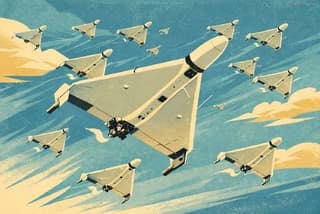
LUCAS is modelled on the Shahed-136, Iran's cheap, expendable, delta-wing one-way attack drone that has altered the cost calculus of air warfare. The US military reverse-engineered a captured Shahed, worked with American defence startups, and produced a clone at roughly $35,000 a unit.
Kamikaze drones, also called loitering munitions or one-way attack drones, are essentially guided munitions with wings. They fly to a target area, loiter if needed, then dive into the target and detonate. Unlike conventional drones, they don't come back. Think of them as cruise missiles that cost a fraction of the price and can, because of their low cost and low sophistication, be fielded in the hundreds or thousands.
The Russia-Ukraine war turned this concept into the defining weapon of modern conflict. Ukraine demonstrated that swarms of cheap drones could neutralise tanks, artillery, command posts, and supply lines. The lesson was stark. In a prolonged conflict, the side that can produce and expend more cheap precision-strike platforms faster wins. Expensive, exquisite systems run out. Affordable mass endures.
No weapon embodies this logic better than Iran's Shahed-136.
Powered by a 50-horsepower engine, with a range of 2,000 kilometres and a 40-kilogram warhead, the Shahed is not sophisticated. It navigates using inertial guidance and GPS to hit pre-programmed targets.
What makes it fearsome is its economics. Each unit costs an estimated $20,000 to $50,000, a rounding error compared to a cruise missile. Iran has also kept iterating on the original platform, improving it considerably over the last few years. The newer Shahed-238 adds jet propulsion and radar-guided seekers, evolving from a dumb munition toward increasingly dynamic targeting.
It proved so potent that even Russia purchased thousands Shaheed drones for use in Ukraine and now manufactures its own variant, the Geran-2.
Even a major military power with its own defence-industrial complex chose to license and copy Iran's design rather than reinvent the wheel.
India, meanwhile, has been doing something quite different.
During Operation Sindoor in May 2025, India deployed loitering munitions...
 Join our