Newsletters
Yogi's New Normal For UP: Factionalism Isn't The News, Stability Is
Swarajya Staff
Feb 20, 2026, 12:23 PM | Updated 12:23 PM IST
Every UP CM over past three decades left either diminished or toppled from within
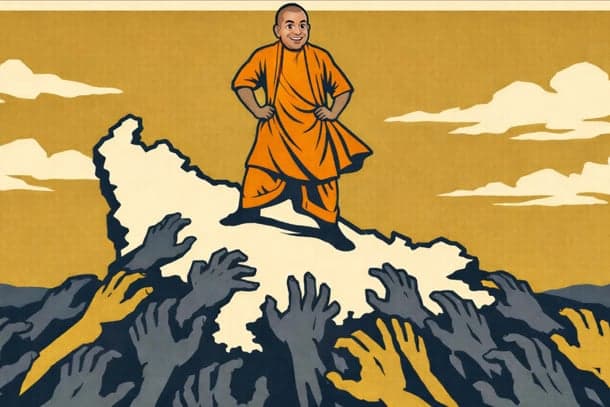
In December 2025, around 52 MLAs and MLCs of the Bharatiya Janata Party (BJP) in Uttar Pradesh, all belonging to the Brahmin community, gathered for a separate meeting in Lucknow. Incidentally, this happened shortly after the appointment of Pankaj Chaudhary as state BJP president.
Earlier in the year, BJP MLAs belonging to the Rajput, Kurmi, and Lodh communities had also hosted similar events.
The "Brahmin MLA dinner meet" happened days after the state unit of the party went through the SIR test. Following a smoothly conducted SIR in Bihar, the BJP was expecting a similar process in Uttar Pradesh as well. The proceedings were anything but.
It took constant reminders and exhortations by leaders as senior as Yogi Adityanath, then BJP president J.P. Nadda, and National General Secretary (Organisation) B.L. Santhosh to get the cadre up and running for the SIR. This, in a party known for its organisational discipline and efficiency.
Earlier, a post-mortem of the BJP's less-than-expected 2024 Lok Sabha performance in UP found alleged "sabotage by MLAs and ministers," a "lack of synergy between government and party," and widespread discontent among workers who felt ignored by their own government.
These stories added to the steadily-growing buzz and speculations around "factionalism" in the Uttar Pradesh BJP. Observers and commentators alike wondered whether Yogi Adityanath's grip was loosening.
But by the standards of UP's political history, what we're witnessing isn't instability. It's a near-miracle of cohesion.
Uttar Pradesh Doesn't Do Stability
Uttar Pradesh doesn't do stability. It does churn. Over the past three decades, every chief minister who entered office with a strong mandate left diminished, besieged from within, or toppled outright. Factionalism isn't a bug in UP politics; it's the operating system.
The state's sheer scale, its caste fragmentation, and its 24 crore people create a gravitational pull toward fracture. Hard-won stability withers within a short period. Coalitions collapse, both of parties and of communities supporting a party. Loyalties dissolve.
To be sure, Yogi Adityanath hasn't eliminated this dynamic. But to understand how extraordinary even that is, you need to see what UP normally does to its leaders.
Let's start from the most recent examples and go backwards in time.
The Yadav Civil War (2012–2017)
Akhilesh Yadav's government should have been a cakewalk. In 2012, the Samajwadi Party won 224 seats, a landslide in a 403-seat assembly. Akhilesh Yadav was young, without any baggage, and backed by his father Mulayam Singh Yadav's formidable political machinery. For two years, it worked.
Then the cracks appeared.
By 2014, Akhilesh's uncle Shivpal Yadav, who was officially a cabinet minister, unofficially the party's chief executive, and increasingly resentful of his nephew, began acting as a parallel power centre. Decisions made in the Chief Minister's office were reversed in party headquarters. Transfers were countermanded. Shivpal controlled candidate selection; Akhilesh controlled governance. The SP had two heads, and neither would bend.
By 2016, the conflict escalated. Akhilesh expelled Shivpal loyalists. Mulayam publicly rebuked his son. For months, Uttar Pradesh had a chief minister and a chief minister-in-waiting from the same family, at war.
In 2017, the SP was routed, its tally decreasing by 122 seats.
The Bureaucratic Freeze (2007–2012)
Mayawati's fourth term as chief minister started (2007) with 206 seats, her first-ever majority. For a Dalit leader who'd spent two decades navigating unstable coalitions, it should have been liberation. Instead, a new problem presented itself.
Mayawati's signature move was the bureaucratic reshuffle. Officers were transferred so frequently that the administrative machinery seized up. District magistrates, police superintendents, and secretaries rotated in and out at dizzying speed. The ostensible reason was preventing corruption and ensuring loyalty. The real reason: Mayawati trusted no one.
Her previous governments (1995, 1997, 2002) had all been coalition arrangements, fragile and short-lived. Each time, allies defected, partners betrayed, and power slipped away. So when she finally governed alone, she didn't delegate; she micromanaged.
The result was administrative gridlock.
In 2012, the BSP lost 80 seats from its 2007 tally of 206. Mayawati hasn't returned to power since.
Mulayam's Second-Term Fade (2003–2007)
Mulayam Singh Yadav's 2003 victory was supposed to be his coronation. He'd been chief minister before (1989–1991, 1993–1995), but always in coalitions, always constrained. This time, the SP won 143 seats and cobbled together a workable majority.
From the start though, factions emerged. Not ideological, but transactional. Different ministers controlled different revenue streams. The Public Works Department had one power centre. The police had another. Urban Development a third. Each operated semi-autonomously, distributing patronage to their own networks.
It worked, but it was exhausting and expensive. By 2007, the machine was running on fumes. The SP won just 97 seats.
The lesson: even a seasoned player like Mulayam, arguably UP's most skilled politician of the past 30 years, couldn't escape the decay curve and became another example of the principle that power in UP has a half-life.
Another feature common to all three governments above was that in each case, anti-incumbency had already crossed the threshold from manageable dissatisfaction to serious public resentment well before polling day at the end of their tenures.
The Pattern Holds
You could go further back. Kalyan Singh's 1997–1999 government first saw withdrawal of support by the BSP and then a complex order of defections of MLAs, dismissal of government, Jagdambika Pal (then in Congress) as chief minister for a day, and reinstatement of the BJP government by the Allahabad High Court.
Ram Prakash Gupta's government (1998–1999) was a study in managed chaos.
Rajnath Singh was CM for around 16 months before BJP lost power in the Assembly elections of 2002.
The pattern is consistent. Political stability in Uttar Pradesh was almost impossible.
The caste arithmetic is complex. Regional bosses are entrenched. Electoral trade-offs are too many to keep track of and too granular. Every government, by virtue of being in a majority in the Assembly, becomes a coalition of micro-interests, and those coalitions are inherently unstable.
So What Makes Yogi Different?
Yogi Adityanath has now been chief minister for almost nine years. The BJP on its own won 312 seats in 2017 and 255 in 2022, both massive mandates. His government hasn't faced a rebellion, a cabinet revolt, or a serious challenge to his authority. Ministers who were sidelined stayed quiet. Most MLAs who felt ignored didn't defect (the ones who did could hardly damage the party). The BJP's organisational discipline held.
This is historically unprecedented.
Part of it is ideology. Hindutva, as a consolidating force, transcends caste in ways that SP's Yadav politics or BSP's Dalit mobilisation never could. The BJP's Hindu vote isn't perfectly unified, but until now it's cohesive enough to override some of UP's traditional fault lines.
Part of it is the RSS. Unlike the SP's family structure or the BSP's unitary command, the BJP has an external disciplining mechanism. The Sangh arbitrates disputes, enforces silence, and prevents open revolt. Factionalism exists (it always does in UP) but it's contained within organisational channels.
Part of it is Yogi himself. His elevation to the chief minister's post left many begrudging, but his popularity among the cadre and the voters ensured that those disgruntled did not come out against him in the open.
And part of it is simply luck and timing. Yogi's tenure has coincided with the Modi-Shah era's peak dominance nationally. The BJP's institutional strength at the centre reinforced Lucknow. Local dissent had nowhere to go.
But the Gravity Hasn't Disappeared
Which brings us to 2025. The murmurs of discontent, MLAs meeting in caste groups, BJP workers complaining they're ignored by their own government, aren't aberrations. They're UP reasserting its baseline.
The remarkable thing isn't that this is happening. It's that it's happening so gently. There's been no cabinet revolt. No public mutiny.
The appointment of Pankaj Chaudhary as state BJP president, widely seen as the Centre's choice to oversee party matters in the state, was absorbed without open confrontation. Almost every second MLA is reportedly nursing a grudge, yet no one is leaving the camp or attempting a coup.
This is unprecedented even if compared to the conduct of the previous national behemoth, the Congress. Chandra Bhanu Gupta was amongst the most important leaders of the party in Uttar Pradesh post-Independence. He took the oath of the chief minister's office four times. Yet, such was the jostling in the Congress that even across four terms, he could not complete an aggregate of five years as the chief minister.
By UP's standards, Yogi's BJP is still disciplined.
The real test thus isn't whether factionalism exists. It always will. The test is whether it's manageable. Can dissent be vented without rupturing the social coalition that the party leadership and organisation has painstakingly stitched together since 2014? Can rival camps coexist without undermining cohesion? Can Yogi keep the delicate balance without tipping over?
These are new questions for UP politics. Previous chief ministers never got to ask them because they never got this far.
 Join our