Obit
A Quiet Giant Departs: Arunachalam Vellayan And The Last Of Old School Chettiars
K Balakumar
Nov 18, 2025, 12:39 PM | Updated Nov 21, 2025, 10:37 PM IST
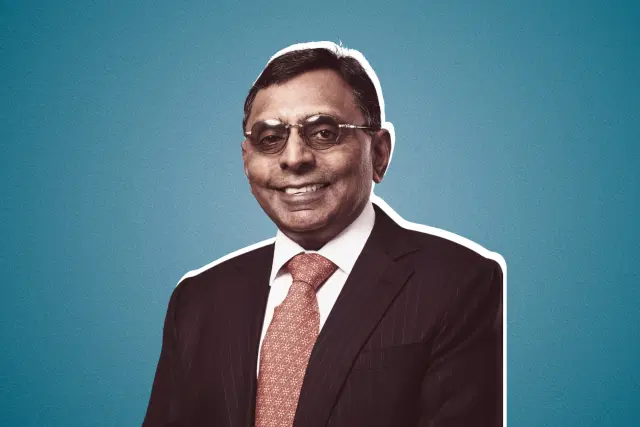
Writing about Arunachalam Vellayan, who passed away on 17 November 2025 in Chennai after a brief illness, is a tough task, as one has to make sense of the contrast that he and his business empire represented.
Here was a man who helmed businesses worth billions, who sat at the top of one of India’s most respected conglomerates (Forbes has his group at 33 among the richest ones in India), and yet was most comfortable in embracing relative anonymity.
In an age where industrialists court Instagram fame, TED talks, and television panels as eagerly as market share, Vellayan belonged to the vanishing tribe of those who believed that business was work, not a personal brand. The ones who let balance sheets, not Twitter timelines, do the talking.
With his passing at 72, a gentle but firm chapter in the Murugappa story has closed. And with it, perhaps, the wider legacy of the old Chettinad way of business.
A legacy begun in Burma, nurtured in Madras
The Murugappa saga began in an unlikely place. Rangoon, where Dewan Bahadur AM Murugappa Chettiar started a money-lending firm in 1900. When the family moved back to India in 1935 ahead of the Japanese invasion, they brought with them the capital and commercial instincts of the Chettiars, a community whose numerical modesty belies the scale of their financial imprint on South and Southeast Asia.
A Vellayan was born in 1953 (9 January) into this lineage, the son of M.V. Arunachalam and grandson of the founder. His name belonged to that peculiar Chettiar tradition of recycling initials and family markers, a kind of closed-circle nomenclature that confounds outsiders but reinforces continuity within (for instance one of the sons of AM Murugappa Chettiar was, wait for it, AMM Murugappa Chettiar).
Over eight decades, the family built a sprawling group that now comprises 29 businesses, nine listed companies and a roster of brands that are woven into everyday Indian life. BSA, Hercules, Parry’s, Chola, Shanthi Gears, among many others. Over 60,000 employees work across sectors as diverse as bicycles and abrasives, auto components and farm inputs, sugar and nutraceuticals.
Yet, the Murugappas never behaved like the 9 billion dollar revenue powerhouse. No splashy parties in five-star hotels. No PR blitzkrieg. They remained anchored to Dare House, the iconic art deco building at the eponymous Parry’s Corner, a structure that itself feels like a metaphor for the group. Quietly elegant, rooted in history and refusing to chase fashion.
It was an ethos that Vellayan and the rest of the family believed firmly in.
The making of a modern scion
If the Chettinad community was known for its conservatism, young Vellayan's education was an unlikely mix. He went to The Doon School, acquiring a polish and perspective uncommon among Chennai industrial families of his generation. His college years at Shri Ram College of Commerce, New Delhi, and later at Aston University and Warwick Business School, gave him a global view of manufacturing and markets.
It is said that when his father was president of FICCI, he struggled to follow boardroom conversations conducted entirely in Hindi by North Indian business barons. Determined his children should not face that handicap, he sent Vellayan north, making him one of the rare Tamil industrialists fluent in Hindi.
It was this blend (Doon School crispness, northern cultural comfort, Chettinad conservatism and British business education) that shaped the Vellayan style, which was eclectic, worldly but always grounded.
In his decades across the group, Vellayan wore multiple hats (Chairman of Coromandel International, Chairman of EID Parry, board member across the group’s principal companies and later Chairman of the Board of Governors of IIM Kozhikode).
He was known among peers for a calm, unflappable manner, the kind that made difficult decisions seem almost gentle. Nowhere was this more evident than in the emotionally fraught sale of Parryware, one of the group’s oldest consumer brands. But Vellayan’s thinking was clear-eyed. The joint venture with Spain's Roca in 2006, and the eventual full exit in 2010, had his stamp. As he liked to say, "We are not emotionally attached to our businesses." It was not a line that emerged out of dispassion, but it was a result of innate discipline.
Sportsman, bon vivant, Madras man
For all his corporate sobriety, Vellayan had an unexpectedly warm personal life. He loved food and he adored sport. Prior to Doon School, he went to Chennai's Don Bosco, where one of his schoolmates was the great Vijay Amritraj. Their friendship remained intact across decades. When the Amritraj-backed ATP tournament in Chennai ran into sponsorship trouble after the Tatas pulled out, it was Vellayan who helped rescue it, working phones and contacts to stitch together government and corporate support.
Vellayan's love for hockey was equally enduring. The Murugappa Gold Cup, one of India’s oldest tournaments, owes much of its continuity and prestige to his quiet patronage. He belonged to an earlier Madras, where friendships lasted fifty years, where loyalties were not transactional, where sport was not a networking tool but a simple joy.
The storms in his life
It is impossible to tell his story without acknowledging the turbulence. In 2015, Vellayan was named in an insider trading notice related to Coromandel’s acquisition of Sabero Organics.
It was a bruising episode, personally painful and publicly difficult. True to Murugappa tradition, he stepped down from his chairmanship roles to protect the group from reputational drag. He cooperated, fought his case and defended his integrity. And though the cloud eventually passed, it left its mark on him, on the group and on his health. (He did resume duties as the Chairman of the Group in 2018, but within weeks he retired as he turned 65, the age of superannuation in the group management.)
The thing is, even in adversity, he did not lash out, give interviews or wage media battles. That restraint, that refusal to perform pain for cameras, was vintage Vellayan.
If the SEBI case shook the group, the storm that followed was even more destabilising. In 2020, a long-suppressed grievance, the demand for board representation by Valli Arunachalam (daughter of the late M V Murugappan) exploded into the public. It was as much an issue of inheritance as it was of gender justice. For a group that had prided itself on settling matters quietly within the family, the very spectacle of the feud was devastating.
A settlement was eventually reached, but by then, the strain had seeped into every branch of the sprawling family tree. In recent years, the group is said to be working toward a formal division among the families. This is a far cry from the once seamless collective identity.
Vellayan, already battling health complications, bore the emotional weight of this upheaval. Those close to him say these years aged him more than any in his professional life.
Farewell to a vanishing tribe
What remains remarkable about Vellayan is not any single achievement, though there are many, but his mode of leadership. Where modern corporate India celebrates visionary disrupters, Vellayan valued unglamorous virtues. He represented the Chettinad business archetype of an understated, analytical and frugal approach. It is a model that built half of Tamil Nadu’s industrial base.
Vellayan is survived by his wife Lalitha, sons Arun and Narayanan, and grandchildren. His passing is not merely the departure of a patriarch. It feels like the fading of an entire species of Indian business leaders.
The Murugappa Group will endure, evolve and continue to grow. But its last great link to the soft-spoken old guard has now been severed. For a man who spent his life avoiding the spotlight, the void he leaves behind is unexpectedly large.
And that may be the truest measure of Arunachalam Vellayan.
 Join our