Obit
The Man Who Put 'Idhayam' in Tamil Kitchens Is No More
K Balakumar
Mar 05, 2026, 11:12 AM | Updated 11:12 AM IST
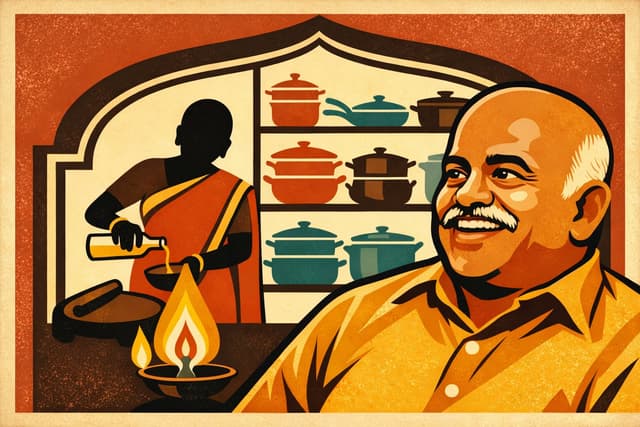
On 14 January 1987, when Doordarshan's Tamil channel flickered to life from the newly installed Kodaikanal tower, a young actress named Chitra appeared on screen in a simple, conversational commercial. She told her husband, half-playful and half-firm: "I didn't ask you to cook or wash clothes. I only asked you to buy Idhayam Gingelly Oil." When he wondered what was so special, she smiled and declared, "This is a ladies' subject. Why don't you just go, get it?"
It was a modest advertisement. But it marked the birth of a brand that would seep into Tamil Nadu's kitchens and consciousness, and later across other states too. Behind that moment stood V R Muthu, who passed away today at 73, a low-key industrialist who preferred that his oil brand speak louder than he ever did.
Under Muthu's helm, Idhayam grew to commanding heights, dominating the branded sesame oil market nationally and holding a formidable groundnut oil share in Tamil Nadu. Yet the man himself rarely occupied headlines. Even his role as an independent director at Hatsun Agro Product, another successful company from Tamil Nadu, reflected the same quiet credibility.
The Nadar Spirit
To understand Muthu is to understand the industriousness of the Nadar community and the unpretentious town of Virudhunagar. The Nadars are a community that rewrote its own destiny over a century. From marginalised palm-climbers to dominant traders and industrialists, they have built schools, banks, and distribution networks, and dominate the trading and kirana shop segment in Tamil Nadu. They are now moving forward in industries too.
Like many Nadars of southern Tamil Nadu, Muthu's forebears had sought fortune in Rangoon, Burma (now Yangon, Myanmar), engaging in commission and trading businesses in the early decades of the twentieth century. But World War II in the 1940s forced them to flee back to India. While the British government allowed refugees to skip income tax due to lost records, Muthu's elders voluntarily declared their Rangoon earnings and paid their dues. This was an anecdote Muthu never stopped narrating, and it underlined that ethics mattered to him and his family in business.
It was this DNA of truth and hard work that transformed them from commission agents into manufacturers. The shift into oil manufacture was almost accidental. A major client, an oil producer, faced financial ruin, and Muthu's grandfather and others in the family stepped in to vertically integrate.
The Thrifty Visionary
Born in 1953, Muthu was a product of a unique upbringing characterised by extreme thrift and high ambition. As a child, he once asked his father to "stop the motor" at the famed Courtallam falls to save water, not realising it was a natural waterfall. He was the kind of boy who asked for a tuition fee discount when the teacher took a day off. These kinds of anecdotes would elicit heavy trolling in this social media age, but they reveal his early mindset.
As he would later recount, his childhood was steeped in frugality. Money was not to be spent lightly. Even in prosperity, the habits of thrift endured, and this meant that even as the company grew, it remained careful in inventory management, cautious in expansion, and preferred reinvestment over indulgence. That conservative approach would also become a strategic advantage in a volatile commodity business like edible oil.
Muthu's father, V V V Rajendran, was also a very practical man. He had the foresight to see beyond the borders of Tamil Nadu. In the late 1960s, as the anti-Hindi agitations paralysed Tamil Nadu's colleges, he sent Muthu to Mumbai to study at MMK College. The goal was to keep him away from the strikes and also ensure he learnt Hindi. It was a strategic move that would later allow Idhayam to navigate the national market and export to 49 countries.
Before Idhayam, there was VVD, a trusted household name in coconut oil during the 1970s and 1980s. The initials stood for the family enterprise and carried credibility across Tamil Nadu. But family businesses, especially in tightly knit trading communities, often undergo partitions. When the family split, a new identity became necessary.
The Ad and Its Story
The original plan was to name the new brand "Sakthi". But apparently there existed another brand under the same name, which forced a pivot. Rummaging through their old taglines, they found a phrase used for their "Anandham" brand: "Friendly to the Heart" (Idhayam). They caught on to the word.
And so, on 1 December 1986, Brand Idhayam was born.
Muthu drove the marketing personally. In a pre-digital era, advertising was expensive and risky. There was only Roopavahini, the Sri Lankan Tamil channel, before Doordarshan's Tamil service began. Launching a television advertisement on the very first day of DD Tamil's telecast was audacious but perfectly timed.
The ad was deliberately Tamilised. The dialogue felt like it came from inside a middle-class kitchen. There were no lofty claims, no aggressive sales pitches. It focused on quality, trust, and a gentle assertion of domestic authority. The oil was positioned not as a commodity but as a matter of the heart, both literally and metaphorically.
Over time, the brand would rope in another popular actress, Jothika, whose association further cemented Idhayam's recall. It is rare for film actresses to be remembered for the brands they endorse. But in Tamil Nadu, both Chitra and Jothika became inseparable from Idhayam in public memory. The ads were made by the Tamil Nadu agency Leka Advertisers and Film Makers.
When Jothika starred in the film Dhool, the brand received free publicity through the comedy track of actor Vivekh, who drew attention to Idhayam — a testament to how deeply Muthu had embedded the brand into pop-culture consciousness.
The Marketing Mind
Muthu, it can be argued, was one of Tamil Nadu's greatest marketing minds. He understood that to win the kitchen, he had to win the heart of the woman of the house. Muthu used to say that there were objections to his commercials for making cooking and washing clothes a woman's domain. He understood these sentiments and where they were coming from. But he also understood how Indian families, especially in that era, functioned.
Muthu was clear that he was selling not just oil but a cultural identity. He refused to use dubbed ads from Mumbai, insisting that the dialogues reflect local flavour, often mimicking the wit of Tamil director Bhagyaraj. His strategy worked so well that in the United States, Idhayam is often identified by "the lady on the bottle".
It is also instructive to remember that in the 1980s and 1990s, traditional Indian oils faced a coordinated smear campaign in the form of motivated health reports, largely originating from or influenced by Western industrial interests, which favoured highly processed refined oils like palm and sunflower oil.
It was in this climate that Muthu came up with his relentless branding, quality standardisation, and consumer education. By insisting on purity, consistent taste, transparent sourcing, and a strong retail presence, he reframed the brand in the health segment long before it was trendy.
Over time, nutritional science began to swing back. Sesame oil's antioxidant profile and groundnut oil's favourable fatty acid balance earned renewed respect, even in global health conversations. In that quiet vindication lies part of Muthu's larger legacy.
The Idhayam Man Had a Heart of Gold
Under Muthu's leadership, his brothers Sathyam, who oversaw production, and Thendral, who took charge of operations following their father's death in 1994, automated the plants and launched Mantra groundnut oil in 2006, quickly capturing around 70 per cent of the Tamil Nadu market share. Today the company has grown into a Rs 900 crore empire, commanding nearly 80 to 90 per cent of the branded sesame oil market. This is considered formidable for a family-managed enterprise rooted in a tier-two town. The firm remains unlisted, tightly managed, and disciplined.
Muthu's wife ran the boutique "Thozhi", while his daughter-in-law scaled a "garbage bank" initiative that segregated waste from 700 homes into 45 categories, enabling paid-for recycling and achieving zero landfill output.
Muthu was a man who believed in finding joy in his work even while ensuring it remained a profitable, world-class enterprise. Whether it was supplying oil for Prime Minister Narendra Modi's breakfast in Moscow or ensuring every Tamil household had a bottle of gingelly oil for their idli podi, Muthu's reach was vast yet intimate.
He also shared his business vision and ideas openly, as he believed that such stories could be educational for others. He was a popular speaker in the Rotary circuit and at management associations. Most of the information in this piece was culled from his own speeches, because he was otherwise a man who did not seek the glory of newspaper publicity.
Muthu was the bridge between old-world honesty and the high-tech ambitions of modern India. In his death, he may have left behind a blueprint for the next generation of Indian entrepreneurs. Grow without greed, lead without ego, and always stay "friendly to the heart".
Virudhunagar may have lost one of its favourite sons, but thanks to Idhayam and Muthu, we now know that you do not need a metro address to build a national brand.
 Join our