Politics
After HC Rebuke, Udhayanidhi Can't Stay Silent On Genocidal Speech Charge
K Balakumar
Jan 22, 2026, 03:23 PM | Updated 03:23 PM IST
For decades, the political landscape of Tamil Nadu has been defined by the high-decibel rhetoric of so-called rationalism. But the Madurai Bench of the Madras High Court has now drawn a line in the sand that separates political dissent from dangerous incitement.
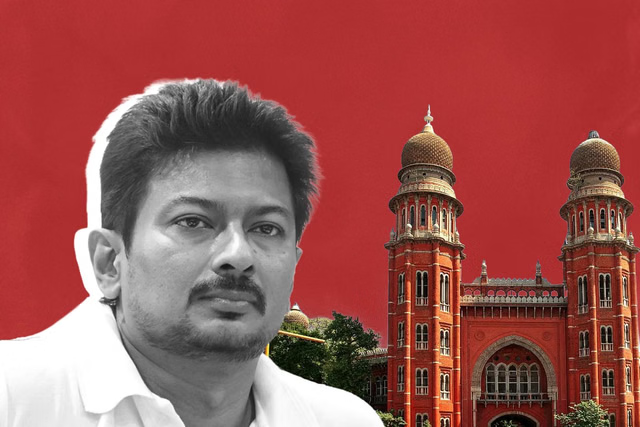
Justice S Srimathy's verdict, quashing an FIR against BJP's Amit Malviya, has called into question in no uncertain terms Deputy Chief Minister Udhayanidhi Stalin's September 2023 anti-Sanatana Dharma speech.
The verdict's operative opinion is that Udhayanidhi's exhortation to "eradicate Sanatana Dharma" is hate speech and a literal call for genocide. The core of the legal argument is deceptively simple but devastatingly logical. When a high-ranking state leader compares a religion practised by over 80 per cent of the nation's population to "mosquitoes, dengue, and malaria" and demands its "eradication," the semantics of the word ozhippu (abolition/eradication) cannot be softened.
As Justice Srimathy pointed out, if you advocate for the disappearance of a faith, you are, by extension, advocating for the disappearance of the people who follow it. The order records that this call can reasonably be read as a form of hate speech and as implying genocide or culturicide of the followers of Sanatana Dharma.
The judge noted with pain that the initiators of hate speech are often spared while those reacting are targeted, and explicitly held that Udhayanidhi's formulation crosses from ideological criticism into a call for annihilation. In one stroke, the court effectively scythed the interpretation that the DMK had long purveyed.
The DMK's official response, fronted by spokespersons and social media surrogates, tried to push back on familiar lines. Udhayanidhi, they argue, had only attacked a "regressive system" rather than a faith or its followers, while Malviya and the BJP allegedly twisted his speech to project it as a genocidal call. That line of defence, which may have worked in the heat of 2023's rhetorical free-for-all, now sits uneasily alongside a High Court order that cuts through all the bluff and bluster.
A weak defence up against the record
In court, the state's own attempt to shield Udhayanidhi was to argue that many spiritual and historical figures had opposed Sanatana Dharma in one form or another, seeking to normalise the minister's formulation within a broader reformist tradition.
Justice Srimathy rejected that argument, particularly the effort to conscript Mahatma Gandhi into the anti-Sanatana camp. The order stresses that Gandhi repeatedly called himself a Sanatani Hindu and drew strength from texts such as the Bhagavad Gita and the Ramayana, making it untenable to claim him as a model for language that calls for the "eradication" of Sanatana Dharma itself. In doing so, the court has gone beyond bare legal reasoning and entered the ideological battlefield that the DMK thought it had mastered.
On X, however, DMK voices continue to speak as though the dispute remains at the level of political interpretation. They frame the BJP as the hate-monger and the Centre as using the verdict to target Tamil Nadu and Dravidian politics. What the written judgment does is freeze the meaning of "Sanatana ozhippu" in a judicial document that explicitly treats it as a call that can imply genocide and culturicide.
Silence is admission, not strategy
For Udhayanidhi Stalin, the political and moral stakes have escalated rapidly. When the controversy first erupted in 2023, he doubled down, insisting he stood by his remarks and positioning himself as the bold inheritor of the EVR-ite tradition. Now, however, continued silence cannot pass as mere tactical restraint. It increasingly looks like an inability or unwillingness to answer core questions.
The insistent queries are: Does he accept the court's characterisation of his words as having genocidal and culturicidal implications? If he rejects that reading, how does he justify the language of "eradication" in a constitutional democracy? What is his message to crores of believers who now see a judge explicitly acknowledge their fear that "eradicate Sanatana Dharma" is a call to erase them culturally?
The longer these questions remain unanswered, the more Udhayanidhi's silence resembles a sullen acceptance of the verdict's moral framing. For a leader projected as a future Chief Minister, that is a damaging perception to live with.
Dravidian ideology under judicial glare
The fallout also has larger implications. The court has undeniably forced a distinction that the Dravidian ecosystem has sought to blur: the difference between robust critique of social evils and language that advocates eradication of a civilisational ethos.
By explicitly using terms such as 'genocide' and 'culturicide', the order asserts that lines exist, and that Udhayanidhi crossed them. The verdict undermines the DMK's attempt to occupy a progressive, pluralist space in the wider opposition while sustaining a harshly exclusionary vocabulary at home.
In theory, the DMK has two options. It can stand by Udhayanidhi's original rhetoric and attack the verdict head-on as judicial overreach into ideological terrain. Or it can continue with the current muddle: insist that nothing was wrong, claim that everything has been distorted, and hope that the storm will pass.
At present, the party appears stuck in the second lane. The social media defence leans heavily on the narrative that the BJP twisted the speech. To sustain that line, DMK leaders must either suggest that the court has been misled or is wrong, or simply pretend the crucial passages of the order do not exist. Neither is a sustainable strategy in an era when every paragraph of a high-profile judgment is in the public domain.
The party's silence, and the flimsiness of its online counter-attack, only strengthens the impression that it has no convincing answer.
 Join our