Politics
Are Bhumihaars Brahmins? Bihar's Identity Crisis Exposes Deep Caste Tensions
Abhishek Kumar
Jan 05, 2026, 01:32 PM | Updated Feb 03, 2026, 07:09 PM IST
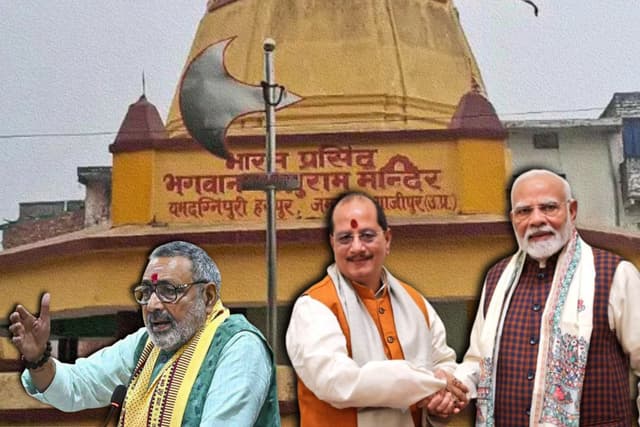
When Prime Minister Narendra Modi was trailing behind Ajay Rai on the eventual day of 4 June 2024, one of the factors held responsible for it was Bhumihaar discontentment against the Bharatiya Janata Party (BJP) in Bihar and Purvanchal districts of Uttar Pradesh.
Rai belongs to the Bhumihaar community, a landholding caste which switched sides during the decline of the Indian National Congress (INC) towards the BJP's pitch for nationalism and restoration of dharma. It is in this context that the BJP readjusted its strategy, resulting in a significant share of tickets for Bhumihaars during the Bihar Assembly elections 2024.
Bhumihaar or Bhumihaar Brahmins in Bihar?
The party and its coalition government are now in new trouble with the community regarding the identity itself. The contest for categorisation is now down to an age-old issue of whether Bhumihaars are a separate caste in themselves, or they should be categorised under Brahmins (like Maithili Brahmins and others).
On 22 December 2025, Bihar Deputy Chief Minister Vijay Sinha was in Muzaffarpur, Bihar, for a Jan Samvaad regarding recurring land disputes in the state. On being queried by one of the petitioners, Sinha asked to include Bhumihaars in revenue registers as Bhumihaar Brahmins.
'Please forward this matter to the District Magistrate and the Commissioner. They will send it to the Principal Secretary. No one has the authority to change the existing tradition. This is already written down for the Brahmins. It has been happening for years and years. It will remain the same; if there has been any irregularity, it will be corrected,' said Sinha.
The order is crucial from three aspects: person, place and timing. Sinha himself is a big political representative of the Bhumihaar community and his announcement came in Muzaffarpur, which is considered the second hotbed of Bhumihaars after Begusarai district.
Thirdly, Sinha said it at a time when the issue of categorisation is at the forefront of Savarna politics in the state.
The issue emanated from a two-month-old letter sent by Bihar's General Administration Department on 10 October 2025. In its letter, the GAD asked the Savarna Commission, a body formed by the government in May 2025 to address upper-caste concerns, whether the use of Bhumihaars should be continued in government documents or it should be replaced with Bhumihaar Brahmins.
The inter-government exchange was needed because two persons named Anjani Kumar Benipuri and Awadhesh Mishra asked the state government to replace Bhumihaar with Bhumihaar Brahmins in the caste survey and other government documents. However, many in the community treat Bhumihaars as a separate category.
Under the chairmanship of Mahachandra Singh, the Savarna Commission held two meetings on 21 November and 8 December 2025, but could not arrive at a conclusion. If the third meeting also turns out to be unfruitful, the matter will be reverted to the state government itself. Sinha's oral order meanwhile has become the point of contention.
Understanding Bhumihaar Identity through Yachak and Ayachak lens
Though coming to the forefront now, Bhumihaars' identity has traditionally been a folklore of conflicting questions. The most common and simplistic narrative is that Bhumihaars are those Brahmins who worship both Shastra (sword or weapon) and Saastra (books). The fact that Lord Parashuraam is the most revered deity in the community is used as vindication of it.
The counter-question of how Brahmins engaged in different forms of livelihood is answered through the struggle for sustenance, in which a lot of Brahmins felt inadequately served by the family art form of living on alms or dakshinas. A significant chunk of them slowly accommodated multiple skills like fighting, accounting, land ownership and tilling, but did not fully leave the way they lived.
With time the fight continued, leading to differential definitions of Yachak and Ayachak Brahmins. The term Yachak means those who live on alms, while the Ayachaks are those who engage in different professions. In his book, Brahmarishi Vansh Vistaak, Swami Sehjanand has described Bhumihaar and Tyagi as 'adjectives' of Yachak Brahmins.
Dr Ratnesh Chaudhary, a social worker fighting for the Bhumihaars' cause, widens this fold by including Ayachak Brahmins from different states.
'When the Kanyakubja Brahmins of Kannauj became known by surnames like Tiwari, such as the Tiwari Brahmins of Tivar village in Jabalpur, where did the Brahmins of the once-powerful Magadh kingdom go? They are the Bhumihaar Brahmins,' said Chaudhary.
'When the Maithil Brahmins of Mithila are identified separately, where did the Ayachak (non-begging) Brahmins of the Anga region go? They are the Bhumihaar Brahmins. Likewise, the Tyagis of Uttar Pradesh; the Niyogis of Madhya Pradesh–Chhattisgarh; the Chitpavans of Maharashtra; those with surnames like Desai; and the Mohyals of Punjab and Himachal, these too are Bhumihaar Brahmins,' he added.
In many areas, especially Magadh, Bhumihaars are also termed as Babhans, considered one of the distorted forms of Brahmins. Babhan and Bhumihaar are two popular daily-life terminologies used in South Bihar (Magadh–Shahabad region), while community members from North Bihar generally use Bhumihaars, with some exceptions in the form of highly educated individuals who prefer Bhumihaar Brahmins.
The community's current regional influence in Bihar is spread across Gaya, Patna, Nalanda, Sheikhpura, Lakhisarai, Muzaffarpur, Begusarai and Munger. In Uttar Pradesh, their main influence lies mainly in areas closer to Bihar like Ballia, Ghazipur, Jaunpur, Azamgarh, Mau and Varanasi. Approximately five million Bhumihaars in Uttar Pradesh also reserve the clutch to power in many nearby seats.
Struggle with recognition
While the term Bhumihaar is usually referred to landholding power, Cheyt Singh, a Banaras king of the 18th century and Mangal Pandey, hailed as hero of the 1857 War of Independence, come from this community. The angst with Pandey is held as the reason why Bhumihaars were given third position in the preliminary list of castes made by the British administration in 1865, a mechanism which was repeated in the 1881 Census.
The community's dominant voice in those days demanded a status on par with Brahmins, which was subtly accepted in the 1911 Census, and later in the 1931 caste census, the British categorised Bhumihaars and Bhumihaar Brahmins. These government documents gave acceptance to a slowly building social narrative that Brahmin is a varna, while 'Bhumihaar' is a socially prominent 'adjective'.
Over time the community gained prominence as one of the Brahmins, but socially they are seen as more aggressive in demeanour, simultaneously giving air to perceptions of Kshatriya origin. From 2015, when Nitish Kumar was not a part of the NDA, government documents started using Bhumihaars instead of Bhumihaar Brahmins, which was later repeated in the 2023 caste survey.
The Strategic Calculus
Post-Mandal politics, the era following the 1990 implementation of reservations for Other Backward Classes, is more about numbers than social dominance. The politics of backwardness and numerical inferiority does not work much for upper castes, which forces a rethinking of strategy.
In such circumstances, gaining more and more numbers to have influence, both decisive and kingmaker, of one community on as many seats as possible is a more pragmatic move.
That pragmatism would mean that along with Brahmins (3.45 per cent), the Bhumihaar Brahmins together would make 6.51 per cent. This would make Brahmins the second most populous community in the state after Yadavs, who are over 14 per cent. The question in the long run is more about the distribution of benefits.
The Bihar caste survey makes it clear that Bhumihaars are also the poorest community among upper castes in the state. This poverty is mainly attributed to lack of opportunity in the post-Mandal phase, during which a significant chunk of youth turned either to active armed struggle or sought refuge under its strongman patrons like Anant Singh, Suraj Bhan Singh in Bihar, or Krishnanand Rai in UP.
Rai was later mercilessly killed by Mukhtar Ansari. Before him, Ansari had also killed Awadhesh Rai, brother of Ajay Rai, in 1991, for which he was convicted. Yogi Adityanath's tough stance on Ansari is also seen as an attempt to consolidate Bhumihaar votes besides the community.
Parallelly, in Bihar, Bhumihaars spent the 1990s opposing Lalu Yadav's raj through both democratic and armed means. Ranbir Sena, a violent army opposing RJD's rule, is also seen as a product of Bhumihaar muscle, led by Brahmeshwar Mukhiya. Even after the RJD tried to woo the community by giving as many tickets as possible, the voters of the community did not vote for the party.
In recent Assembly Elections, the RJD had given a ticket to Shivani Shukla, daughter of convicted strongman Munna Shukla. Local reports state that many Bhumihaars took a bath in the holy Ganga river to atone after voting for the Lantern symbol. They supported the candidate, not the party.
Systemic Influence amidst Social Decline
In post-independence Bihar, Shri Krishna Singh, often seen as the most industrially minded Chief Minister of the state, hailed from this community. The opening of the Baidyanath Dham Temple in Deoghar to Dalits, as well as the rise of Begusarai as a prominent industrial town, are a few often attributed to him. Currently leaders like Lallan Singh and Giriraj Singh are considered the strongest voices of the community.
In Uttar Pradesh, Raj Narain, a prominent anti-Indira Gandhi voice, belonged to this community. More than four decades after the case, Jairam Ramesh, a senior Congressperson, remarked on the INC's declining stature ahead of the 2014 General Election, 'Because of the Bhumihaar from Ghazipur.' He was referring to former Comptroller and Auditor General Vinod Rai, whose reports on INC-era corruption tanked its perception.
Although Rai never brought his caste into the public domain, his hold over the system exemplifies how Bhumihaars have evolved in the post-Mandal phase. Rather than being hooked to the idea of state power, the community now leans towards key nodes in the system.
This diverse individual's hold on the system, whose benefits do not necessarily trickle down to the community in a democracy, is what has kept this community, with less than 2.86 per cent share in Bihar and around two per cent share in UP population, politically relevant.
Traditionally, Bhumihaars have often been seen as part of upper-caste echelons, where on paper they are Brahmins, while on the societal level it is a bit more diverse. The distinct social identity of Bhumihaars emerged only in the 1990s after unequivocal opposition to the socialist onslaught, an effort first led by a Rajput leader named Anand Mohan, who later was sentenced in the 1993 lynching case of Gopalganj District Magistrate G. Krishnaiah.
The Road Ahead
Additionally, it is also to be seen whether Bhumihaars will be given a separate category as well as be seen as a part of the Brahmin community by the government. The ball currently is in the Bihar government's court, but the real headache will be for the Union Census.
Abhishek is Staff Writer at Swarajya.
 Join our