Politics
Can Pankaj Chaudhary Deliver? Three Challenges Facing BJP’s New UP Unit Chief
Diksha Yadav
Dec 24, 2025, 08:00 AM | Updated Dec 23, 2025, 08:54 PM IST
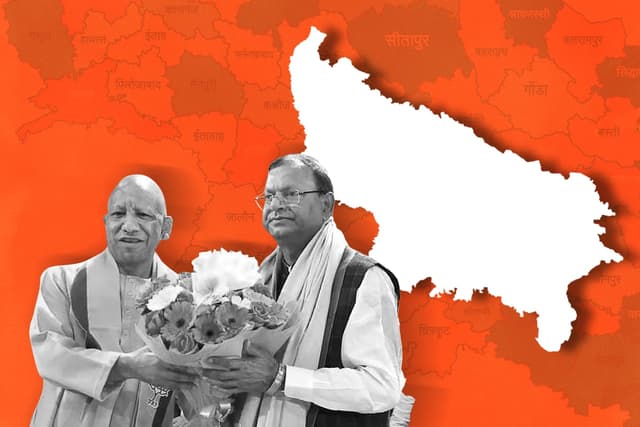
After months of anticipation following the 2024 Lok Sabha election setback, the Bharatiya Janata Party (BJP) finally announced Pankaj Chaudhary as the new Uttar Pradesh state president.
The seven-time Member of Parliament from Maharajganj, who currently serves as Union Minister of State in the Ministry of Finance, brings a unique blend of electoral success and grassroots credibility to a party desperate to recover lost ground before the crucial 2027 state elections.
But why did it take so long to announce the new party state chief?
The answer lies in the BJP’s complex calculations around caste politics, organisational restructuring, and the delicate balance between the Delhi and Lucknow power centres.
The Kurmi Card: BJP’s Calculated Gamble
The Kurmi factor loomed large in the decision to choose Chaudhary. “If you look at the Lok Sabha election, then BJP has suffered a lot from the loss of the Kurmi vote in UP. And BJP had to recover it,” says Amit Yadav on the Swarajya podcast What This Means.
(You can also listen to the full episode on Spotify or Apple Podcasts.)
“Before that, BJP tried to make Swatantra Dev Singh a Kurmi leader, but that attempt was unsuccessful because the party couldn’t establish him as a pan-state Kurmi leader among people since he hasn’t fought and won any Vidhan Sabha or Lok Sabha elections.
However, during his tenure as state party chief, BJP received massive Kurmi votes in the 2022 state elections. Because if you look at Swatantra Dev Singh, he is very good at organisational work because he has worked in the sanghathan for years.”
What makes Chaudhary different from previous attempts at Kurmi leadership? His credentials are formidable: seven Lok Sabha election victories, experience as a parshad (councillor), and service as Deputy Mayor.
Yadav emphasises this crucial distinction: “As far as Pankaj Chaudhary is concerned, he has been winning seven times continuously in the Lok Sabha elections. Before that, he was a parshad also. He also became Deputy Mayor in the 1980s. So, this means that he has worked for people on the ground and is popular among the Kurmis as well. He has been winning elections even when the BJP was very weak in Uttar Pradesh. So it is not that he won just because of the BJP’s symbol. He has his own popularity too.”
The BJP faced a stark reality. It had no other viable Kurmi leader across different regions of the state. “Ek samay BJP mein Kurmi leader the, Kurmi state president the, Vinay Katiyar, Om Prakash Singh. So, all these leaders were there, politically active, they used to contest elections, they used to win elections. So, they had political influence.
But presently BJP didn’t have any other option among Kurmis. So, BJP had to make Pankaj Chaudhary the state party chief,” Yadav explains.
Pankaj Chaudhary’s Plus Points
Chaudhary brings a fresh approach to an organisation that has become stagnant.
“Look, if we talk about Mr Chaudhary, he is a soft-spoken person. And I don’t think he belongs to any lobby,” says Yadav. “I think that in the organisation he has a fresh approach. Because those who have been working in the organisation for years develop their own lobby. When the lobby is formed, then they likely take biased decisions which impact the elections and party performance negatively.”
Since he does not belong to any lobby, it is possible that he will come with a fresh approach and build a new team. He also has good communication with the central party leadership, which is an advantage.
Another interesting aspect of Chaudhary’s profile is that he also comes from the trading and business community. “Though he is a Kurmi, he also represents the vyapaari varg. So, this will also benefit BJP,” Yadav explains.
Can BJP Really Win Back Kurmi Voters?
While Chaudhary’s appointment sends a positive signal, expecting the entire Kurmi vote bank to automatically shift to the BJP would be unrealistic. Yadav is clear-eyed about this.
“As far as the question of how much the Kurmi vote will be impacted, I believe that the entire Kurmi vote will not shift to the BJP. But yes, it will definitely have an impact. There will be some benefit, especially with the narrative and countering rival parties’ upper-caste rhetoric.”
The Kurmi voting pattern in Uttar Pradesh is complex and varies significantly across regions. “In UP, Kurmis are spread across different regions: Braj, Awadh, Bareilly, Bundelkhand, Central UP, and Purvanchal, and everyone has a different voting pattern. Kurmis vote only after seeing the local candidates. So it will be important for BJP to also build Kurmi leadership in different regions,” Yadav notes.
The party suffered particularly in the Awadh and Bundelkhand regions in the 2024 Lok Sabha elections, areas where it had completely sidelined Kurmi representation. “If you look at the 2024 elections, BJP had completely sidelined them; as a result, they suffered losses in the Awadh region and the Bundelkhand region,” he adds.
If you look at the Samajwadi Party (SP), on the other hand, in the 2024 elections they had stronger Kurmi faces than the BJP candidates in the Ambedkarnagar and Basti regions, such as Lalji Verma and Ram Prasad Chaudhary. Their popularity was not limited to just their constituencies, but extended across entire districts.
Purvanchal in Focus?
An interesting dimension to this appointment is the concentration of BJP’s top leadership from Purvanchal, or eastern Uttar Pradesh. The Prime Minister, Chief Minister, Deputy Chief Minister, and now the state party president all hail from this region.
Yadav addresses this concern. “If someone says that because he is from Purvanchal, Chaudhary has been chosen as the chief to get Purvanchali votes and dent the SP stronghold, that’s wrong. Because last time BJP had already made a Jat president from west UP.
Apart from that, other castes in the western region, like Rajputs or Brahmins, cannot be made party president, as it will not fit in the social and caste equation. So, it is obvious that if an OBC or any other caste president has to be made, then that person will come from Purvanchal.”
He adds that in the Gorakhpur division, in areas like Azamgarh, Mau, Ghazipur, and Ballia, “the BJP’s performance has been good. It is already one of the strongholds of the BJP, and in this area, Kurmis are not that many in number.”
Three Key Challenges Facing BJP in 2027
Challenge 1: Reviving an Inactive Organisation
The most immediate and damaging challenge for the BJP is organisational lethargy in the state. One of the most damaging factors in the BJP’s 2024 Lok Sabha defeat was that the party cadre was either unhappy or indifferent, and certainly not as active as required.
“There were no significant changes on the ground after the 2024 LS results. The organisation has been very inactive,” Yadav observes.
“One reason for this can be because the outgoing state president was on an extension, so there would have been this attitude that the new president will see what needs to be done. I am done, the next one will take care when he comes,” Yadav explains.
“So, what I mean is that a lazy attitude of whoever comes next, he will handle it, would have been there both at the top level and at the cadre level. As a result, a lot of time has been wasted.
I think that a year has passed now. The best time to announce the new leadership was at least three to four months back, or before the Special Intensive Revision (SIR) exercise in the state began.”
The SIR exercise exposed the depth of the BJP’s organisational inactiveness on the ground.
The scale of the failure is staggering. “The biggest party in the world, which has such a big organisation, you are in power. After that, how big a failure is this that your organisation is so inactive in the state that it is functioning like it was in 2007, 2008, or 2010.
The Chief Minister himself had to tell them in the organisation meeting to get active on the ground and help people in the SIR process. He said that four crore names have been cut off, of which 80 to 90 per cent are BJP supporters. It’s a huge failure.”
“SIR is a very big process, which will decide the future of politics. And if the cadre is so inactive, then you can guess what is going on on the ground,” Yadav says, without mincing his words.
Challenge 2: Breaking Internal Factionalism and Groupism
The new state party chief faces the enormous challenge of uniting a deeply fractured organisation where multiple groups have formed within the BJP, with leaders pulling in different directions.
“In UP BJP, many groups have developed, and many people are fighting with each other. So this grouping needs to end. And now because the party has chosen someone who is not from all these groups, this groupism can end. Since Chaudhary is from outside these groups, it’s likely that he will not take any decision in a biased manner,” Yadav suggests.
He adds, “BJP could benefit from this. And BJP needed a person who had good communication with the central leadership and who was not from any lobby or any group in the state.”
Challenge 3: Fighting Anti-Incumbency at the Local Level and the Cabinet Reshuffle Imperative
Yadav’s major recommendation is that the BJP should reshuffle its cabinet ministers.
“I think they should reshuffle the entire cabinet. At least 60 to 70 per cent of the cabinet should be reshuffled ahead of the state elections, bringing big leaders back into organisational work for elections to make the party strong at the ground level. Tell them to prove themselves and come back to power. And bring fresh faces into the cabinet who are active and will get to work right away,” Yadav argues.
Though the Chief Minister has pan-state popularity and a strong following, one cannot deny the anti-incumbency on the ground against local leaders. The biggest example of this was the 2024 Lok Sabha elections, where the BJP lost significant ground in Uttar Pradesh.
Yadav makes an important point about the right comparison. “When it comes to the question of which government is better, then I feel BJP should not compare themselves with Akhilesh Yadav or Mayawati’s rule. But rather, they should compare the tenure of Yogi Ji’s first term from 2017 to 2022 to his second term. Because in his first term, a lot more good things happened which are not happening now.”
He continues, “So that way BJP can see what they did last time and what they are doing wrong now, and work on that.”
What SP Is Doing Right and Where It Is Vulnerable
Organisational strength
The Samajwadi Party has demonstrated superior organisational planning. Yadav says, “The Samajwadi Party is working very well at the organisation level; their cadre is very active on the ground. The SP is far ahead of the BJP in that sense.”
He provides concrete evidence. “Almost seven to eight months before the start of the 2024 elections, SP had indirectly announced 35 to 40 candidates who would get the Lok Sabha tickets. I had also posted the list on X at that time. Those candidates became active on the ground and started people outreach way before the BJP. And if you go back and look at that list, most of these candidates also won their seats.”
The strategic advantage is clear. “The SP is going with the same strategy again before the 2027 state elections. The party has hinted to about 40 to 50 per cent of candidates that they will be getting tickets, and they have already started working in their regions.”
The SP’s advantage is that, due to early hints, their candidates get a lot of time on the ground to work in their areas and interact with people.
The PDA strategy
The SP’s Pichhda (Backward), Dalit, Alpsankhyak (Minority), or PDA formula has its own limitations.
“I mean, this will not necessarily help you win the state election because not all OBCs and Dalits vote uniformly. That kind of unity doesn’t exist. So you cannot do anti-upper-caste politics if you want to win elections. You need the support of people across communities,” Yadav explains.
However, he identifies a critical vulnerability. “SP will suffer a lot if they do anti-upper-caste politics. In the 2024 elections, many other issues worked in their favour apart from getting the social engineering right.
Also, they should not be overconfident and pretend that the BJP has lost and they have won already, because then they will suffer a lot. We have seen what happened to the BJP when it was overconfident in 2024.”
Diksha Yadav is a senior sub editor at Swarajya.
 Join our