Politics
Delhi Blast: The White-Collar Jihad And Politics Of Silence
Kishan Kumar
Nov 12, 2025, 10:50 AM | Updated Nov 13, 2025, 11:26 AM IST
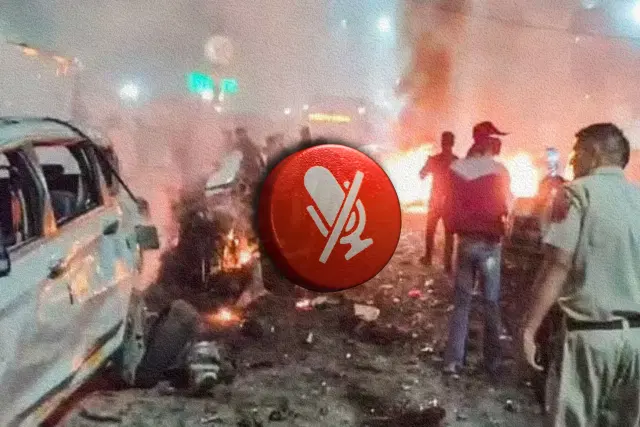
In Delhi, on a dull evening on November 10, a white Hyundai i20 turned itself inside out. The blast was abrupt, almost sheepish, the mechanical equivalent of a stutter. Forensic teams sifted through the debris and found nothing that a proper bomb ought to leave behind. There were no ball bearings, no crater, no shrapnel lodged in nearby walls. It was a premature detonation, a bomb that lost its nerve.
The panic belonged to a young doctor named Umar, who believed that his colleagues, also doctors, were already in custody. He drove out of the city and pressed a switch. Passers-by died. His plan did not.
The men arrested in the days that followed were not the usual ghosts of poverty that the Indian imagination summons when it imagines a terrorist. They were medical professionals, neurologists, surgeons, teachers, trained not in the mechanics of death but in the ecclesiastical business of preserving life.
They were said to be part of a growing constellation of what officials called a “white-collar ecosystem of terror”, a phrase that felt stitched together at gunpoint but was nonetheless painfully accurate. If one believes the police reports, these doctors were less interested in healing the public than in constructing a quieter, more efficient apocalypse.
Within hours of the arrests, the public waited for the country’s most prominent Muslim organisations to say something, to claim shock, anger, or, at the very least, bewilderment that this, too, could happen among one’s own. What emerged was an orchestrated quiet. Spokespersons offered procedural quibbles. Politicians provided explanations regarding electoral harassment and bureaucratic humiliation. A great deal was said about everything except the doctors and their explosives.
This evasive choreography is not new. The pattern has been rehearsed across decades, and it is always made to seem accidental, organic, tragic but understandable. The word “radical” is made elastic enough for disposal, “terrorist” is reserved for cases where guilt is mathematically undeniable, and until then, there is time to blame the state, the police, the ruling party, or, if imagination fails, history itself.
Every explosion births a parallel narrative: the accused are framed, the police are biased, the courts are instruments of a Hindu majoritarian project. The bomb becomes an afterthought, a footnote to an argument about surveillance and dignity.
Yet Delhi was different. Not because of the dead; India tallies those with desensitised reflex, but because the identity of the perpetrators slit open a comfortable mythology. Terrorism, in the popular liberal imagination, is supposed to germinate in deprivation. We prefer our radicals impoverished, undereducated, and embittered. Here were men with degrees, salaries, and careers. The familiar alibi of marginalisation failed its exam.
In April, before the Delhi blast, there was Pahalgam. Gunmen walked into a crowd and asked for names. Those with Hindu names died. Lashkar-e-Taiba’s local costume shop, The Resistance Front, first claimed the killings and then denied them. Soon, the story was weighed down with geopolitical intrigue, cyber infiltration, and the possibility of a narrative forged in a foreign capital. But the bodies were real. The questions were real. The bullets were real.
A public intellectual, Javed Akhtar, allowed himself a sentiment that should have been ordinary: rage. He demanded a decisive response, something more convincing than fireworks traded across a militarised border. His condemnation was so unambiguous that it was treated as a betrayal.
A Pakistani actress barked at him from across a camera: learn some shame; be silent like your colleagues. The instruction sounded suspiciously like internal law enforcement, the policing of speech within a community that insisted on presenting itself as perpetually misunderstood, perpetually wounded.
Silence became the halo of moderation. In the absence of speech, there is plausible deniability. The Delhi doctors may have been misguided; they may have been victims of state paranoia; they may have been technicians in the wrong place at the wrong time. And if the arrests were legitimate, if explosives were real and plans were active, then perhaps the entire tragedy was the spiritual offspring of insult, discrimination, unemployment, and atmospheric Islamophobia. Whatever the conclusion, the rhetoric arrives fully assembled: nothing is inherent, everything is provoked.
Over the years, India has constructed a cottage industry of explanatory literature in which the terrorist is an ecological product of the nation that fears him. Reports by Western think tanks line up neatly with academic narratives that attribute Islamist violence to alienation and state aggression. According to this logic, grievance is the mother tongue of radicalisation. Each bomb, then, is a message sent by the oppressed to their oppressors.
There is a different hypothesis, less lyrical but more consistent with evidence. It insists that terrorism in India is not merely a social reaction but a deliberate ideological project, maintained not only by the devout or the deranged but by the polite and occasionally the respected. The “white-collar ecosystem” is not a metaphor. These men were recruited precisely because no one would suspect them. Their degrees were camouflaged.
To speak this aloud is to trespass into forbidden terrain. Within the labyrinth of community leadership, the “moderate” is elevated as a necessary counterweight to the radical. Yet moderation, as practised in these moments, is a form of abstention. Condemnation is avoided, responsibility is diluted, and the entire pageantry is carefully designed to produce the appearance of neutrality. But neutrality, in the presence of violence, is a kind of blessing.
In private, Indian security officials admit what public figures will not: silence is oxygen. It expands the space in which radicalisation can operate. It sanctifies the idea that the only real danger to Muslims is the Indian state.
When community institutions spend more energy organising voter registration campaigns than confronting the reality of young men building bombs, the message is less political than existential. The state cannot be trusted. The police cannot be trusted. The courts cannot be trusted. Only the community can be trusted. And if a few of its sons decide to pursue darker work, perhaps the state provoked them.
This feedback loop of grievance and silence produces the perfect incubator. Radicalism no longer appears barbaric; it appears predictable. Terrorists are not zealots; they are citizens without options. Their choices are explained away, and those who call for accountability are scolded for being insensitive to pain.
A decade ago, many thinkers warned that India’s problem was not the bomber but the “prepared mind”. Education, they argued, does not vaccinate against fanaticism; it refines it. White-collar terrorists are not aberrations. They are the next logical step in a project that prefers sophistication over theatrics.
Delhi’s blast will fade. The trial will be delayed. Commentators will move on. The doctors, even if convicted, will be woven back into the folklore of persecution, proof that the state hunts the innocent, that the machinery of democracy is rigged against the faithful.
The more unsettling truth survives beneath the bureaucratic dust: the radical does not operate in isolation. He is buoyed by the one who stays silent, defended by the one who files petitions, and sanitised by those who recast every explosion as an epilogue to injustice. The bomb is a small part of the story. The quiet afterwards is the real crime.
Kishan Kumar is a graduate in Economics from the University of Delhi, currently working in the political communication space. He focuses on narrative-building, strategic messaging, and public discourse, with a strong interest in politics, policy, and media. He posts on X from @FreezingHindoo.
 Join our