Politics
Has Akhilesh Learnt The Right Lessons From Bihar?
Abhishek Kumar
Dec 15, 2025, 11:59 AM | Updated 12:39 PM IST
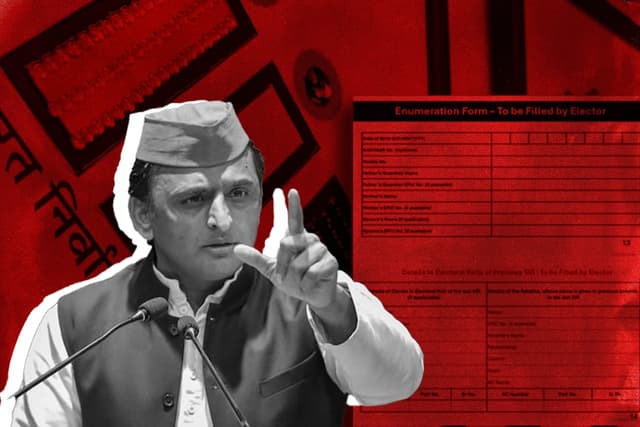
The long interval before the next assembly election hasn't stopped Akhilesh Yadav from already taking cues from the Bihar results.
In his latest attack on the SIR drive (Special Intensive Revision of electoral rolls), the Samajwadi Party (SP) chief accused the Bharatiya Janata Party (BJP) of attempting to take away rights given by the Constitution.
Akhilesh Yadav's attack on SIR
Invoking the emotive issue of reservation and the Constitution, Yadav said, "The BJP government is conducting the SIR to hide its failures. We appeal to everyone to register their votes and prevent them from being cancelled. Otherwise, the BJP is preparing to take away the constitutional rights championed by Baba Saheb Dr Bhimrao Ambedkar. If the right to vote is taken away, reservations will also end. All other rights guaranteed by the Constitution will be snatched."
He also accused the Election Commission of India (ECI) of taking instructions from the BJP. Yadav asserts that there is no need for haste in Uttar Pradesh (UP).
Weeks after the Bihar Assembly election results, Yadav alleged that millions had been deprived of their voting rights.
On the Bihar results day, he claimed the NDA's sweeping victory was driven by the SIR exercise and warned that such "games" would not be allowed in UP.
He claimed the NDA had planned to remove around 50,000 voters from each constituency it lost in the 2024 Lok Sabha before the next assembly elections in the state in 2027. That, he argues, is why he has issued a "vigilant-mode" directive to party workers, especially the PDA bloc of Pichhra, Dalit and Alpsankhyak cadres, coining a term PPTV, a parallel he draws to CCTV surveillance.
Unlike Tejashwi Yadav in Bihar, Akhilesh is leaving no stone unturned in trying to discredit the SIR drive. Even tragic cases such as the deaths of Booth Level Officers are being framed as evidence of coercion and pressure tactics.
He highlights these incidents while subtly invoking sensitive identities, a narrative amplified by IT cells claiming the burden falls disproportionately on certain communities.
Fear, Surveillance and PPTV: Manufacturing a Crisis
Electorally, in the run-up to the 'UP 2027', he is trying to strike a balance between the old vote bank of Muslim-Yadav and renewed push towards PDA, an attempt to include non-Yadav OBCs and occupy the Dalit space after the decline of Mayawati's Bahujan Samaj Party (BSP).
While facilitating the inclusion of more communities, he has to ensure that the erstwhile vote bank remains intact. This explains why he is regularly asking voters to contact the PDA wing of the party in case they encounter procedural issues during the SIR exercise.
Tejashwi's Failure and Akhilesh's Overreach
Tejashwi Yadav showed little mercy when it came to dealing with INC and other alliance members. The alliance members ended up fighting among themselves on around a dozen seats after multiple rounds of negotiations.
Additionally, Tejashwi and his party did not fully align with INC's demand of raising the SIR issue.
On one end, its spokespersons on national television constantly spoke on it, while on the ground, a unified voice galvanising cadre on this issue was absent.
Tejashwi Yadav spoke about the problems with the ECI and even threatened it, but it always lacked substance. Towards the end, RJD was more engaged with spreading rumours about the Chirag-Nitish fight than SIR.
However, in the light of the intensity of INC's anti-SIR pitch taken up by Akhilesh Yadav, Bihar's loss seems to be more about Tejashwi Yadav not taking up the mantle of being the regional commander-in-chief of INC's narrative on the exercise.
The stark difference between the cold shoulder given by Tejashwi Yadav to SIR and the enthusiastic supporting hand lent by Akhilesh Yadav indicates that he is signalling a more co-operative stance to INC for 2027 AE.
Akhilesh Yadav learned from Bihar that opposition parties must unite to defeat the NDA and BJP in the 2027 Assembly Elections, especially since the BJP has been heavily investing in state elections after its surprising under-performance in the 2024 General Elections.
The challenges before Akhilesh Yadav
However, SIR may not be the perfect pitch to bat for alliance unity.
The first problem Akhilesh Yadav has to face is how SIR is perceived among the masses in states like West Bengal, Bihar and UP. Apart from party cadre and leaders, it is hard to find any opposition to SIR on the ground. It is hard to find someone supporting a neighbour with fake documents living off state-sponsored benefits while they themselves struggle to support their family.
This sentiment has played out repeatedly in Bihar and eastern Uttar Pradesh, where the traditional M-Y (Muslim–Yadav) axis is strong but is always vulnerable to weaken in favour of a broader Hindu consolidation. In the recent Bihar Assembly election, Mukesh Sahani's bid to forge an N-M (Nishad–Muslim) alliance fell flat.
Additionally, in the Uttar Pradesh districts bordering Bihar, Nishad communities have historically positioned themselves as the frontline of Hindu mobilisation during communal flashpoints.
What the BJP-led NDA has done is bring communities together with the help of labharthi politics, fully aided by transparency.
For the average voter, regardless of party preference, the SIR looks less like a threat and more like one of the final blows to the opaque, arbitrary systems that have haunted everyday life for decades. So when a political party tries to cast an exercise promising transparency as a looming shadow, the narrative collapses against the weight of lived reality.
Tejashwi Yadav and his strategists felt it while riding the bullet with Rahul Gandhi.
Bihar did not buy into the narrative. The voters in Bihar were cognisant enough to grasp the fault-lines by analysing both points and counterpoints.
Same holds true for UP voters, whose awareness is perhaps being under-appreciated by Yadav, which is the second major problem.
SP's brains have been failing to come to terms with how the Yogi government has ensured that no serious charge of discrimination can be made against it when it comes to including the SCs and the Backward Classes in its developmental journey.
Unlike yesteryears, most of them have proper identity and historical documents sought after by ECI for the mass exercise. That is true for Muslims of UP as well, leaving Akhilesh Yadav with only the option of galvanising them on a minority-majority plank. Taking INC on board comes handy here.
The third problem for Yadav is the persistent negativity running through his campaign. For voters, his statements have become a steady stream of warnings, anxieties, and worst-case scenarios. What might once have sounded like vigilance now increasingly resembles reflexive fear-mongering.
Such negativities play right into the hands of BJP's communicators, which are re-emerging as a narrative-setter after the 2024 debacle.
The more Akhilesh Yadav attacks the SIR exercise, the more it looks like he is pre-emptively building a shield for an expected defeat. Put simply, instead of setting the agenda with concrete proposals on investment, roads, education, jobs, and infrastructure, the SP finds itself expending most of its energy countering a 'demon created out of thin air'.
Anti-SIR Can't Be a Governance Substitute
SP's campaigns against SIR resemble RJD's negative campaigning during the Bihar elections. The BJP effectively countered these tactics in Bihar and will likely do the same against SP in 2027. In the digital era, political campaigns lacking evidence have very short shelf lives.
What remains instead is a rhetoric of grievance that, while emotionally charged, cannot alone anchor a credible alternative to the BJP.
If history is a guide, controversies like SIR rarely survive beyond a few news cycles. They do ignite dramatic confrontations like the earlier debates on intolerance or the alleged assault on constitutional values, but fade before reshaping voter behaviour.
The anti-SIR discourse is already showing signs of dissipation, weakened by its internal contradictions and lack of demonstrable impact.
If Bihar offered a cautionary tale, Akhilesh Yadav is reaching for a playbook built on grievance rather than governance, one that may again fall short when tested at the ballot box.
Abhishek is Staff Writer at Swarajya.
 Join our