Politics
Impeachment Or Intimidation? How A Judge Is Being Targeted For Dispensing Justice
Shubhendu Anand and Abhishek Dwivedi
Dec 16, 2025, 04:57 PM | Updated 06:54 PM IST
Does enforcing the constitutional rights of a community and delivering a judgement rooted in the framework of the Constitution warrant impeachment of a judge? Well, if so, then Dr Ambedkar and the other founding fathers of the constitution would be turning in their proverbial graves.
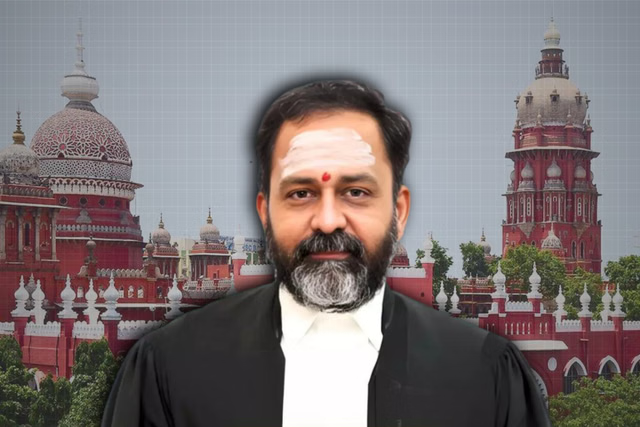
This alarming scenario indeed unfolded when a Member of Parliament from the INDI Alliance submitted a letter to the Lok Sabha Speaker invoking the gravest constitutional remedy of Impeachment against Justice G.R. Swaminathan of the Madurai Bench of Madras High Court.
As defined in the Black's Law Dictionary, Impeachment refers to "A criminal proceeding against a public officer, before a quasi political court, instituted by a written accusation called "articles of impeachment;" for example, a written accusation by the house of representatives of the United States to the senate of the United States against an officer".
Similarly P. Ramanatha Aiyar Advanced Law Lexicon defines Impeachment as, "To impeach, as applied to a person, is to accuse, to blame, to censure him. It includes the imputation of wrongdoing. To impeach his official report or conduct is to show that it was occasioned by some partiality, bias, prejudice, inattention to or unfaithfulness in the discharge of that duty, or that it was based on such error that the existence of such influence may be justly inferred from the extraordinary character or grossness of the error".
The above-noted definitions raise the central question that lies at the heart of this controversy: On what ground is such an extraordinary step taken?
The Constitution of India under Article 124 (4) and (5) provides the process of impeachment of the judges of the Supreme Court and High Courts on the grounds of misbehaviour and incapacity.
It is therefore left to the wisdom of the readers to decide, since when delivering justice, protecting religious and property rights granted by the Constitution, and ensuring compliance with binding judicial precedents, have to be treated as misbehaviour and incapacity.
Justice Swaminathan's order on the Karthigai Deepam issue at Dheepathoon (Ancient Stone Lamp Pillar), written squarely within the four corners of the Constitution, with proper application of mind and a faithful adherence to the constitutional and legal principles.
Yet the judgement is undermined by those who often claim themselves to be the defenders and saviours of the constitution. They are now threatening a judge with the hammer of impeachment for performing his constitutional duty, thereby threatening his judicial independence, which is the core of the same constitution.
Crucially, Justice Swaminathan's direction to light the Karthigai Deepam at Dheepathoon was not merely a religious concession. The order ascertained constitutional rights, property law, and the judicial will to enforce the long-pending order in WP No. 18884 of 1994 of the Madras High Court itself.
Therein it was held:
The Devasthanam, which is the owner of the hill to the extent indicated in the above-said decree, shall alone light the Deepam in Thirupparankundram hill and they alone shall light the Deepam ordinarily in the traditional place of the Mandapam at Subramaniyaswami Temple near Uchipillaiyar Kovil. This year viz., for the year 1996, it is stated that the Karthigai Deepam festival positively falls on Sunday the 24th day of November, 1996. There is hardly three days for the festival. Therefore, I direct that this year the Devasthanam shall light the Karthigai Deepam in the usual place as directed by me in the years 1994 and 1995 in W.M.P. Nos. 28622 of 1994 and 24619 of 1995, dated 17-11- 1994 and 1-12-1995 respectively. The Devasthanam shall not also allow any other person to light the Deepam in any other place during this year viz., on 24-11-1996. 3. Subject to the clause 4 and with a view to respect the wishes of the worshippers, it is open to the Devasthanam to permit the lighting of the Deepam for future years at any place in Thirupprankundram Hill with the prior permission of the Authorities under the Tamil Nadu Hindu Religious and Charitable Endowments Act, 1959; and 4. While permitting any other person to light the Deepam in any other place or if the Devasthanam itself wants to light the Deepam in any other place they shall have due regard to the nearness of the Dargah and only choose a suitable place atleast 15 meters away from the Dargah, the flight of steps and the Nellithope area, and places declared to hereby to the 8th respondent under the clause 2 of the decree in O.S. No. 4 of 1920.
Justice G.R. Swaminathan rightly emphasised that the lighting of the Deepam is part of Tamil culture and tradition, along with the property rights of the temple. The dispute concerning property rights of the temple had been the subject matter of the litigation a century ago, in 1920, when Madurai, near which this hillock is located, came under Muslim rule, the hilltop came to be occupied, and a mosque was constructed.
Since the body of a Fakir is said to be laid, it is known as Dargah. It is pertinent to mention here that the Dargah belong to Sikkander Badusha, the last barbaric ruler of the Madurai (Malabar) Sultanate.
There is a temple at the foot of the hill and another temple halfway up the hill. There are tombs dedicated to Muslims below the hilltop and the Dargah. Frictions often arose between the Hindus and the Muslims over the illegal encroachment of the temple's land by the Muslims.
The issue was finally and authoritatively settled in O.S. No. 4 of 1920 on the file of the First Additional Sub-Judge of Madurai. It was observed by the learned Trial Judge:
After referring to a 1909 Government Order which states that the whole hillock is worshipped by the Hindu community as a Linga, it was found by the judge that the hill has been from pre-historic times deemed sacred by the Hindus and that it is essentially a Hindu place of worship. After failing to date the construction of the tomb, the learned Judge observed that the Hindus have been regarding the hill as holy, the holiness of which is found mentioned in Hindu works older than the advent of the Prophet in Arabia. The hill was an endowed property of the temple management. The devasthanam was in undisturbed possession of the hill which represents Siva Linga and in which God Subramaniya is enshrined. The temple itself is not a separate structure but is cut out of the rock.
He categorically held:
The devasthanam was not deprived of its possession of the hill either by the Muslims or the British Government. It was all along in possession of the hill and its adjuncts excepting occupied and assessed portions.
The devasthanam was recognised as the owner of the hill. Even the subsequent Muslim rulers and the British, allowed the devasthanam to continue in undisturbed possession.
Aggrieved by the judgement of the Trial Court and decree dated 25.08.1923, the trustees of the mosque moved the Madras High Court in 1924 (A.S. No. 34). The Hon'ble Division Bench reversed the decision of the trial court. The temple management went to the highest court, which was the Privy Council then.
The Privy Council overturned the Judgement of the Division Bench and High Court's judgement and restored the decision of the trial judge. Lord George Lowndes writing for the Privy Council held that:
On the whole their Lordships are of opinion that the appellant has shown that the unoccupied portion of the hill has been in the possession of the temple from time immemorial and has been treated by the temple authorities as their property. They think that the conclusion come to by the Subordinate Judge was right and that no ground has been shown for disturbing his decree.
Justice Swaminathan's Order merely reaffirmed the long-settled legal position and enforced long-acknowledged property and religious rights.
Vilifying such a well-reasoned order is indicative of the intention to threaten the independence of the judiciary, probably to please a certain section of their vote-bank.
Impeachment is a constitutional safeguard against judicial misconduct. It was never meant to be a political weapon against judges who discharge their duties without fear or favour.
The authors, Shubhendu Anand & Abhishek Dwivedi, are advocates practicing in the Supreme Court of India.
 Join our