Politics
Inside Uttar Pradesh's New Law To Manage Banke Bihari Temple: What Changes And Will It Work?
Swarajya Staff
Dec 23, 2025, 07:00 AM | Updated Dec 22, 2025, 11:43 PM IST
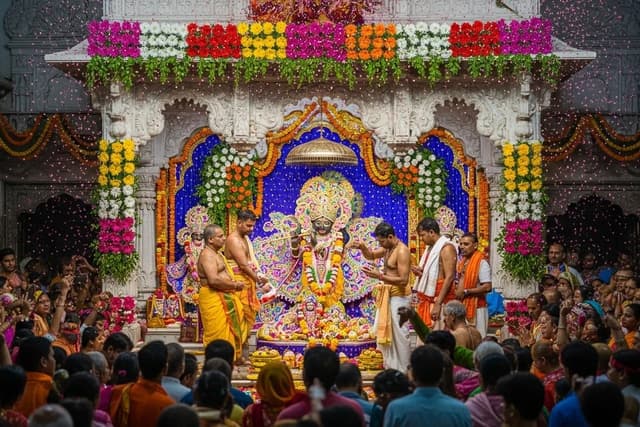
The Uttar Pradesh Shri Banke Bihari Ji Temple Trust Bill, 2025 was formally notified as an Act on Monday, 22 December, after receiving the Governor's approval.
The Bill had been passed by both Houses of the Uttar Pradesh Legislature, the Legislative Assembly and the Legislative Council, on 14 August earlier this year and had received the Governor's approval on 21 August. It was notified yesterday, 22 December.
With its enactment, a new legal framework for the temple's management has now come into existence.
The new law explicitly states that all offerings, donations, and both movable and immovable properties connected to Shri Banke Bihari Ji Temple will fall under the administrative purview of the Nyas (Trust).
This includes the sacred idol enshrined within the temple, all categories of offerings presented to the deities throughout the temple premises and parikrama (circumambulation) area, donations received in cash or kind, properties consecrated for pooja, festivals, and religious ceremonies, and bank drafts and cheques received through postal services or wire transfer.
Furthermore, temple-related jewellery, grants, contributions, funds collected from the hundi, and all other assets will be recognised as temple property under this framework.
The Nyas will hold authority over darshan arrangements, the appointment of pujaris, and the determination of their honorarium and associated benefits.
Most importantly, the Nyas will assume responsibility for devotee safety and the comprehensive administration and management of the temple complex.
Organisational Structure
The Nyas will comprise 18 members in total, 11 nominated members and seven ex-officio members.
The nominated contingent will include:
three distinguished saints-scholars affiliated with Vaishnav traditions and peethas,
three representatives from Sanatan Dharma traditions,
three respected individuals from any branch of Sanatan Dharma, and
two members from the Goswami tradition who are descendants of Swami Haridas, one representing Raj Bhog seva and the other Shayan Bhog seva.
All nominated members must be Sanatan Hindus, serving three-year terms.
Ex-officio members will include:
the District Magistrate of Mathura,
the Senior Superintendent of Police,
the Municipal Commissioner,
the Chief Executive Officer of the Uttar Pradesh Braj Teerth Vikas Parishad,
the CEO of the Banke Bihari Mandir Trust, and
one state government nominee.
Should any ex-officio officer not follow Sanatan Dharma, his or her junior officer will be designated as a replacement.
Finance and Administration
The Nyas possesses autonomous authority to acquire movable or immovable property valued up to Rs 20 lakh. Government approval becomes mandatory for expenditures exceeding this threshold. The Nyas's Chief Executive Officer will hold ADM-rank status.
Nyas meetings must be convened quarterly, with 15 days' advance notice mandatory. The Nyas and its members will not bear personal liability for decisions taken in good faith.
The state government asserts that the Nyas will preserve Swami Haridas's spiritual tradition, maintaining all religious customs, festivals, and rituals without interference.
Reports suggest that the immediate objectives for the Trust include upgrading prasad distribution, creating dedicated pathways for senior citizens and differently abled persons, drinking water amenities, seating benches, entry kiosks, queue management systems, a gaushala, an annakshetra (round-the-clock community kitchen), an exhibition hall, a dining area, and waiting rooms.
Why the law was needed
The Banke Bihari temple in Vrindavan, western Uttar Pradesh, is perhaps the most popular Krishna temple in northern India. It is also perhaps the worst managed. Both the devotee and the deity suffer from the lack of management.
For devotees, a darshan at Banke Bihari requires walking through narrow lanes where sanitation workers may or may not have done the cleaning for the day. Even when they do clean in the early mornings, it does not take long for garbage to pile up and for the lanes to get dirty again.
As they get closer to the temple, devotees have to squeeze and jostle their way through hundreds of others packed into a small space on a good day, and thousands on other days. At times, the number can even be in lakhs.
Queue management exists, but only in name. Devotees push, shove, and jostle merely to catch a glimpse of their beloved Krishna. The elderly, women, children, and the differently abled naturally have a worse experience than able-bodied men.
Adding to the problem is the small area of the temple itself, which most estimates put between 1,200 and 1,500 square feet. Here too, if one knows someone inside the temple and parts with sufficient lucre, a relatively easier darshan can be arranged.
Reports of overcrowding and discomfort to devotees are common and frequent. The latest ones started pouring in from 19 December, last Friday, as schools began shutting for winter vacations and families from around Vrindavan made their way to the town for darshan at the temple.
The temple is always vulnerable to a stampede. Worst fears came true on Janmashtami in 2022 when a stampede did occur, with many devotees sustaining injuries and some losing their lives.
What is worse is that poor management extends to the service of the deity as well. Last week marked the first time in its history that the temple failed to offer the traditional morning Bal Bhog to Bihari Ji.
The contractor responsible for preparing the deity's four daily offerings had not received the previous month's payment despite repeated appeals since early December. His team consequently refused duty on the morning of 15 December.
It is not just the temple authorities who are slipping in the service of the deity. Even the Supreme Court-appointed High Powered Committee in September altered the traditional darshan timings. The Supreme Court will now adjudicate whether the new timings 'offer sufficient rest' to the deity or not.
The legal tangle and administrative mess are not new. The latest round of laws and petitions in this case originates in early 2025.
A legislative context
The Uttar Pradesh government promulgated an ordinance on 26 May 2025 to establish a statutory trust for managing the Shri Banke Bihari Mandir.
This followed a Supreme Court order on 15 May 2025, which permitted the use of temple funds to acquire land for a proposed corridor project, on the condition that the acquired land be registered in the deity's name.
The Supreme Court order itself was the result of various litigations filed in the Allahabad High Court after the stampede of 2022.
The Uttar Pradesh Shri Banke Bihari Ji Mandir Nyas Ordinance, 2025, later replaced by a Bill introduced in the Uttar Pradesh Assembly, proposed a Trust Board combining nominated trustees from Vaishnav traditions and Goswami lineage representatives with ex-officio government members.
Crucially, the state planned to use part of the temple's corpus, exceeding Rs 300 crore, to acquire five acres of surrounding land for a safety corridor, with additional funds allocated for infrastructure development. It was for this suggestion that the Supreme Court ordered that the land be acquired, but only in the deity's name.
However, in August 2025, the Supreme Court stayed the operation of the ordinance and the trust constituted under it, questioning the haste in its promulgation. The Court declined to examine the ordinance's constitutional validity, relegating that issue to the Allahabad High Court, and appointed an interim high-powered committee, headed by a retired High Court judge, to oversee the temple's day-to-day management pending the High Court's decision.
The Trust created by the Uttar Pradesh Shri Banke Bihari Ji Temple Trust Act, 2025, notified on 22 December, will eventually replace the interim high-powered committee.
At the time of writing, the notification related to the Act per se was unavailable publicly. Once available, readers can expect its coverage on this website.
 Join our