Politics
Livelihood Versus Robin Hood Of Delhi
Arush Tandon
Jan 12, 2026, 07:09 PM | Updated Feb 03, 2026, 07:08 PM IST

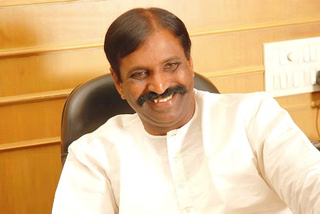
Aam Aadmi Party Rajya Sabha member Raghav Chadha apparently lived 24 hours as a delivery person. He put out a 40-second ‘trailer’ out on X of what is likely to be a larger video recording his day.
In his approach to politics, Chadha is a perfect fit for the Aam Aadmi Party and perhaps the most appropriate successor to Arvind Kejriwal. While most politicians correctly take performance to be a major part of politics, Kejriwal entirely conflates the two. Chadha is only steadying following the footsteps of his party chief.
The latest ‘24 hours as a delivery agent’ show follows Chadha’s crusade for delivery/gig workers starting in late December 2025. In post after post, Chadha inverted the logic of employment, arguing that it was due to the delivery personnel that their employing companies became unicorns rather than conceding that if not for the very companies, the personnel would not have employment in the first place.
Chadha’s ‘bleeding heart’ is an archetype of champagne socialism that keeps rearing its high-on-champagne head every now and then in the field of Indian public life.
Chadha, who is inverting economic logic in order to appear as a crusader for gig workers, got married at the Leela Palace in Udaipur, a hotel where the cheapest room rent as of date is in excess of Rs 70,000/-. He celebrated the first anniversary of his wedding in Maldives, which costs tourists a fortune to stay in, and a little less than a fortune for them to get from the island housing the airport to the island housing their hotel of stay.
Not to forget, Chadha’s party is in power with a back-breaking majority in the Punjab. If buzz in political circles and the internet is to be believed, Chadha was till recently the de facto chief of the state. He could have easily made the state government turn his current demands on delivery companies into law. That is unless he only thought of gig workers in December 2025.
This is a necessary trait of ‘champagne socialists’. They have to compulsorily appear as the most ardent supporters of whatever cause is in vogue at a given period of time, and all available victimhood must be ascribed to the people they claim to represent.
After all, why is Chadha ‘spending a day’ only as a delivery agent and not as a miner or a primary school teacher or as a factory worker? Is it his case that delivery personnel work harder than miners or factory workers or school teachers or sales representatives? Why are these professions not the beneficiaries of Chadha’s comradeship and support? Or is it his case that everything is perfect in these professions and that they need no improvements? Does Chadha believe that delivery personnel are more deserving of his grace than a worker in a textile or a garment factory?
Astute observers over the years have written about how privileged ‘champagne socialists’ agitate for the working population because deep inside they carry a guilt for not being worthy of the privilege they enjoy. To add to it, as Zomato founder Deepinder Goyal pointed out, the modern gig economy makes you confront the working class in person each time you receive your order, highlighting the difference between ‘us’ and ‘them’, often multiple times a day.
Normal people, when seeking to help them, would tip the delivery agent and would wish well for them as a group. But ‘champagne socialists’ have to make it about themselves. Since he has jumped on the gig workers cart, Chadha has not really done as much for them as he shown what he wants to do. Again, performance is politics and politics is performance.
Underlying all of this are fundamental economic and social truths. The gig economy in India has emerged as a significant source of employment, particularly in a country grappling with youth unemployment, skill mismatches, and limited formal job opportunities.
Platforms like Zomato, Swiggy, Blinkit, Zepto, Ola, and Uber have created millions of flexible, on-demand roles, primarily in food delivery, ride-hailing, quick commerce, and freelance services. Government estimates and other reports suggest the sector already employs over a crore workers (with projections reaching close to 5 crore by 2030-2047), making it one of the fastest-growing job creators.
These opportunities are especially vital for semi-skilled or unskilled individuals, migrants from rural areas, fresh graduates, and those sidelined by traditional employment barriers.
One of the key strengths of gig work is its low entry barriers. Workers often need only a smartphone, a two-wheeler (or sometimes none for certain tasks), and basic verification—no formal degrees, interviews, or long-term commitments are required. This democratizes access to income in a labour market where formal jobs remain scarce.
While many enter the gig economy as a primary livelihood, a substantial portion views it as a transitional cushion—a bridge until more stable employment materialises.
At a time when Chadha and his ideological allies seek to introduce poorly thought-out ideas in the gig economy, it is crucial to recognise and support the platforms that have created entire ecosystems of dignified, accessible work where none existed before. Disrupting these platforms through hasty regulation or populist grandstanding risks destroying the very ladder millions are climbing.
The choice is strikingly clear. If livelihoods are to be preserved and grown, silver-spoon wannabe Robin Hoods should sit down.
 Join our