Politics
Parliamentary Panel Recommends Decriminalising 689 Provisions Across 78 Laws In Jan Vishwas Bill Report
Swarajya Staff
Mar 14, 2026, 10:48 AM | Updated 10:48 AM IST
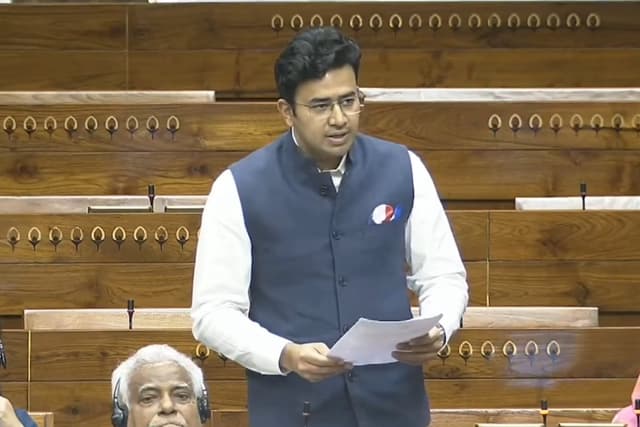
A parliamentary select committee presented its report on the Jan Vishwas (Amendment of Provisions) Bill, 2025 to the Lok Sabha yesterday (13 March), recommending the decriminalisation of 689 provisions across 78 different legislations.
The landmark proposal would result in the removal of more than 1,000 criminal offences related to procedural and technical violations across multiple sectors including municipal governance, motor vehicles regulation, electricity, textiles and agriculture processing.
The committee, chaired by Bengaluru South MP Tejasvi Surya, held 49 sittings since October 2025, reflecting extensive deliberations on the legislation.
Union Minister for Commerce and Industry Piyush Goyal had introduced the bill in the Lok Sabha on 18 August 2025, referring it to the select committee the same day.
The 2025 bill builds upon the Jan Vishwas (Amendment of Provisions) Act, 2023, which had decriminalised 183 provisions across 42 central acts.
The committee recommended replacing imprisonment or criminal fines with civil penalties in areas where offences are procedural or technical in nature, while retaining criminal provisions in cases where public health, safety or systemic integrity could be compromised.
Key recommendations include retaining enforcement powers of the Reserve Bank of India under the RBI Act whilst accepting the removal of certain provisions relating to auditors.
Regarding the Motor Vehicles Act, the committee endorsed proposed amendments aimed at simplifying compliance and reducing legal ambiguity whilst strengthening road safety provisions.
The panel also suggested exploring the creation of a Centralised Regulatory Management System to streamline regulatory compliance across ministries and regulators.
The 24-member committee included representatives from various political parties, including Praveen Khandelwal, Kalyan Banerjee, N K Premachandran and Sunil Dattatray Tatkare amongst others, ensuring cross-party participation in the deliberations.
 Join our