Politics
The 'Petitioner-in-Person' Paradox: Why Mamata Banerjee's Supreme Court Appearance Was Legally Untenable
Shubhendu Anand and Abhishek Dwivedi
Feb 06, 2026, 03:11 PM | Updated 03:11 PM IST
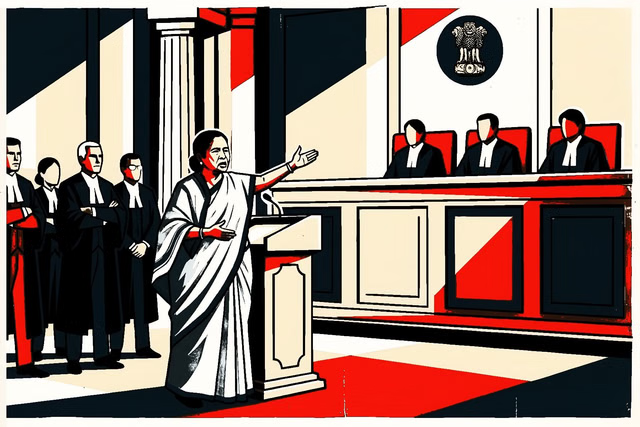
On 4 February 2026, Mamata Banerjee, the sitting Chief Minister of West Bengal, appeared in-person before the Chief Justice's bench of the Supreme Court of India comprising Chief Justice Surya Kant, Justice Joymalya Bagchi, and Justice Vipul Pancholi.
Her writ petition titled Mamata Banerjee Vs. Election Commission of India challenged the Special Intensive Revision (SIR) exercise of electoral rolls being conducted by the Election Commission of India ahead of the state assembly elections in West Bengal.
She alleged that while conducting SIR, the Election Commission of India has disproportionately targeted her state through mass deletions of voters' names in the electoral roll and appointment of micro-observers from BJP-ruled states. She went to the extent of calling a constitutional body a "WhatsApp Commission".
What is surprising, for a Chief Minister with a law degree, is that she was standing before a constitutional court, which has certain decorum, rules, and procedure. She was not in her party office addressing her partymen.
"Historic" for the Wrong Reasons
This attempt by CM Mamata Banerjee to make the constitutional court her platform for political grandstanding was immediately hailed as "historic" by certain sections of the media and her supporters.
Indeed, it was historic for the advocates present in the Supreme Court too. As practising advocates, it was probably their first instance of seeing a petitioner-in-person arguing despite being accompanied by a battery of top lawyers of the country.
This conduct of Mamata Banerjee raises serious apprehensions about the misuse of constitutional and legal rights for political signalling. Many may think of this as a publicity stunt and fear that this may open Pandora's box for political or politically motivated litigation in future, where leaders would personally appear before the court to make statements, despite being represented by able lawyers, and indulge in political grandstanding.
The procedural liberty granted to a litigant to appear in-person and argue his or her case should not be used as a political or publicity tool by politicians.
What the Rules Actually Say
This brings us to an important and relevant rule under Order IV of the Supreme Court Rules, 2013, which reads:
"…Whenever a party wants to appear and argue the case in person, he/she shall first file an application along with the petition seeking permission to appear and argue in person. The application shall indicate reasons as to why he/she cannot engage an Advocate and wants to appear and argue in person, and if he is willing to accept an Advocate who can be appointed for him by the Court. Such application shall, in the first instance, be placed before the concerned Registrar to interact with the party-in-person and give opinion by way of office report whether the party-in-person will be able to give necessary assistance to the Court for proper disposal of the matter or an Advocate may be appointed as Amicus Curiae. If the application is allowed by the Court, then only the party-in-person will be permitted to appear and argue the case in person."
It is explicitly indicated in the above rule that an application is to be made to the Registrar of the Supreme Court of India, and only after due permission of the Registrar, the petitioner is allowed to assist the Hon'ble Court.
However, once an advocate is engaged by the petitioner, he or she ceases to be a "petitioner-in-person".
Mockery of Procedure
In the present case, mockery in the name of petitioner-in-person was evident from the time the matter was taken up for hearing. Despite being represented by a team of advocates that comprised some of the most respected Senior Advocates of the Supreme Court, Mamata Banerjee chose to speak, often interrupting her own counsel.
This made the Hon'ble Chief Justice of India remark, "Madam, you have the best counsel in the Supreme Court to represent you," indirectly asking her not to address the court and let her lawyers do the job.
Banerjee's decision to play the role of part-litigant and part-advocate in the Supreme Court of India has no sanctity in the eyes of law. When a sitting Chief Minister uses this procedural label just to appear "alone against the system" while being represented by the best advocates of the country, it not only hints at political signalling but also amounts to abuse of procedure.
The Courtroom as Political Stage
The other conjecture that people draw is that the courtroom was never a forum for Mamata Banerjee for availing her legal remedies. Rather, it was a stage for her to politicise the issue.
This is also demonstrated by her allegation against the Election Commission of India that "Commission has appointed micro-observers from BJP-ruled States," which was categorically denied by Mr Rakesh Dwivedi, Senior Advocate representing the Election Commission of India.
He informed the court that despite repeated requests by the Commission, the West Bengal government did not provide an adequate number of Group B/Class II officers, leaving the Commission with no alternative but to depute micro-observers from outside the state.
Does this not look like a case of taking advantage of one's own wrong? Mamata Banerjee cannot be permitted to have her cake and eat it too.
Can a Sitting Chief Minister Practise Law?
A lot of people are arguing that Mamata Banerjee is herself a lawyer, with a law degree from Jogesh Chandra Chaudhuri Law College, Kolkata, and has practised law, hence she can argue her case in the Supreme Court of India.
Let us look at what the law says about sitting Chief Ministers' right to practise law or argue their case as lawyers. Rule 49, Part VI of the Bar Council of India Rules states:
"49. An Advocate shall not be a full-time salaried employee of any person, Government, firm, corporation or concern, so long as he continues to practise, and shall, on taking up any employment, intimate the fact to the Bar Council on whose roll his name appears, and shall thereupon cease to practise as an Advocate so long as he continues in such employment."
The Hon'ble Supreme Court of India, in the case of Ashwini Kumar Upadhyay vs. Union of India & Anr, dealing with the question whether MP/MLA/MLC can practise as advocates, noted that:
"As regards the legislators (MP/MLA/MLC) they occupy a unique position. They are not appointed but are elected by the electors from respective territorial constituencies. The fact that they have to take oath administered by the President/Governor before they take their seat in the House, does not mean that they are appointed by the President/Governor as such unlike in the case of the Prime Minister/Chief Minister and Ministers in the Council of Ministers."
The above judgment draws a distinction between a sitting Chief Minister and ordinary legislators (MLAs/MLCs) when it comes to practising law and/or appearing in court to argue a case.
Chief Minister Mamata Banerjee, as the executive head of the government, draws continuous remuneration from the public exchequer and exercises constitutional power, which bars her, in law and ethics, from presenting herself as a practising advocate before the Supreme Court.
Neither Petitioner-in-Person Nor Practising Advocate
Chief Minister Mamata Banerjee's appearance before the Supreme Court was neither permissible under the Supreme Court Rules, 2013 as a petitioner-in-person, nor as a practising advocate under Rule 49 of the Bar Council of India Rules.
This selective cherry-picking, where top lawyers handle legal arguments and technicalities while the sitting Chief Minister delivers populist soundbites like "Save democracy" and "Justice crying behind closed doors," is nothing but an attempt to turn courtroom proceedings into a media event, which shall be discouraged at all costs.
Let courts remain courts. There are enough avenues to play politics outside the hallowed corridors of the judiciary.
The authors, Shubhendu Anand & Abhishek Dwivedi, are advocates practicing in the Supreme Court of India.
 Join our