Politics
Tragedy Of The Thespian: Why Kamal Haasan's Rajya Sabha Debut Should Embarrass Him
K Balakumar
Feb 07, 2026, 11:43 AM | Updated 12:53 PM IST
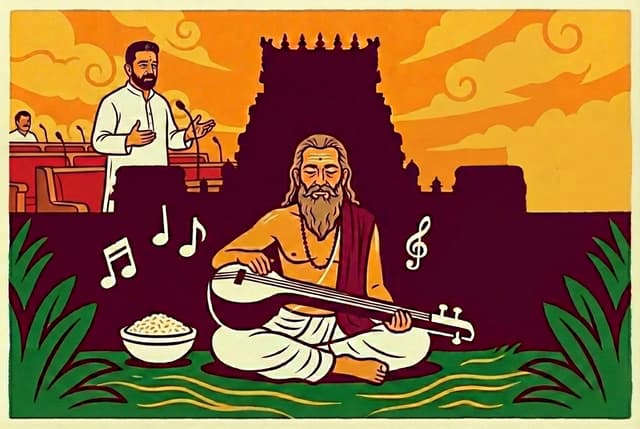
The actor's debut speech was a distortion, as bombast replaced fact, and a saint's humility was dragged through the mud to serve a tired Dravidian trope
Kamal Haasan's maiden speech in the Rajya Sabha should have been a moment of gravitas. An actor-politician finally stepping onto the constitutional stage, exchanging arc lights for parliamentary focus. But what we got instead was a performance that was overwritten, under-thought, and finally self-defeating. It was comical in delivery, farcical in substance, and deeply regrettable in its intent.
At the heart of Kamal Haasan's speech was a fabricated grievance. Finance Minister Nirmala Sitharaman, in her Budget address, had quoted EV Ramaswami Naicker's infamous slur that Tamil was fit only for begging. The Finance Minister, it had to be said, was merely citing the Dravidian leader's recorded words. But in the echo chamber of Dravidian politics, nuance is an inconvenience. The quote was venomously twisted into a claim that the Finance Minister herself had demeaned Tamil.
Silly theatrics
Kamal Haasan picked up this distortion and thundered away in the Rajya Sabha, berating the Finance Minister for an offence she never committed. It was rhetoric built on a lie. It was indignation fuelled by fiction. Worse, the language he used was typically labyrinthine, self-important, and theatrically emphatic. It managed to confuse even those accustomed to his famously convoluted monologues.
He spoke as if he were delivering a Mark Antony oration, pausing for applause that never came, and finally sat down with the air of a man who believed he had made history.
Social media, inevitably, had its fun. Memes flourished, but beyond the amusement lay something more troubling. Embedded within this speech was Kamal Haasan's now-familiar habit of taking potshots at Hindu traditions, reducing complex spiritual practices to crude caricature in order to impress his ideological patrons.
This time, the unwitting victim was Saint Tyagaraja.
Desecrating the divine
Kamal Haasan equated the saint's Bikshai Pathram (the ceremonial vessel tied to ascetic way of living) to a beggar's bowl.
To understand the depth of this insult, one must understand the ceremonial unja vrithi. Unlike the act of begging, which is born of necessity or destitution, unja vrithi is a rigorous spiritual discipline practised by the most elevated souls. It is a vow of voluntary poverty and total surrender to the Divine.
A practitioner of unja vrithi does not ask for money. He or she walks the streets singing the praises of God, accepting only small handfuls of grain offered voluntarily by householders. It is designed to crush the ego. By living on the grace of the community, the saint acknowledges that he owns nothing, not even his next meal.
In essence, Tyagaraja was no destitute. He was offered royal patronage by the Thanjavur Maratha court, which he famously declined, choosing instead a life devoted entirely to Lord Rama.
Of course, Kamal's pejorative words were not stated plainly. Kamal prefers obliqueness, a fog of words that allows him to get away with many things because most of us can't comprehend what he says.
Repeat offender
But this is not unprecedented. In 2020, during an online interaction with actor Vijay Sethupathi, Kamal Haasan referred to Tyagaraja as a "beggar". The remark drew protests of sorts from sections of the Carnatic music fraternity. The moment, however, coincided with the Covid lockdowns, and the outrage dissipated in the backdrop of the larger chaos happening then.
As you can see, Kamal Haasan has this tendency to flatten Hindu traditions into uncharitable interpretations. Rituals as superstition, renunciation as deprivation, and devotion as submission. These are not critiques arrived at through study or empathy, but slogans inherited wholesale from a certain strain of Dravidian polemic that thrives on antagonism to Hindu civilisational ideas and traditions.
That this is done by a man who otherwise prides himself on nuance and complexity makes it all the more galling.
Rajya Sabha is no film set
Anyway, what Kamal Haasan offered in Rajya Sabha was neither honest nor informed. He built his speech on a false premise, ornamented it with theatrical bluster, and then used the occasion to sneak in a slur against one of India's greatest cultural figures.
And it matters because the Rajya Sabha is not a film set. Words spoken there do not dissolve with the closing credits. They enter the public record. When a Member of Parliament misrepresents history, maligns tradition, and propagates falsehoods, it corrodes the quality of democratic discourse itself.
The tragedy is not that Kamal Haasan criticised a Finance Minister. That is his right. The real tragedy is that he did so on a lie, and then chose to drag a saint, who lived, composed, and died in luminous devotion, into the gutter of political point-scoring.
 Join our