Politics
When Fairness Becomes Optional: BJP, UGC, And A Savarna Trust Deficit
Abhishek Kumar
Feb 05, 2026, 11:23 AM | Updated Mar 04, 2026, 03:52 PM IST
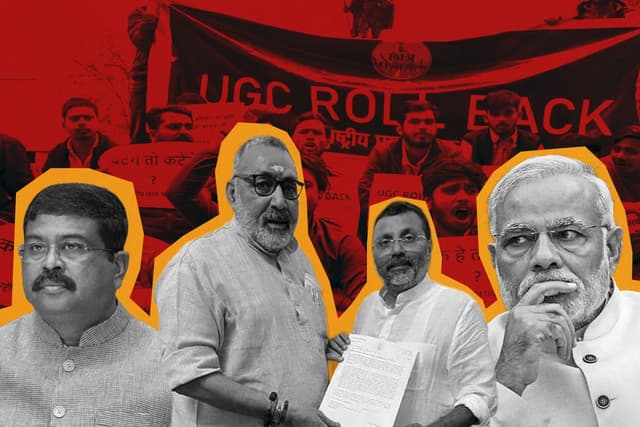
On Republic Day, a Provincial Civil Services officer in Uttar Pradesh sent his resignation to the Governor. In Kaushambi, a district head of an outfit calling itself Savarna Army wrote to the Prime Minister in his own blood. Eleven BJP functionaries resigned across the state.
These were not fringe elements. They were the party's own people: booth-level workers, middle-class professionals, bar association members, and retired officers, many of whom have delivered election after election, canvassing in summer heat while asking nothing in return.
In mid-January, they got a shock. And then outrage followed.
The shock was the University Grants Commission's new equity guidelines, issued earlier that month. Within a fortnight, the Supreme Court stayed implementation, calling the regulations "vague" and "capable of misuse". But by then, the damage was done. Not to the regulations, which will be revised and reissued in some form, but to the compact between the BJP and the community that has been its most faithful electoral base for three decades.
The Regulations
The UGC notification defined "caste-based discrimination" as discrimination specifically against members of Scheduled Castes, Scheduled Tribes, and Other Backward Classes. Not discrimination based on caste, but discrimination against particular castes. The 'General Category' population was explicitly excluded from this definition.
Under these regulations, if a Brahmin student is mocked for his caste, denied opportunities because of his surname, or subjected to harassment for wearing a janeu, the institutional machinery offers him nothing. The Equal Opportunity Centres, the Equity Committees, the 24-hour helplines, the Equity Squads that would patrol campuses—none exist for him. In the eyes of the UGC, he cannot be a victim. His birth disqualifies him from victimhood.
The equity committees mandated at every institution must include representatives from SC, ST, OBC communities, women, and persons with disabilities. No provision for general category representation exists. When accusations are made, the accused faces a tribunal on which his community is not mandated to have a voice.
The draft regulations had included a clause providing penalties for "false or frivolous" complaints. The final notification removed it entirely. In a country where the Supreme Court itself has lamented the weaponisation of laws like Section 498A and the SC/ST Act—laws in which the presumption of innocence is inverted—the UGC decided that safeguards against false accusations were unnecessary.
1990–2024
To understand the unprecedented outrage of January 2026, it is important to first study three decades of accumulated grievance.
The students who protested the Mandal Commission in 1990—most now on the verge of retirement—detest what they term the 'falsity of narrative' regarding the status of Other Backward Classes.
The Mandal Commission introduced a new social division in politics, rooted in measurable economic and educational inequality, tracing it back to the ritual hierarchy of traditional caste discourse.
But certain observations regarding that division were different from its political packaging.
As data on SC/ST Atrocities Act cases would later reveal, the perpetrators in Dalit atrocity cases were more substantially OBCs than 'Savarnas'.
The Indian National Congress's electoral formula of uniting 'general category' voters, Dalits, and Muslims precisely to sideline the numerical dominance of OBCs stands as political vindication of this reality.
Popular narrative, however, continued to hold that a minority had kept the majority at the lower social bracket for thousands of years. Post-1990 university education irrigated this narrative. Content creators, lecturers, UPSC teachers, and journalists-turned-YouTubers reaped the advantage of it in the post-smartphone era.
Today, the majority of average 'non-Savarna' Indians believe the 'Savarna' class is guilty of snatching everything from the former for millennia. It is a political narrative, but the internet's dividing algorithms have pushed it to extremes.
When Rashtriya Janata Dal spokesperson Kanchana Yadav openly talked about framing Savarna students, her party—which now actively courts that community—issued no warning note. There was little uproar against the advocacy of unnatural justice in the garb of social justice.
The BJP's Bargain
For years, the BJP's pitch to 'upper castes' was simple: you may not get targeted benefits, but the state will remain fair.
'Savarnas' who had revolted against Mandal in the 1990s stayed with the party. The BJP expanded its kamandal in traditional Mandal strongholds, securing enough voters to govern major northern Indian states through a multifaceted appeal: unified Hindu identity combined with manoeuvred tempering of economic policies and emphasising targeted welfare delivery.
The party's calculation was that 'Savarnas' would remain in its fold with rule of law and fairness regarding law's spirit, while it cultivated SCs, STs, OBCs, EBCs, and even Pasmanda Muslims. The strategy was to court backward classes and SC/STs through community legends like Ambedkar, 'Savarnas' with cultural affiliations (read Hindutva) and representation of their leaders, and the poor from all communities through targeted welfare delivery.
The glitch came when welfare delivery plateaued. The party's stupendous performance on this parameter in a short span meant it had little left in its distributive packets. Welfare quickly moved from being electorally expedient to the bare minimum for preserving newly gained voters. Every election cycle now demands a new set of welfare.
Simultaneously, Ambedkar's importance graduated from equality advocate to demigod in political and social discourse.
The 2024 Lok Sabha exposed this weakness. The narrative of BJP conspiring to end the Constitution and reservation showcased the thin ice of backward support the party stands on. Even with a decade of its changed avatar, 'non-Savarna' support to BJP was still vulnerable to the slightest of pulls from the other side.
For 'Savarna' voters, the only positive development in the reservations debate in the last decade has been EWS reservations.
The negatives are starker, foremost of which is the continuing status as historical oppressors during an era when their favoured government occupies the centre. The majority of online narrative-makers for their favourite party belong to the 'Savarna' community, yet they could not change the institutional discourse in universities and conferences.
Resurgence of Social Conflict
Alongside policy grievances, a sense of resurgent social conflict has emerged. The rise of Chandrashekhar Azad's Bhim Army, now represented in Parliament from Nagina, does not look like an encouraging signal from the 'Savarna' perspective. In Uttar Pradesh, Madhya Pradesh, and Bihar—especially Bodh Gaya—the outfit has been at the forefront of dozens of controversies. The Gwalior High Court incident over installing Ambedkar's statue became a major flashpoint.
In Maharashtra and other states, multiple instances of Ambedkarite outfits' aggression have emerged as a source of concern. Using the legally coercive mechanism of unconditional arrest under the SC/ST Act has gained mainstream acceptance. On 'Savarna' social media feeds, such threats have become normalised. Manuvad versus Ambedkarism is the popular framing.
Many prominent voices claiming to speak for the 'Savarna' community hold the Modi government responsible, especially for how it buckled under public protests to amend the SC/ST Act and add automatic arrest provisions. Chronic issues like differential cut-offs continue burning fuel.
Consider the 'Savarna' perspective. The community sided with BJP after growing frustrated with Congress's minority politics and the emergence of dominant OBC outfits. BJP's 2014 rise under an OBC face was supposed to work as a bulwark against aggression, since BJP's machinery disciplines the undisciplined. For instance, a strongman like Samrat Chaudhary would be given charge of cleansing Bihar's law and order machinery through bulldozer action. "BJP's gunda also tends to behave more civilised after joining its ranks" is a common line among core BJP vote banks.
That is why 'Savarnas' were never uncomfortable with the BJP’s outreach to OBCs. The problem is that the BJP imported some ideas and tactics coming from Ambedkarite groups. While this may have made strategic sense, it came across as settling old scores. Things got worse when regional OBC parties teamed up with Ambedkarite groups to protect their shrinking vote banks.
The Communication Failure
The BJP's response to the UGC crisis revealed its strategic blindness.
One prominent political reporter on a Hindi news channel revealed that party leaders gave her bullet points against the guidelines so she could utter what they could not due to party discipline. What worsened the situation was Godda MP Nishikant Dubey's clarification. In tweet after tweet, he mentioned the Modi government's decision to provide a 10 per cent EWS quota. Despite heavy backlash, he kept returning, and so did the backlash.
The government sent Dharmendra Pradhan to calm public anger. His assurance that no injustice would occur reassured no one and instead exposed how the decision had been made—arbitrarily and on ideological grounds, with approval from the top leadership. Later, Digvijay Singh, who chaired the parliamentary committee, disclosed that members’ suggestions were ignored in favour of one-sided regulations.
What the 'General Category' did get was support from community members who vociferously opposed the government, despite in many cases being insiders.
This is where the BJP failed. The party's lack of strategic political communication did almost more damage than the guidelines themselves. The BJP assumed this anxiety could be managed the old way: representation at the top, reassurance in rhetoric. That approach failed spectacularly.
The Grammar Shifts
For 'Savarna' influencers and opinion-shapers, such moments of administrative "ignorance" have provided the first solid, evidence-based groundwork for altering the grammar of regional politics.
For decades, the moral architecture of Indian politics rested on a stable binary: ''Savarnas' as historical oppressors, OBCs, SCs, and STs as the oppressed', and the state as messianic protector of the marginalised. The BJP inherited this framework largely intact, choosing not to dismantle it but to soften its edges through civilisational issues, invoking Hindu unity while leaving institutional grammar untouched.
Has that approach now run its course?
The language of oppression—once monopolised by subaltern politics—has begun to migrate upward. In Prayagraj tea stalls and Lucknow University faculty rooms, 'Savarnas' no longer speak the language of inherited privilege. They speak the language of persecution.
'General category' students talk of institutional vulnerability. Parents speak of career risk and, by extension, threats to livelihood. Professionals increasingly frame their anxiety in terms of a presumption-of-guilt architecture, where accusation precedes inquiry and procedure is subordinate to signalling.
This worldview is not rooted in denial of caste discrimination, but in how anti-discrimination frameworks are read by those outside their protective ambit. The UGC's equity regulations are perceived not as safeguards for the vulnerable but as one-sided weaponisation of grievance—a system where accusation itself becomes punishment, procedural balance becomes expendable, and symbolic assertion takes precedence over due process.
This marks a profound existential pivot. For a community whose political loyalty was built not on material redistribution but on institutional confidence—the belief that the state, even when redistributive, would remain procedurally neutral—this crossed a red line.
That is why protests were led not by political parties or career activists but by bar associations, student groups, faculty collectives, and retired officers: precisely those whose relationship with the state is mediated through institutions rather than patronage. That is why giving representation to 'Savarna' leaders is on the verge of being seen as tokenism. If the institution's code of conduct does not guarantee natural justice, representation of a person from the community can only delay what is inevitable, not stop it.
The new generation of upper castes increasingly see themselves not as beneficiaries of privilege but as administratively exposed minorities. The rhetoric mirrors, almost eerily, the language of OBC mobilisation after Mandal: we are being structurally cornered. The general category now views the state as a predatory entity using "equity" as a euphemism for institutional purging.
The expansion of the SC/ST Act's scope, the perceived impunity of radical identity groups, and BJP's mid-2025 pivot toward supporting caste enumeration have crystallised this perception into a single phrase circulating widely: Mandal 2.0. In this narrative, the state is no longer a neutral arbiter but an actor that trumps merit and legal safety to satisfy electoral arithmetic.
There is, however, a crucial difference between OBC and 'Savarna' politics. For OBCs, the state's ostensibly neutral actions were often perceived as covertly biased, with resentment directed both at upper castes and the state. For 'Savarnas', the sense of being cornered is sharper and more direct. State policies are not seen as subtly unfair but as explicit, in-your-face bias.
Savarna anger is concentrated almost entirely on the state—read, in electoral terms, as the government itself. The parallel with the "criminal tribes" framework of colonial India is now openly drawn: the state has created a presumption-of-guilt architecture where birth determines whether one can be a victim or must always be a perpetrator.
The Numbers That Matter
The bigger problem for BJP lies in the timing of this grievance moving from periphery to mainstream.
In the last few elections, the party seems to have met the limits of welfare-beneficiary mobilisation. The party finds it hard to convert welfare goodwill into ideological dedication. In Uttar Pradesh alone, vote share collapsed from 50 per cent to 41 per cent in 2024, while the SP-led INDI alliance won 43 seats against NDA's 36.
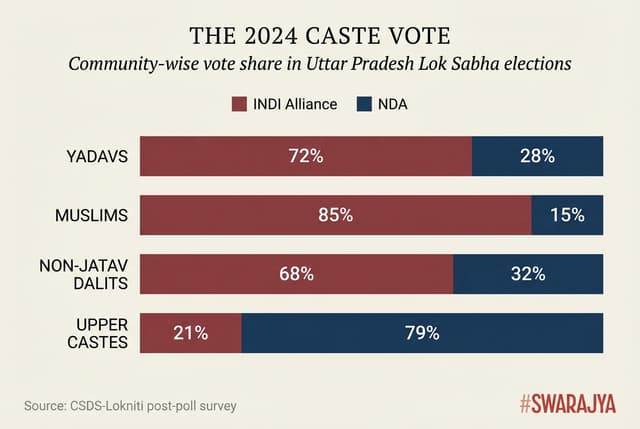
Post-election surveys by CSDS-Lokniti and other agencies reveal that the Constitution-and-reservation narrative successfully consolidated Yadavs (82 per cent for INDI), Muslims (92 per cent), and made significant inroads among non-Jatav Dalits (56 per cent for INDI) and non-Yadav OBCs.
Upper castes remained with BJP at 79 per cent—still the party's most loyal demographic by far. But this loyalty came without reciprocal material delivery.
Nationally, BJP's vote share moved from 31.2 per cent (2014) to 37.4 per cent (2019) to 36.5 per cent (2024). The 2024 decline appears modest in aggregate but conceals sharp regional reversals. Uttar Pradesh alone tells the real story: from 71 seats in 2014, the party slipped to 62 in 2019 and collapsed to 33 in 2024. No other state contributed as decisively to pulling BJP's national tally to 240—a full 32 seats short of the halfway mark.
Beneath these numbers lies a deeper structural shift: steady bipolarisation of Indian elections. Take Madhya Pradesh for example. Between 2018 and 2023, BJP's vote share surged from 41.1 per cent to 48.6 per cent while Congress stagnated around 40 per cent. Together, the two parties cornered 89 per cent of votes—the highest ever in the state.
Post-2024 assembly elections reinforce this pattern. Haryana, Delhi, Jharkhand, Maharashtra, and even Bihar show shrinking space for third forces. Bihar, long known for leaving nearly a quarter of the electorate for non-aligned players, saw that space contract to just 15.5 per cent in 2025.
This matters because bipolar elections make BJP structurally vulnerable even when seat tallies temporarily obscure the risk. Roughly 50 per cent of Hindus do not vote for BJP. The party's path to majority hinges on two conditions: consolidating the remaining half while preventing erosion within its core base. That is why groups such as Yadavs in Uttar Pradesh, Madhya Pradesh, and Bihar; Santhals in Jharkhand; and backward classes in Tamil Nadu remain electorally indispensable—and politically volatile.
Among all social blocs, 'Savarnas' are the only group that delivers near-decisive consolidation to BJP. If that consolidation weakens—through demobilisation, NOTA votes, or independent candidates—the arithmetic shifts sharply.
The Impossible Arithmetic
Nowhere is this clearer than in Uttar Pradesh. Savarnas constitute just 18–20 per cent of the population—roughly 9 per cent Brahmins, 8 per cent Thakurs and Rajputs, with smaller shares of Bhumihars, Kayasthas, and Baniyas. Yet they remain decisive in 140–150 assembly seats due to the first-past-the-post system.
In Purvanchal alone, over 90 seats hinge on Savarna votes; in Awadh, over 60; in Western UP, over 25. Recent mahapanchayats of Tyagi and Jat communities declaring an end to "captive voting" underline how fragile this consolidation has become.
Bihar sharpens the contradiction further. According to the 2023 caste census, upper castes make up just 10.57 per cent of the population. Individually, Bhumihars stand at 2.86 per cent, Brahmins at 3.66 per cent, Rajputs at 3.45 per cent, and Kayasthas at a mere 0.60 per cent—down from a combined 13 per cent in 1931. Yet during the 2020–2025 assembly term, these groups held 64 of 243 MLAs. OBCs and EBCs together constitute 63 per cent of the population.
More revealing is the poverty data. A striking 27.58 per cent of Bhumihar families live below the poverty line—the highest among 'forward castes'—puncturing the myth of uniform 'Savarna' prosperity. Yet in the 2025 elections, BJP allotted 49 of its 101 tickets—nearly 50 per cent—to 'upper-caste' candidates representing barely a tenth of the state's population.
Madhya Pradesh and Rajasthan replicate this pattern in organisational form. In MP, 'upper castes' account for 12.9 per cent of the population but occupy nearly 70 per cent of BJP district president positions. Rajasthan is starker still: 71 per cent of district presidents are 'upper caste'. Rajputs, just 6 per cent of the state's population, won 24 of BJP's 29 tickets in 2018.
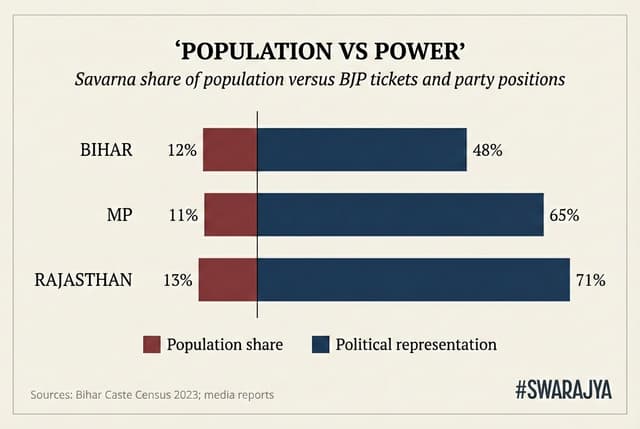
In light of the UGC equity regulations, this disproportionate presence masks a deeper unease. What 'Savarnas' increasingly enjoy is symbolic power without policy protection—visibility without security. In a bipolar electoral system, even a small crack in their political mobilisation can trigger outsized consequences.
The Dilemma
The BJP faces an irreconcilable choice: prioritise non-Savarna outreach to counter SP's PDA formula, or secure the 'Savarna' base before expanding elsewhere.
The deeper structural problem is that BJP has no policy framework that can simultaneously satisfy both coalitions. EWS reservations were intended to offer a form of economic parity, but in practice they have been hampered by unfilled vacancies, procedural ambiguities, and verification difficulties. Caste census appears inclusive but terrifies 'upper castes' as a prelude to further exclusion. Cabinet representation offers visibility without institutional protection.
Every symbolic gesture now gets read as confirmation that 'Savarnas' are valued for their labour during elections but expendable when governing requires arithmetic.
What comes next is not a dramatic exit—'upper castes' have no viable alternative party. What comes is demobilisation: the booth worker who chooses to skip one election cycle, the IT cell volunteer who goes quiet, the professional who votes but does not campaign. In first-past-the-post arithmetic, even 10–15 per cent reduced turnout of a group is the difference between majority and coalition dependency.
The UGC crisis was the catalyst, not the cause. The underlying compact—cultural allegiance in exchange for institutional fairness—has been broken. Repairing it will now require more than rhetoric. Or the BJP can continue managing coalitions through symbolism and discover, too late, that its fixed deposit has become the most expensive loan in Indian politics.
A new judicious UGC guideline being announced by a non-Savarna MP of BJP can arrest this decline.
Abhishek is Staff Writer at Swarajya.
 Join our