Punjab
AAP Just Made Its Biggest Political Mistake In Punjab By Breaking An Unwritten Rule
Abhishek Kumar
Mar 11, 2026, 09:28 AM | Updated 10:00 AM IST
The Aam Aadmi Party has just made the most consequential political mistake of its four years in Punjab, one that may not be recoverable.
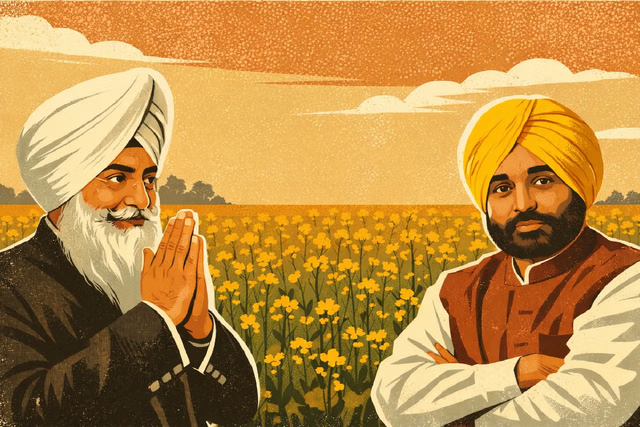
On 3 February 2026, Punjab Chief Minister Bhagwant Mann posted a Punjabi couplet on X mocking Gurinder Singh Dhillon, the spiritual head of Radha Soami Satsang Beas (RSSB): "Whether they become so today or tomorrow, God help those courts where visitors start acting as judges."
Dhillon had visited Nabha jail to meet Bikram Singh Majithia, a relative by marriage, and told reporters outside that the charges against Majithia were false and baseless. All it took was a private visit and an ill-advised remark for the chief minister to turn it into a political rupture.
In fewer than 140 characters, Mann did what no sitting Punjab chief minister, across parties and across decades, had done before him. He publicly picked a fight with a major dera chief. And in doing so, he may have ended AAP's political future in the state.
From Surjit Singh Barnala through Beant Singh, Prakash Singh Badal, Amarinder Singh and Charanjit Singh Channi, no sitting Punjab chief minister had publicly confronted a major dera chief. The restraint held across governments of every party and temperament.
It was political, not devotional. Every chief minister understood that Punjab's dera networks are embedded in village society, kinship structures and caste solidarities in ways that no government scheme can replicate.
Mann broke that compact in fewer than 140 characters. To understand why this is so damaging, return to 10 March 2022.
Sixty-Six Seats and What Carried Them
AAP won 92 of Punjab's 117 assembly seats, the largest majority in the state's history. The sweep was concentrated in Malwa, where AAP took 66 of 69 seats, historically an Akali stronghold.
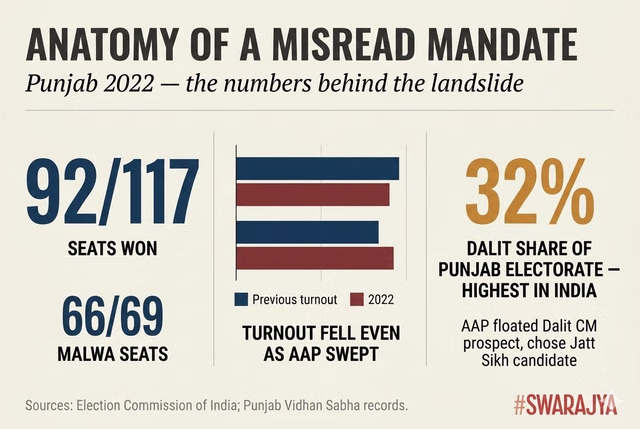
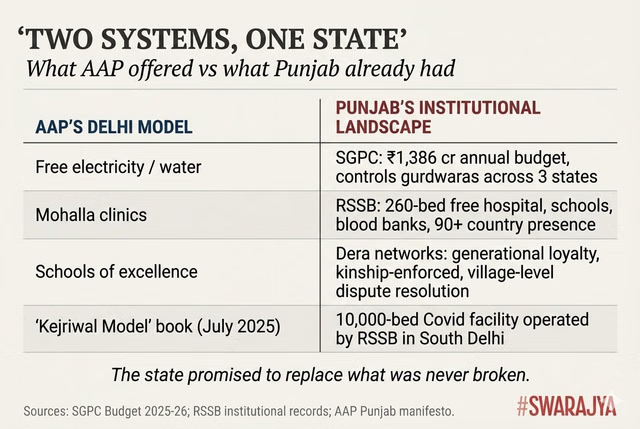
RSSB's influence spans at least nineteen assembly constituencies across this belt. The organisation's following runs into millions across northern India, with centres in more than ninety countries. Among Dalits, who constitute thirty-two per cent of Punjab's electorate, the highest proportion of any Indian state, RSSB's social infrastructure is deep and irreplaceable.
The Maharaj Sawan Singh Charitable Hospital operates 260 beds across multiple specialties, free to all regardless of caste. The organisation runs schools, maintains blood banks, and during the second Covid wave operated what was then the country's largest care facility: a ten-thousand-bed centre in South Delhi.
Through hospitals, community service and informal dispute resolution, RSSB has built a parallel welfare system that the state in Punjab has never matched.
Sustained dera alienation in this belt can shape the outcome in twenty to thirty seats. Those are not peripheral constituencies. They are the foundation on which AAP's 2022 majority was built. Mann has taken a sledgehammer to that foundation. This was not a one-off lapse by the chief minister, who is now infamous for free-spirited gaffes.
Through December 2025 and January 2026, Mann had already been escalating on a separate religious-institutional front. An FIR regarding 328 missing saroops from the SGPC's publication house was registered, reviving a five-year-old case precisely as the Akali Dal was showing signs of recovery after a by-election in Tarn Taran. SGPC leadership called it interference in religious affairs. The Akal Takht summoned the chief minister.
Mann appeared on 15 January and told the Akal Takht he was "not well versed with Sikh principles." His own MLA from Banga resigned from a party post over remarks Mann had made targeting a gurdwara. Three weeks later, the RSSB front opened.
In the space of two months, Mann has managed to antagonise both the SGPC and RSSB, the two institutional pillars that between them structure much of Punjab's social and political life. More than a strategy, it is political self-destruction on two fronts simultaneously.
A Mandate Built on Rejection
Punjab did not choose AAP in 2022. It rejected everyone else. The Akali Dal had been hollowed out by the drug crisis, the Bargari beadbi incident, the police firing at Kotkapura, and the pardon facilitated for Dera Sacha Sauda chief Gurmeet Ram Rahim.
The Congress had been consumed by the Amarinder Singh-Navjot Sidhu rivalry. Voter turnout fell by roughly five percentage points despite the scale of AAP's victory. AAP swept 66 of Malwa's 69 seats on a wave of rejection, not endorsement.
A party that arrived on those terms cannot afford to create new reasons for rejection. That is precisely what Mann has done, and against the very communities whose disillusionment with the Akalis delivered him those seats.
It is possible that AAP believes its mandate rests primarily on Jat Sikh consolidation, and that dera networks are dispensable. If so, this is a misreading of 2022 that the 2027 results will correct decisively.
The Grammar Mann Never Learned
Punjab's public sphere operates on a different grammar from Delhi's. In the capital, the state is the primary welfare provider and religious institutions do not dominate political life. The "Kejriwal model" works there.
In Punjab, the Shiromani Gurdwara Parbandhak Committee, with an annual budget of Rs 1,386 crore for 2025-26 and control of major historic gurdwaras across three states, functions almost like a parallel administrative system. Dera networks operate at a level government schemes cannot reach.
Confronting them publicly is not reformist. It is reckless.
The party's own response confirms the scale of the blunder. Three ministers, Hardeep Singh Mundian, Mohinder Pal Bhagat and Dr Ravjot Singh, were directed by the party leadership to maintain active contact with RSSB and Dera Sachkhand Ballan, alongside seven Dalit MLAs.
If the confrontation was deliberate, the damage control would not have been this frantic. If it was accidental, it reveals a chief minister operating without political supervision on the most sensitive institutional terrain in the state.
The Akali Dal, for all its failures, understood the mechanics of Punjab's dera landscape: neither confrontation nor subordination, but calibrated distance. By November 2024, Sukhbir Badal had resigned the party presidency. By August 2025, the Akali Dal had formally split.
The traditional opposition was in ruins. AAP had until 2027 with a clear field and the largest legislative majority in Punjab's history. All it had to do was not make enemies it did not need to make.
Mann has made them. The communities that delivered those 66 Malwa seats are watching.
And mandates built on rejection, not loyalty, do not survive the creation of new grievances. AAP has until 2027. The clock, after February 2026, is running considerably faster.
Abhishek is Staff Writer at Swarajya.
 Join our