Punjab
The Majithia Question: Can BJP Find A Way Into Rural Punjab — And At What Cost?
Abhishek Kumar
Feb 10, 2026, 07:30 AM | Updated 05:31 PM IST
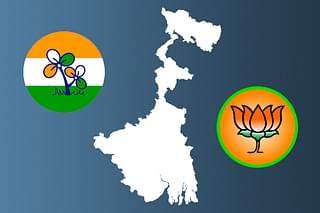
The BJP's Punjab problem is simple to state and hard to solve. The party recorded its highest-ever vote share in the state in 2024 and won zero seats, because its support is confined to urban Hindu pockets in a state where rural Sikh voters decide elections. Its apparent answer has been to court Punjab's powerful deras and signal a rapprochement with Bikram Singh Majithia, the Akali strongman and Sukhbir Singh Badal's brother-in-law, whose ties to Radha Soami Satsang Beas offer access to a rural mobilisation network no BJP leader can match.
But Majithia carries the drug-era baggage that destroyed the SAD-BJP government in 2017. The party must decide before 2027 whether this bridge to the countryside is worth crossing.
'Tiger Abhi Zinda Hai' - The Tiger Is Still Alive
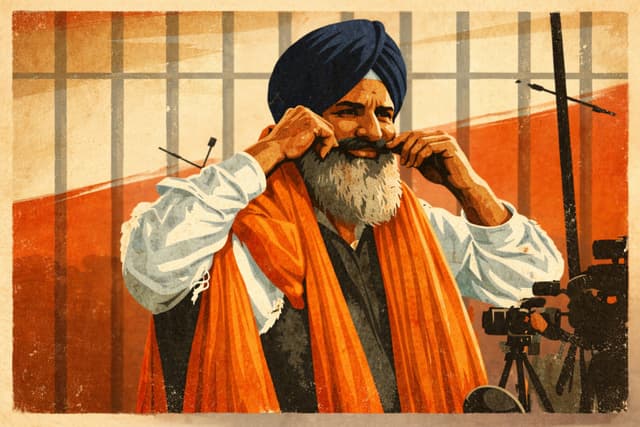
When Bikram Singh Majithia walked out of Nabha Jail on 4 February 2026, twirled his trademark moustache, and declared "Tiger abhi zinda hai" to cheering Akali workers, he was not merely celebrating a Supreme Court bail order.
He was announcing the return of a political infrastructure that the Bharatiya Janata Party desperately needs but cannot publicly embrace. Therein lies the central dilemma now confronting the saffron party in Punjab, eighteen months before assembly elections it has no credible path to winning alone.
The bail itself, granted by Justices Vikram Nath and Sandeep Mehta in a disproportionate assets case alleging Rs 540 crore accumulated through drug money laundering, was legally unremarkable. The court noted Majithia's seven-month detention, his existing bail in the predicate 2021 NDPS case, and the completion of investigation, with a 40,000-page chargesheet with 272 witnesses already filed.
But the political choreography surrounding the release was anything but routine.
A day before the order, Radha Soami Satsang Beas chief Gurinder Singh Dhillon, the head of one of northern India's most influential spiritual organisations with an estimated following exceeding 30 lakh in Punjab, visited Majithia at Nabha Jail and told the media that the cases against him were "false and baseless."
This was extraordinary from a man who had, during the 2024 Lok Sabha elections, publicly declared the dera "apolitical."
More significantly, Punjab BJP president Sunil Jakhar immediately issued a statement noting that "the statements made by saints don't go waste," describing Majithia as an innocent man jailed by a vindictive AAP government.
Though Jakhar told The Tribune his words should not be read as signalling a SAD-BJP alliance, there are very few takers in the state's political class who believed him.
A Head Without a Body
BJP's response to Majithia's release matters more than the release itself due to its record in Punjab over the past five years. It is a record of urban concentration and rural dilution: a party that polls respectably in aggregate but cannot convert votes into seats because its support is structurally confined to Hindu-majority urban pockets while the state's 117 constituencies are overwhelmingly determined by rural Sikh voters.
In the 2024 Lok Sabha elections, the BJP, contesting independently for the first time after SAD walked out of the NDA in 2020 over the farm laws, recorded its highest-ever vote share in Punjab at 18.56 per cent. It won zero seats. Not one.
The Congress swept seven of thirteen constituencies, AAP took three, and even the diminished SAD managed Bathinda through Harsimrat Kaur Badal.
The BJP's second-place finishes in Gurdaspur, Jalandhar, and Ludhiana revealed a consolidated Hindu vote, but a Hindu vote alone cannot win in a state where Sikhs constitute approximately 58 per cent of the electorate and dominate 65-odd rural and semi-rural constituencies.
If the Lok Sabha results exposed the problem, the December 2025 Zila Parishad elections confirmed its seriousness. Of 346 Zila Parishad zones across 22 districts, the ruling AAP captured 218. Congress managed 62. SAD won 46, a modest but symbolically significant recovery, including in Bargari, the site of the 2015 sacrilege incident that had damaged the party's image among orthodox Sikhs.
The BJP won seven.
In Panchayat Samiti elections, the party's tally was 73 out of 2,838 zones, its rural presence limited almost entirely to Fazilka and Pathankot. Party leaders called it a "good beginning."
These numbers represent a crisis for a party that rules at the Centre and considers every state election a critical contest. The BJP in Punjab is, to borrow a phrase used by party insiders, a head without a body. It has national branding, central resources, and high-profile defectors like Sunil Jakhar (formerly Congress president) and Captain Amarinder Singh (formerly Congress chief minister), but no soldiers in the villages.
Without a rural structure or what multiple party sources describe as a "Sikh shield," the BJP remains decoupled from the state's agrarian ecosystem.
The Dera Strategy: Ballan and Beas
The BJP's response to this structural weakness has been to bypass conventional party-building and go directly to the institutions that actually command rural allegiance in Punjab: the deras.
Prime Minister Narendra Modi's visit to Dera Sachkhand Ballan in Jalandhar on 1 February 2026, just three days before Majithia walked free, was the most visible expression of this strategy.
Modi arrived at the Ravidassia community's holiest shrine on the 649th Guru Ravidas Jayanti, performed ardas and parikrama, touched the feet of Sant Niranjan Dass (who had been awarded the Padma Shri at the Republic Day ceremony just days earlier), renamed the Adampur airport as Sri Guru Ravidas Ji Airport, and addressed the gathering with only two chairs on the stage: his and the Sant's.
Dera Sachkhand Ballan exercises direct influence over at least 19 of 23 assembly seats in the Doaba region, where Dalits, 34 per cent of Punjab's population (the highest proportion in any Indian state), are the decisive electoral force.
Read this alongside RSS chief Mohan Bhagwat's repeated pilgrimages to Radha Soami Satsang Beas (in 2012, 2014, 2018, and most recently December 2023, when he held an hour-long closed-door meeting with Gurinder Singh Dhillon), and the pattern becomes unmistakable.
The BJP and the Sangh Parivar are conducting a systematic courtship of Punjab's dera network: the Ravidassia vote through Ballan, the broader rural Sikh and Hindu vote through Beas.
These are not random acts of spiritual tourism. They represent a coordinated attempt to acquire the religious legitimacy that the BJP lost during the farm protests, using institutions that rural Punjabis actually venerate, rather than party structures that rural Punjabis actively distrust.
The RSSB Connection
The RSSB connection leads directly to Majithia. His wife Ganieve Kaur is a close relative of Dhillon. This family link gives Majithia access to a vote mobilisation infrastructure that no other Akali leader, and certainly no BJP leader, can replicate.
When Dhillon publicly declared Majithia's cases "false," he was not merely expressing a family opinion. He was signalling to the RSSB's vast following where the dera's sympathies lay.
For the BJP, this makes Majithia the indispensable bridge to rural Punjab: the man who can open the gates to the villages where the party currently has little presence.
The Internal Fracture
The problem is that this bridge comes with baggage.
Union Minister of State Ravneet Singh Bittu, grandson of assassinated Chief Minister Beant Singh and the BJP's most prominent Sikh face in the Union cabinet, has publicly and repeatedly opposed any rapprochement with the Akalis.
In January 2026, Bittu stated bluntly that an alliance with the Badals would mean a return of chitta (synthetic drugs) and gangsterism to Punjab. AAP spokesperson Baltej Pannu demanded to know whether Jakhar and Amarinder Singh, who advocate the alliance, do not know who spread drugs and nurtured gangsterism in Punjab, or simply choose to ignore it for political convenience.
The alliance camp, led by Jakhar, who has argued since July 2025 that the BJP must grasp the soul of Punjab and that the SAD partnership is essential for communal harmony, believes the party simply cannot build a winning coalition without Akali support.
The go-solo camp, led by Bittu and working president Ashwani Sharma, warns that embracing Majithia revives the drug narrative that brought down the SAD-BJP government in 2017 and handed AAP its 92-seat landslide in 2022.
The new BJP national president Nitin Nabin inherits this unresolved question. Punjab is a major challenge for his presidency.
The seat-sharing arithmetic alone is daunting: before the 2020 split, SAD contested 94 of 117 seats, leaving the BJP just 23. The BJP is likely to demand at least 50, a number the Akalis are unlikely to concede to a party that won seven Zila Parishad zones.
The Omnidirectional Approach
What the BJP's central leadership appears to have decided, at least for now, is to pursue all options simultaneously. Court the Ravidassia Dalits through Dera Ballan. Maintain the RSS channel to Dera Beas. Signal sympathy for Majithia through Jakhar. Let Bittu play the dissenter for urban audiences. And wait for the AAP government's anti-incumbency to do the rest.
The risk is that this omnidirectional approach produces no coalition at all, that by trying to be everything to everyone, the BJP ends up only with the Hindu vote it already has and nothing more.
The December 2025 local body results suggest that AAP retains formidable rural strength despite governance failures. And the farm protest wound, now five years old, has not healed in rural Punjab; it has calcified into a structural distrust of the BJP that no number of dera visits may dissolve.
Majithia, for his part, has announced his return in terms that leave no room for ambiguity.
The tiger, he says, is alive. The question the BJP must answer before 2027 is whether it can ride this particular tiger without being consumed by everything the animal carries on its back.
Abhishek is Staff Writer at Swarajya.
 Join our