Ground Reports
Delhi Has The Buses, The Data, And The Apps. Why Can't You Still Find Your Bus?
Ankit Saxena
Mar 10, 2026, 08:38 AM | Updated 01:42 PM IST

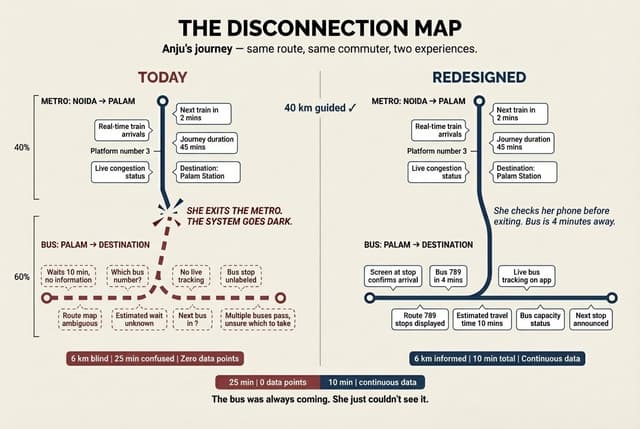
Anju's journey begins underground, and for the first forty kilometres it is flawless. She boards the Delhi Metro at Noida, taps her card, takes the Magenta Line to Palam, and arrives on schedule.
The signage is clear, the train is air-conditioned, and every transition is governed by real-time information displayed on screens she barely has to glance at. It is the kind of experience that makes you forget you are using public transport at all.
Then she steps out of the station, and the system goes dark.
Her destination lies six kilometres away. Outside the metro exit, she asks an e-rickshaw driver about bus routes. He gestures vaguely toward a bus stand a five-minute walk down the road.
She walks there, waits ten minutes, and then checks with a fellow passenger: do buses to her destination stop here? They do not.
Another stop, five minutes further along a perpendicular road, serves the route she needs. She confirms this with two or three strangers before crossing over.
When she finds it, there is no shelter. The only indication that it is a bus stop at all is a cluster of people standing near a signboard bolted to a lamppost. She has no idea when her bus will come.
But the absence of infrastructure is not the primary concern. The earlier bus shelter she waited at was structurally adequate, yet it did not serve her any better.
The system that had guided her with quiet precision for nearly forty kilometres underground has fallen completely silent for the last six.
Delhi's public transport is intended to function as a multimodal network: long distances covered by the metro, buses and other modes handling last-mile connectivity. Lakhs of people transit through it every day.
Anju's experience, seamless underground and formless above it, captures, in a single commute, the central failure this piece is about.


The fleet Delhi already has
Delhi is making a serious bet on buses again, after decades in which the metro was the only story in public transport worth telling.
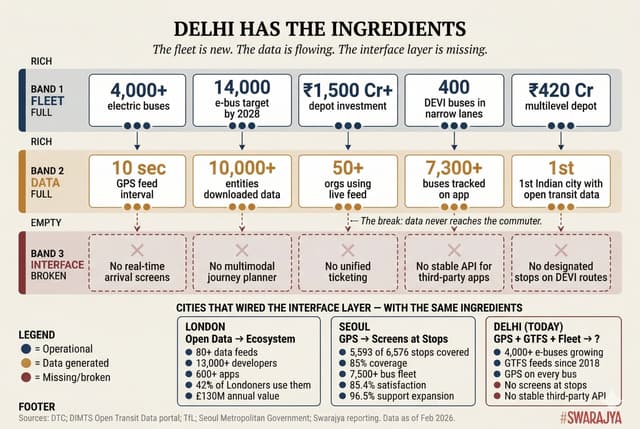
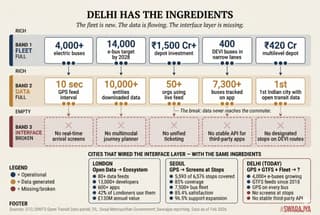
In February 2026, the induction of 500 new electric buses into the Delhi Transport Corporation fleet pushed the city's total past 4,000, giving it the largest electric bus fleet in India. The government has set targets of 7,500 electric buses by the end of this year and 14,000 by 2028.
The supporting infrastructure is being built in parallel. DTC has prepared a plan to retire its entire fleet of more than 2,600 ageing CNG buses and replace them with electric vehicles.
The government has invested over Rs 1,500 crore in depot electrification, with multiple depots now fully operational. The three major interstate bus terminals, Kashmere Gate, Sarai Kale Khan, and Anand Vihar, are being upgraded with high-capacity chargers and substations.
Last September, Delhi's first multilevel electric bus depot was commissioned in Hari Nagar at a cost of Rs 420 crore, designed to accommodate 384 buses.
The most visible element of this expansion is the Delhi Electric Vehicle Interconnector, or DEVI, initiative. With 400 compact nine-metre electric buses, DEVI is pushing formal public transit into the narrow internal lanes of the city that have historically never seen a bus. It is an ambitious attempt to extend the system's capillary reach.
Yet a gap is already visible on the ground. Many DEVI buses stop at unmarked points, picking up and dropping off passengers as needed rather than at designated stops.
The vehicles are arriving at pace. The system design that should accompany them, the designated stops, route visibility, and real-time information, is not.
The data that already exists
The paradox is that Delhi is not short of transit data. Each bus carries GPS, CCTV cameras, and a panic button.
In November 2018, Delhi became the first Indian city to publish its transit data in an open, machine-readable format.
The Open Transit Data portal, built by IIIT-Delhi in collaboration with DIMTS, provides geo-coordinates of all bus stops, route maps, timetables, and real-time GPS feeds of bus locations refreshed every ten seconds, all published in GTFS, the globally accepted standard for transit data.
By 2022, more than 10,000 entities had downloaded the static data, and over 50 organisations, including Google Maps, MapMyIndia, TCS Research, and researchers at Harvard, were consuming the live feed. The Delhi Metro Rail Corporation, meanwhile, has long maintained reliable real-time information on train arrivals and departures.
The raw material for a genuinely intelligent transit network, in other words, already exists. The question is why it has not been assembled into one.
Pravesh Biyani has spent seven years trying to answer that question.
An associate professor at IIIT-Delhi, Biyani founded Chartr, a startup incubated at the institute, to build what the public system has not: real-time tracking, ticketing, and multimodal journey planning across both bus and metro.
His diagnosis is blunt. The data is there, but it is scattered across agencies that have no formal obligation to make it interoperable.
"The work that we are doing is with the idea to give people access to as much data as possible about ridership," Biyani says.
"What we have developed aims to open as much data as is available by developing APIs, bringing together all information under one segment."
The One Delhi app, the government's most prominent attempt at a public-facing interface, tracks over 7,300 DTC and cluster buses with real-time coordinates, offers e-ticketing, and provides route information across the network.
Chartr approaches the same problem from a different direction, layering journey planning and multimodal integration on top of the available feeds.
But both run into the same upstream constraint.
Bus GPS units go offline. Routes change without the static data being updated. DEVI buses stopping informally generate no location signal a passenger at a notional stop can use.
User complaints on One Delhi document e-buses with registration numbers that were never added to the system, with unresolved tickets stretching back months.
Arrival times for buses that do appear are frequently inaccurate. The buses run, the data exists, the apps are live, and yet a commuter standing at a bus stop in Delhi still has no reliable way to know when the next bus will arrive.
The bus stop as the point of failure
If the apps represent the software gap, the bus stop is its most visible physical expression. Delhi's bus queue shelters carry no real-time arrival screens.
The shelters vary enormously: some stops have no structure at all, only a board; others offer a proper shelter with seating, weather protection, even a water dispenser.
But none offer what a commuter actually needs at the point of decision: real-time arrival information, route context, and fare clarity.
The result is an experience that runs entirely on assumption. Regular commuters know the bus will arrive eventually; they simply have no data on when.
First-time passengers still walk to the driver's door to confirm the route before boarding. In its current state, the Delhi bus stop functions as a physical marker, not as an intelligent node within a modern transport network.
It is infrastructure from a previous era, untouched by the data revolution happening a few servers away.
Where the problem has already been solved
None of the cities that have solved this problem had resources Delhi lacks. What they had was a governance decision: to treat transit data as public infrastructure, and to design the passenger experience with the same deliberateness applied to the vehicles themselves.
London is the clearest parallel. Transport for London chose, in the early 2010s, not to build a single official app but to open its data and let developers compete.
TfL now publishes more than 80 data feeds through a free, unified API used by over 13,000 developers. Research commissioned by TfL and conducted by Deloitte estimated this policy delivers up to £130 million in annual economic value to London.
More than 600 apps are built on TfL's open data, used by 42 per cent of Londoners. The lesson is not that London spent more money. It is that London made a decision about data governance and held to it.
Seoul answered the same question from the physical end. Every route bus in the South Korean capital transmits real-time location data to a central system, which processes it into arrival predictions and pushes the output simultaneously to screens at bus stops, the internet, and mobile apps.
By 2022, Seoul had installed its Bus Information Terminal system at 5,593 of its 6,576 stops, covering 85 per cent of the network across a fleet of more than 7,500 buses. User surveys found 85.4 per cent of respondents satisfied with the system, and 96.5 per cent supporting further expansion.
The critical insight from Seoul is worth lingering on. Reducing waiting-time uncertainty, even without reducing actual wait times, measurably improves how commuters experience the system.
A bus arriving in twelve minutes, known, is a fundamentally different experience from the same bus arriving in twelve minutes, unknown. Delhi has GPS on its fleet. It has data flowing through the OTD portal. What it does not have is the final physical step: a screen at the stop.
Three layers that need to connect
What Delhi needs is not a single technological fix but a set of coordinated interventions spanning technical integration, physical infrastructure, and institutional alignment.
On the technical front, Biyani's team at Chartr has built what it calls the Delhi Transport Stack, an integration framework designed to address the disconnection directly.
It brings together bus stop data, metro station information, expected arrival times, and last-mile connectivity into a single queryable layer, encompassing all metro routes, nearly 2,000 bus routes, and close to 5,000 bus stands.
Assembling it, Biyani says, required acquiring DTC data through a long process of cleaning, layering in DMRC's metro network data, and then doing something no agency had formally attempted: mapping last-mile connectivity.
"Not just this, with a focus on multimodal integration, we were on the ground in an attempt to even include last-mile means of transit into this network, which is completely unorganised at present," he says.
The ambition is to define journey planning from end to end, not metro-then-figure-it-out, but a single route from origin to destination across every available mode.
The project, however, remains at the stage of discussions and approvals with the Delhi government.
The institutional challenge runs equally deep. The DMRC and DTC operate as independent entities, each generating rich transit data in parallel, with no formal requirement that they share it in a format that serves the commuter as a single customer.
For integration to work, there must be a mandate, not a suggestion but a mandate, for data interoperability between the two agencies. A commuter like Anju should be able to plan one journey, not execute three sequential searches across separate applications.
On the physical side, bus shelters are the node where fleet, data, and commuter are supposed to converge. In July 2025, Chief Minister Rekha Gupta announced that all of Delhi's bus queue shelters would be upgraded. The intent is stated.
The question is whether the execution will be wired correctly, because the shelter alone is insufficient without the system behind it.
A redesigned bus shelter does not need to be futuristic. It needs a screen fed from the GPS data already being generated, showing real-time arrivals for every route serving that stop, including DEVI routes.
It needs a route map showing interchange points to the nearest metro station, and clear fare information. For DEVI specifically, it needs designated stops, not a notional location where a bus may or may not pause.
And finally, there is the operational layer that sits beneath everything else. Even if data is integrated and shelters upgraded, the systems at the depot level remain largely undigitised.
As one public transport professional puts it, static data, timings, and service numbers reaching the user must correspond to what is actually followed on the ground.
Without operational alignment at the depot, platforms and bus stands may carry information that bears no relation to reality. The tools and training at the depot level are essential for any of the layers above to hold.
Her journey, redesigned
Imagine another morning. Before leaving the metro, Anju checks her phone. The bus is four minutes away. She knows which stop to walk to. A small screen at the stop confirms the arrival. She taps the same card she used underground.
She knows the fare before she boards. The journey from metro to destination takes ten minutes, not thirty-five minutes of confusion.
Nothing in this scenario requires technology Delhi does not already possess. The GPS units are transmitting. The data feeds are live. The apps exist. The fleet is growing at a pace few Indian cities can match.
Researchers have already built the integration layer and tested it.
What is required is to wire it all together: the formal data-sharing mandates, the screens at the stops, the operational discipline at the depots. That is what would turn a collection of parallel systems into a single, legible network a commuter can trust.
Delhi has already bought the revolution. The missing piece is the one that connects all of it to the person standing at the stop.
Once Delhi wires that layer in, the same model will serve as a template for every Indian city now scaling up its bus fleet and working to knit together every available mode of transit.
 Join our