Ground Reports
Everything That's Wrong With How India Governs Its Cities — And What It Would Take to Fix It
Adithi Gurkar
Jan 02, 2026, 07:00 AM | Updated Feb 03, 2026, 07:13 PM IST

Picture a newly elected mayor in any Indian city. She has won her mandate from hundreds of voters, carries the legitimacy of the democratic process, and arrives at office with plans to transform her city’s infrastructure, clean its streets, and improve its services.
Within weeks, she discovers a crushing truth: nearly every agency actually delivering services in her city reports not to her, but to state government departments. The transport corporation, the water board, and the development authority all operate parallel chains of command that bypass her office entirely.
Her two-and-a-half-year term will be spent attending ribbon-cutting ceremonies, while real decisions are made in a state capital hundreds of kilometres away.
This is not an exception. This is the system across thousands of cities in India.
The 74th Constitutional Amendment was supposed to change everything. It arrived with the grand vision of empowering India’s cities, of bringing governance closer to the people, and of transforming urban local bodies into “vibrant democratic units of self-government”, the urban local governments. Over three decades later, that vision lies in ruins, a victim of what Santosh Nargund, Director of Policy Engagement at the Janagraha Centre for Citizenship and Democracy, calls a fundamental truth that transcends party lines: “States don’t like to share power, much less devolve it.”
Yet beneath this stark reality lies a more haunting question: how did a constitutional amendment designed to liberate cities end up trapping them in a system even more dysfunctional than before?
The Great Devolution That Never Was
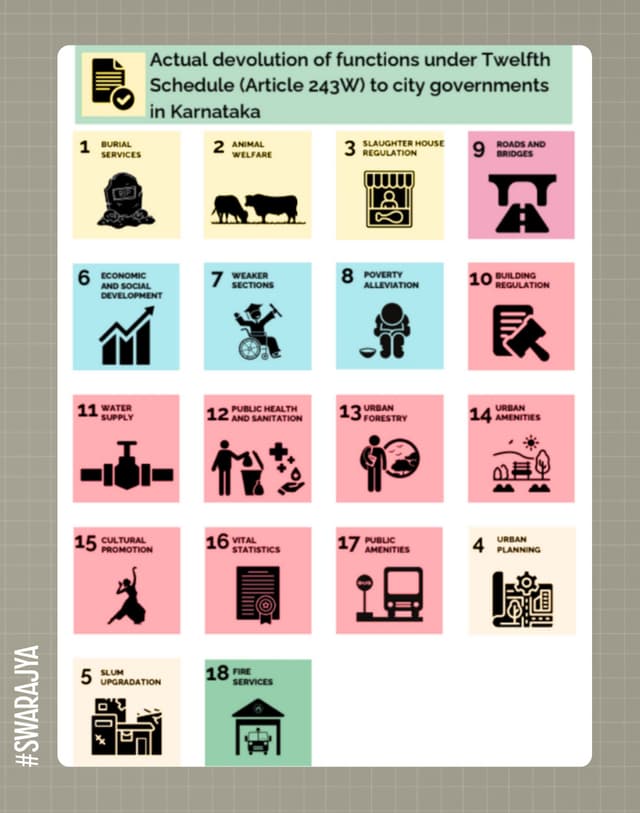
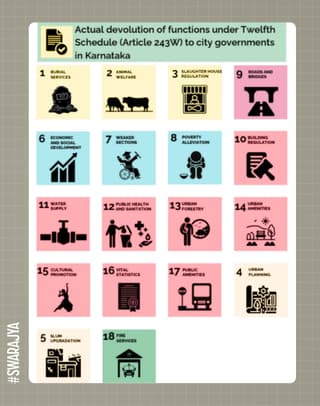
Article 243W, inserted by the 74th Amendment in 1992, reads like a manifesto of municipal empowerment. It mandates state governments to transfer 18 key urban development functions to city governments, everything from urban planning and regulation of land use to public health, sanitation, fire services, urban poverty alleviation, and slum improvement.
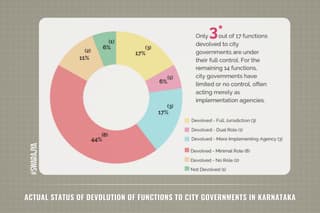
On paper, India’s states have complied admirably. In Karnataka, for instance, 17 out of 18 functions have been officially transferred to municipal corporations under the Karnataka Municipalities Act, 1964 and the Karnataka Municipal Corporations Act, 1976. The legal framework gleams with constitutional propriety.
The reality on the ground tells a different story.
A CAG audit laid bare the fiction: “Several overlaps in discharge of the functions between city governments and parastatals or state government departments.”
“This trend is similar across states in India,” Nargund explains. “While on paper most states have devolved 15 to 16 functions, effectively on the ground, independent jurisdiction is very limited. The local self-government becomes a self-government only when the devolution of these 18 functions takes place. Where there is no devolution in the true sense, they are as good as the extended arm of the state.”
There is a pattern to this selective devolution. Fire services are rarely devolved. Burial grounds, cattle pounds, and solid waste management are almost always transferred. These are the functions states do not want, the unglamorous work that generates complaints rather than ribbons to cut.
But the subjects that truly matter and affect people’s quality of life, public transport, social and economic planning, and town planning, remain firmly in state control. They are often seized by Urban Development and Town Planning Committees that operate beyond municipal reach.
Karnataka’s recent creation of Bengaluru Solid Waste Management Limited (BSWML) exemplifies this tendency. Here was a parastatal created specifically for a function supposedly devolved to the city government, yet it was not answerable to the then BBMP. With the inception of the Greater Bengaluru Authority, BSWML, represented by its Managing Director, is now part of the GBA.
The Model That Never Modelled Anything
“The 74th Amendment came into force in 1993, the Model Municipal Law was adopted in 2003,” Nargund recounts. “However, the then Ministry of Urban Development, now MoHUA, did not do much to enforce it.”
A decade passed between constitutional promise and operational framework. Another two decades have elapsed since, marked by committees and working groups that have submitted report after report.
For Nargund, years of working within this system have transformed initial optimism into hard-earned disillusionment. “Unfortunately, the 74th Amendment is a bit overrated, this coming from me, an initial fan of the amendment myself. As things have unfolded since 2003, it has become clear as day that we have expected too much from it.”
To illustrate just how little has changed, he reads from the amendment’s original statement of objectives, and it is déjà vu: “In many States local bodies have become weak and ineffective on account of a variety of reasons, including the failure to hold regular elections, prolonged supersessions and inadequate devolution of powers and functions. As a result, Urban Local Bodies are not able to perform effectively as vibrant democratic units of self-government.”
The words could have been written yesterday. The situation in 2025 mirrors exactly what it was in 1992, a damning indictment of three decades of constitutional reform that changed everything on paper and nothing in practice.
“We need to look at this through a different light. The state government does not necessarily have to give up everything. When it comes to functions such as water supply, electricity or transport, the state-level parastatals or departments can continue to do their work. These departments do not need to be transferred to the urban local government. Instead, for the extent of the work that happens in the city, have the city-level officer or the city-level engineer report to the Mayor.”
This approach, letting state agencies continue to exist while making their city-level functionaries accountable to local government, is not abstract theory. Kerala has implemented precisely this model with remarkable success. Officers and functionaries report to local governments while remaining on state payrolls. It is a compromise that preserves state institutional capacity while ensuring local democratic accountability.
The alternative, the system India currently operates, defies both logic and scale. “One officer called the Director of Municipal Administration sitting in Bengaluru cannot realistically govern 300 cities,” Nargund argues. “Just imagine the scale of unique problems he will need to oversee. Therefore, it is foolhardy to think the state government alone can effectively administer it all. It is more in the interest of the state to let go.”
Consider what those 300 urban local governments in Karnataka actually represent. There are mega city corporations like Bengaluru with populations in the millions, large city corporations like Mysuru, Hubli-Dharwad, and Mangaluru serving hundreds of thousands, and scores of small town municipal councils and town panchayats spread across diverse regions.
Each faces challenges shaped by local geography, economy, demography, and history. Each serves populations with distinct needs and priorities. The notion that one state-level bureaucrat sitting in a capital city can effectively manage this kaleidoscope of urban contexts is impractical.
So what did three decades of reform actually achieve? “One good thing the amendment did was it gave recognition to the urban local bodies within the Constitution. However, this has proven to be more figurative than operational. Today they effectively have no power and are purely at the mercy of the state governments.”
Constitutional recognition without operational authority creates a peculiar form of political purgatory. Cities exist in the eyes of the law but remain invisible when actual decisions are made. Mayors hold office but not power. Councils convene but cannot command. The legal framework proclaims their importance while the administrative reality denies them agency.

The Three-Tiered Reform Agenda
The prescription for change operates at three levels, each more ambitious than the last.
First: Tighten the Constitutional Provisions
“The constitutional provisions need tightening,” he states. “Presently there is too much leeway that has been given to the states. Here again I am sure we will be faced with debates involving the importance of federalism, decentralisation and centre-state relations. We at Janagraha stand for all these things. However, certain ground rules need to be laid right there in the Constitution.”
His examples reveal the arbitrary nature of current arrangements. “Why should there be varying terms of Mayors across the country? There is no need for the mayor in Delhi to be of only one year while that of Bengaluru stays on for 2.5 years, while in some other parts the term is for five years.”
The variation extends to the mode of election, direct versus indirect. “Since India has generally chosen the Westminster model to indirectly elect its CMs and PMs, the same can be adopted throughout the country,” Nargund suggests. “The crux of the reform lies in ensuring the elected mayor gets to complete a proper five-year term to ensure enough time and space to actually implement his or her vision.”
State Election Commissions face their own crises of credibility and capacity. “Reform should begin with the fair appointment of election commissioners. Delimitation and ward reservation should occur at standard intervals,” Nargund states.
Financial independence proves equally critical. “Stop the financial dependency of the State Election Commission on the state government and instead have its expenditure mandatorily charged upon the consolidated fund of the state.”
The lack of basic equipment reveals how resource constraints hobble even willing commissions. “Some State Election Commissions complain about the lack of EVMs to be able to conduct local body elections in one go across the state. It is a matter of a one-time grant of a few crores that the states may be refusing to provide,” he notes.
Municipal boundary alterations ahead of elections represent yet another tool of control. “There should be no merger or demerger of ULBs up to either six months or one year before the elections.”
Then comes the critical provision. “Make all the agencies, departments and parastatals working for the city report to the Mayor and the council, be it a state parastatal or a Union government parastatal.”
The example of railways illustrates the principle perfectly.
“Today the railways are providing us with suburban railways. Who should they be ideally reporting to in a city? In Bengaluru you have the Namma Railu, the peripheral railway, Metro Rail, etc. Who should they be answerable to? It is the Mayor of the city who is primarily concerned with utilisation and improvement of these services. While the Chief Minister of the state or the central ministers may also claim to be concerned, they at the same time have 300 other cities in the state to worry about. And that precisely defeats the very principle of decentralised governance.”
But even if mayors were granted such authority over parastatals, the current structure of city councils would sabotage continuity and accountability.
“We still propagate this colonial system of standing committees within the city councils,” Nargund continues. Standing Committees for health, finance, and other areas are formed with five to six members each, elected every year. “It then becomes a game of revolving chairs, with everyone vying to be part of each committee at least once in five years.”
The consequences are predictable. “The committees further complicate matters by nominating different people every year. How can one expect continuity in policy in such a system? Each committee will simply want to announce populist policies and move on, with zero focus on actual implementation and hence accountability to the electorate.”
The result is stark. “Most of the Mayors in Karnataka end up being one-year Mayors. When a Mayor gets elected in such a system, she would spend the first two to three months settling in, then she will make announcements, and then the term ends.”
Madhya Pradesh and a few other states notably offer an alternative model: the concept of Mayor-in-Council (MIC), bringing the cabinet form of government to the city level, where each of the councillors in the MIC is given charge of specified portfolios.
But structural reform of city councils alone will not deliver if the money continues to bypass them entirely. “The budget that is given to the parastatal agencies should be transferred or earmarked for the urban local government itself,” Nargund argues. “The BWSSB or the BMTC should not be handed over money by the state directly. Let them submit the plan to the urban local body, get approvals, and after that funding follows. This is how you bring in decentralised accountability.”
The principle is elementary. “Just by stating to them that you are accountable to the ULBs does not make them so, especially when the paycheques are being processed elsewhere. Decentralisation will only happen when money is transferred to the ULBs and other entities submit their budgets and get them approved.”
Beyond fiscal control and administrative hierarchies lies an even more fundamental constraint. Perhaps the most egregious power asymmetry is the state’s ability to dissolve city councils at will.
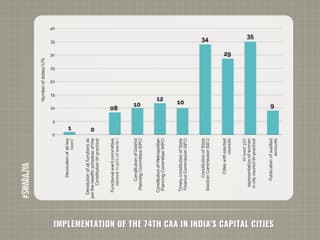
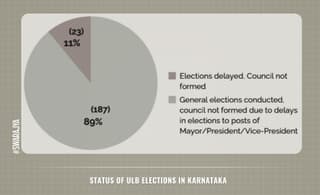
“The state government can dissolve the city council at will. Additionally, the state government can refuse to conduct elections and keep the municipalities under state government rule through an administrator indefinitely. This is unconstitutional and there is practically no check on this.”
The contrast with centre-state relations is stark. “Can this happen in the relationship between the central and the state government? There is so much scrutiny and resistance if President’s Rule is imposed anywhere.”
Nargund proposes a simple safeguard. “A rule can be brought about stating that without the sanction of the legislative assembly, an election cannot go unconducted. Once it comes to the assembly, while the government can still get its way and not conduct elections, this decision will at least be subjected to the scrutiny of the legislators, both ruling party and opposition, and the media. This brings in an element of transparency and accountability.”
“Right now, unfortunately, we do not know how many Mayors have been superseded, how many elections have been conducted. Sometimes there is simply a lack of even a proper record.”


Second: Leverage Central Funds
“While all this cannot be detailed in the Constitution itself, it can be within the Model Municipal Act and the Centre can incentivise the states to adopt these through some schemes or Finance Commission grants,” Nargund explains.
The numbers involved are substantial. “The Centre is granting approximately Rs 86,000 crore per year to the states under the urban development component of the budget. This money is meant for solid waste management, water supply, housing, lake rejuvenation, etc. They can always tie this amount to the state’s performance in the implementation of these reforms.”
Some precedent exists. “While this arrangement is there today with certain centrally sponsored schemes and loans per GDP per state being subject to some local governance reforms, they have very rarely been directly linked to structural reforms.”
The Fifteenth Finance Commission took a tentative step in this direction. “There was a component of structural reform. Here they mandated the conduct of elections to qualify for the grant, and Karnataka has lost Rs 500 to 600 crore as BBMP and some other cities in the state have not had elections.”
The scale of that loss deserves emphasis. “This is not a small number. The budget of many of our small town panchayats is hardly around Rs 2 to 3 crore, so imagine how many such entities could be funded with this money.”
Third: State-Level Initiative
“The biggest onus lies with the state governments,” Nargund insists. “Nothing is stopping the states from trying to improve local governance out of their own initiative.”
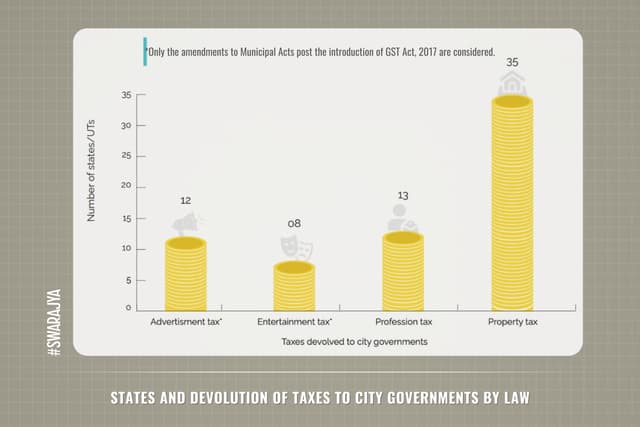
“Today we are saying that the urban local bodies are totally dependent on the state for funds. It is kind of a double whammy for city governments because, by law, you have taken away all the sources of revenue generation. All you have left in their domain is property tax and advertisement tax in Karnataka. Apart from that, they can charge user fees for solid waste management.”
The result is predictable. “The money collected just enables them to take care of day-to-day needs and does not allow for big-bang reforms. If cities are to become engines of growth, they need to attract investment. To attract investment, they have to be in good condition. Even if municipal bonds are to be floated, their own financial strength has to be enhanced.”
Some states have shown the way. “States like Haryana, Tamil Nadu and Maharashtra have devolved a portion of stamp duties and motor vehicle tax to the local bodies.”

The Fiscal Absurdity
Nargund’s description of the current revenue system drips with incredulity. “Where do we buy houses? In cities mostly, but tax is paid to the state government and not the local government. The car or vehicle is used in the city but again taxed by the state, but the blame for potholes and the condition of the roads falls on the local government. This is irrational. Where one uses the service of the local government but is paying the state government, which will not share with the local body.”
The GST story represents similar exclusion. “Consider the biggest finance reform that has happened in India over the past 10 years. It is the GST. While there is a CGST and SGST, there is no LGST. The two big entities sat together and decided that they would divide the pie between themselves and nothing was given to the cities or the panchayats.”
The solution exists at both central and state levels. “This change can be brought about by the central government. If not done at the Union level, then the state governments can commit to a reform where they pledge a portion of the SGST as the share of the ULBs.”
Mayors have articulated their modest demand in conversations with Janagraha. “Don’t give us a big share but give us a definitive share.”
The Constitution already provides the mechanism to grant this request. Under Articles 243I and 243Y of the Constitution, State Finance Commissions must decide how total tax revenue should be divided between the state and local governments. The reality mocks the constitutional mandate.
“As per the Fourth Finance Commission of Karnataka, it was recommended that 13 per cent of the tax collected be given to the ULBs,” Nargund reveals. “The state government disagreed and stated that it would only devolve 12 per cent, despite the constitutional mandate upon the state government to agree with the Finance Commission.”
Even that reduced figure proved aspirational. “In reality, what has actually been devolved to the ULBs is less than five per cent.”
The Central Finance Commission provides a lifeline. “Since all the taxes are going to the coffers of the Centre or the state government, and the Central Finance Commission decides how the division occurs between the Centre and the states, from the Eleventh Finance Commission some funds were also being transferred directly to the ULBs, as they realised that it was not being done by the state governments. This amounts to about Rs 26,000 crore and proves to be the lifeline of many urban local bodies across the country.”
The Participation Paradox
“The very idea behind local governance is that citizens can be a part of the development of their neighbourhoods and cities,” Nargund reminds us. “There needs to be proper accountability to the citizens and city governments should work with them as partners. This can be facilitated by forums such as ward committees and area sabhas.”
Karnataka, ironically, possesses exemplary legal frameworks. “Karnataka has, perhaps, got the best legal framework for participatory governance. All three Acts have provisions for ward committees, and the Municipalities Act has the provision for neighbourhood groups, which are a collection of 200 to 400 households, and the area sabhas, which are at the booth level, and then we have the ward committees at the ward level. All these have already been featured in the law itself but are not being implemented.”
The solution is straightforward. “All the government needs to do is follow the law.”
But even participation requires teeth. “Unless citizens are made part of the decision-making, it does not make much sense. Whenever the local budget is being formulated, we must make it mandatory for local proposals to be considered from the ward committees and the area sabhas.”
“In many ULBs, even basic audit of city accounts was not happening,” Nargund states, “until the Fifteenth Finance Commission mandated annual audits. This led to the Cityfinance.in portal, and today there is more than 90 per cent compliance by ULBs.”
The Capacity Crisis
“When it comes to staffing, the average vacancy is more than 50 per cent in many states,” Nargund reveals. “There is a problem in terms of both competency and adequacy.”
The extent of the vacuum is staggering. “In many municipalities there is a vacancy for the entire electrical department or horticulture department. Sometimes the whole local body runs without any accountant and even town planners. Most of the staffing that you see in Karnataka is of the pourakarmikas.”
The Parliamentary Committee on Urban Affairs has documented these severe capacity constraints.
The cruel irony emerges clearly. “On one hand ULBs do not have enough money, but let’s say we somehow manage to get them that money, they still will not be able to spend the money as they lack the capacity to do so.”
“The Rs 86,000 crore that the central government is earmarking for urban development, as per the latest reports, 40 per cent of it remains unspent as the ULBs are unable to claim the money.”
This represents more than bureaucratic inefficiency. “This is a huge crisis, particularly if we are aiming to be a developed nation in the next 22 years or so. We cannot have cities not be able to spend whatever little money has been allocated.”
The Kerala Exception
Kerala emerges repeatedly in Nargund’s analysis as proof that alternatives exist within India’s constitutional framework.
“Kerala has taken great strides when it comes to decentralisation,” he notes. The state stands out on multiple fronts. “They have a dedicated department called the Department of Local Self-Governance, which most states don’t have. States generally have the Department of Urban Affairs or Urban Development, so there tends to be no emphasis on decentralisation, governance or devolution of functions. The whole focus remains on infrastructure and services.”
“When governance is ignored for too long, the infrastructure and service delivery will suffer a lot.”
Kerala’s participatory mechanisms function as intended. “Kerala also stands out for massive people’s participation. They have an excellent bottom-up approach and most of the money that is spent is decided by something called the People’s Plan. Ward committees and women self-help groups are a regular affair.”
Other examples exist. “West Bengal and Mizoram have functional ward committees. Maharashtra, Haryana and Tamil Nadu, as witnessed in the CAG report, have done well on the devolution of taxes front.”
The Panchayat Contrast
“We need not look too far beyond for inspiration,” Nargund argues. “Our own panchayat system offers the same.”
The 73rd and 74th Amendments are often called twins, but one has thrived while the other has withered. “The 73rd Amendment has gone far ahead. There is regular monitoring through the Panchayat Advancement Index. They have done seven national assessments so far to ascertain the degree of decentralisation across states. In contrast, the Ministry of Urban Affairs has not conducted even one evaluation of empowerment of city governments till date.”
The differential treatment extends to recognition and incentives. “There are national panchayat awards. There are no national nagar palika or nagar nigam awards. Neither the Union nor the state governments facilitate any healthy competition between the cities.”
Why the stark difference between rural and urban devolution? The answer lies partly in numbers. Rural India represents more electoral constituencies. It also lies in the relative weakness of state parastatals in rural areas. Cities, with their concentration of resources and visibility, prove too tempting for state governments to release.
The Heart of the Matter
Yet beneath these technical prescriptions lies a more fundamental question. In a democracy that claims to value decentralisation, why do those closest to problems remain furthest from power?
The answer reveals uncomfortable truths about Indian federalism. State governments guard their prerogatives jealously. The rhetoric of subsidiarity applies until it threatens someone’s authority.
“States don’t like to share power, much less devolve it,” Nargund stated at the beginning. “Unfortunately, this is the truth that stretches across states and political lines.”
Three decades after constitutional reform, India’s cities remain trapped in a system that acknowledges their importance while denying them agency. Mayors preside over ceremonies while bureaucrats make decisions. Councils debate while parastatals act. Citizens vote in local elections that determine everything except who actually governs them.
The 74th Amendment gave urban local bodies constitutional recognition, a presence in the supreme law of the land. But presence without power creates only the illusion of self-governance, a democratic theatre where the roles are assigned but the script is written elsewhere.
Until states choose empowerment over control, until the Centre enforces its own constitutional mandates, and until citizens demand more, India’s cities will remain what they are today: administrative units masquerading as self-governing entities, constitutional provisions that promise everything and deliver nothing.
Perhaps the first step towards genuine urban self-governance is the uncomfortable admission that, three decades on, we have barely begun.
Adithi Gurkar is a staff writer at Swarajya. She is a lawyer with an interest in the intersection of law, politics, and public policy.
 Join our