
Science
How Budget 2026's Telescope Push Connects To A Decade Of Optics Work
Swarajya Staff
Feb 02, 2026, 11:09 AM | Updated 12:18 PM IST
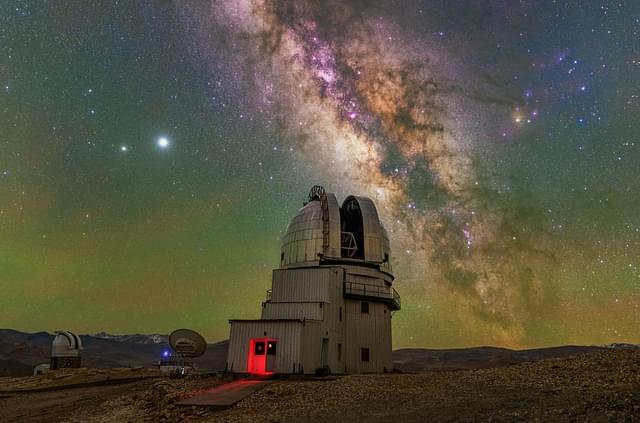
Finance Minister Nirmala Sitharaman's announcement Sunday (1 February 2026) that four telescope infrastructure facilities would be set up or upgraded "to promote astrophysics and astronomy via immersive experiences" may sound like a standard budget allocation for scientific outreach.
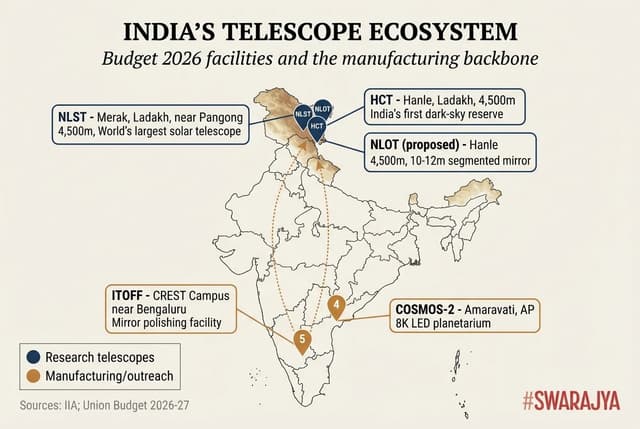
The facilities named are the National Large Solar Telescope (NLST), the National Large Optical-Infrared Telescope (NLOT), the Himalayan Chandra Telescope, and the COSMOS-2 Planetarium.
The Indian astronomy community's reaction has been emphatic. "A game changer for astronomy research in India," wrote Professor Annapurni Subramaniam, Director of the Indian Institute of Astrophysics (IIA), on X.
IIA, the nodal agency for these projects, posted that "the facilities announced in the budget will significantly change the astronomy research and outreach landscape of India in the near future."
But beneath this announcement lies a more significant story about industrial capability building, one that connects directly to work already underway at a facility outside Bengaluru.
Why Indigenous Large Telescopes Matter
Professor Dibyendu Nandi, a solar physicist at IISER Kolkata, articulated in a thread on X why this announcement matters beyond the immediate scientific gains. "Large astronomical observatories (that can address profound and discovery-class science questions) are few and far in between," he wrote. "Getting observation time in these telescopes is very challenging because of high demand + countries which fund the observatories (rightly) prioritize their own researchers."
This is the structural problem indigenous facilities solve. "Our own facilities open up opportunities for our future generation of researchers to compete globally and collaborate with international partners on equal footing by bringing value to the table," Nandi noted, adding that the Indian astronomy community "punches far above its weight in terms of contributions to India's overall science output and its global impact," citing an Ernst & Young scientometric report commissioned by DST.
But building large telescopes is not merely a matter of budget allocation. It requires industrial capabilities that India has spent a decade quietly developing.
The Bengaluru Lab Already at Work
As Swarajya reported in May 2024, a specialised facility called the India-TMT Optics Fabrication Facility (ITOFF), located about 40 kilometres from Bengaluru within the Indian Institute of Astrophysics' CREST campus, is already producing mirror segments for the Thirty Meter Telescope (TMT), one of the world's most ambitious astronomical projects.
ITOFF is the only facility in India capable of polishing thin, aspherical, off-axis, non-axial symmetric mirror segments, the kind required for large segmented-mirror telescopes. The first mirror roundel for TMT was successfully polished at ITOFF last year. Eighteen mirror blanks from Japan's OHARA Inc and the National Astronomical Observatory of Japan are currently at the facility, undergoing processing.
This capability did not exist in India before. It was deliberately created through India's participation in the TMT project.
The TMT Strategy
India joined the TMT consortium as a full member in 2014. The Department of Science and Technology (DST) and the Department of Atomic Energy (DAE) committed Rs 1,300 crore to the project, of which 70 per cent was earmarked for developing hardware and software systems domestically. This was not charity towards an international astronomy project, but a deliberate industrial strategy.
ITOFF, a world-class 3,600-square-metre facility inaugurated in December 2020, emerged from this investment. Here, 84 of TMT's 492 primary mirror segments will be polished to nanometre-level precision using Stressed Mirror Polishing (SMP) technology. According to TMT International Observatory's updates, the equipment commissioning was completed in May 2023.
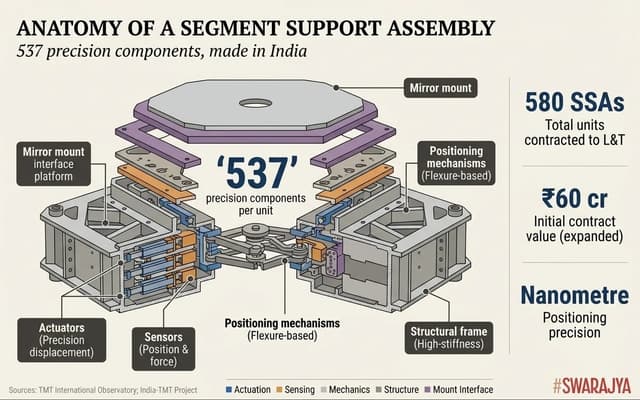
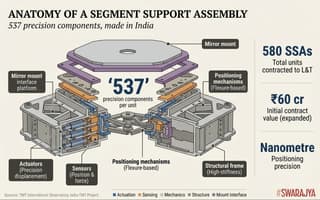
A second critical capability emerged at Larsen & Toubro's precision engineering facility in Coimbatore, contracted to manufacture Segment Support Assemblies (SSAs) for TMT, the complex optomechanical systems that hold and position each mirror segment. Each SSA contains 537 precision components, sensors, and actuators. According to TMT project announcements, L&T successfully manufactured and assembled the first SSA in April 2022.
The initial contract, worth approximately Rs 60 crore for 100 SSAs, has since expanded. L&T is now responsible for all 580 SSAs required for the entire telescope. "All sensors, actuators and SSAs for the whole telescope are being developed and manufactured in India," A N Ramaprakash, associate programme director of India-TMT, told the Indian Express.
Why This Matters for NLOT
The National Large Optical-Infrared Telescope mentioned today is a proposed 10-12 metre class telescope, India's most ambitious ground-based astronomical facility ever. Telescopes of this size cannot use monolithic mirrors; they must be built with segmented mirrors, just like TMT.
Here is the connection the Budget announcement does not make explicit: IIA scientists have already been designing NLOT specifically around ITOFF's capabilities. A February 2024 paper in the Journal of Astrophysics and Astronomy by Varun Padikal, Amirul Hasan, Vineeth Valsan, S Sriram and colleagues states this plainly: the optical designs for NLOT are being "analyzed for fabrication using the India TMT Optics Fabrication Facility (ITOFF) at the CREST campus."
At ITOFF's inauguration in December 2020, attended by the Vice President of India, it was explicitly stated, as reported by the TMT International Observatory, that "the ITOFF facility and the innovative technologies developed for TMT could be utilized to build the primary mirror segments of NLOT and other future projects within India."
In other words, India has spent a decade building the industrial base to manufacture its own large telescope, and the Budget announcement today is the political and financial green light for that capability to be deployed domestically.
Industry's Reading
The Indian Space Association (ISpA), the industry body representing private space companies, connected the telescope announcement to broader ecosystem development. In a statement, Lt Gen A K Bhatt (retd), ISpA's Director General, noted that "the announcement on expanding telescope infrastructure and learning facilities is a meaningful step towards strengthening India's scientific base in astrophysics and astronomy."
Crucially, Bhatt framed this alongside ISRO's increased allocation (Rs 13,705.63 crore in FY 2026-27): "Together, these measures can improve observational capabilities, enable long-term research and strengthen collaboration between ISRO, academia and industry, gradually enhancing India's contribution to global space science and the broader space ecosystem."
This industry-academia-ISRO triangle is precisely what the TMT participation has been building. L&T's work on TMT's SSAs is a template for how Indian industry can participate in mega-science projects, and potentially in NLOT's construction.
The Cost Perspective
Consider the global context. The European Extremely Large Telescope (39 metres) under construction in Chile will cost $1.5 billion. The Giant Magellan Telescope (25 metres) is projected at $2.54 billion. TMT itself (30 metres) is expected to exceed $1.4 billion.
NLOT, at 10-12 metres, would be smaller than these behemoths but still represent a massive leap for Indian astronomy. The current largest optical telescope in India is the 3.6-metre Devasthal Optical Telescope in Uttarakhand. More importantly, a significant portion of NLOT could now be manufactured indigenously, dramatically reducing costs and building long-term strategic capability.
The NLST, meanwhile, has been estimated at over Rs 150 crore according to project documents cited in media reports. It has faced nearly a decade of delays, partly due to security clearances required for its location near Pangong Lake (finally granted around 2016) and funding uncertainties. The Budget announcement signals that these projects are now politically prioritised.
Sitharaman's Personal Investment
This is not an impersonal budget line item. Finance Minister Sitharaman has visited multiple telescope sites personally. She toured the NLST project site at Merak, Ladakh, in June 2025 and was present at the COSMOS-2 planetarium MoU signing in Amaravati in November 2025. She has funded the COSMOS-Mysuru planetarium from her MPLAD funds. At multiple events, she has specifically praised IIA Director Professor Subramaniam's work in establishing these facilities despite challenging high-altitude conditions.
This level of ministerial attention suggests a sustained policy priority rather than a one-off announcement.
Strategic Positioning
Beyond industrial capability, the telescopes serve specific strategic purposes. According to IIA's project documentation, the NLST will fill a longitudinal gap between major solar observatories in Europe and Japan, enabling continuous 24-hour solar observation globally. This is critical for space weather prediction, as solar storms can disrupt satellites, GPS systems, and power grids. The NLST will complement ISRO's Aditya-L1 space mission, providing ground-based data to correlate with space-based observations.
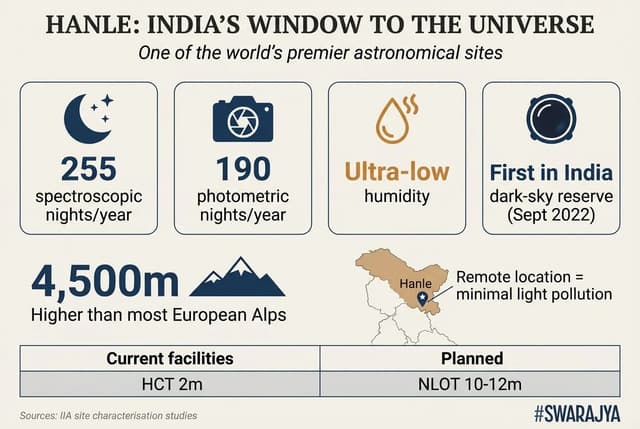
The Hanle site in Ladakh, where the Himalayan Chandra Telescope (HCT) operates and where NLOT will likely be located, is one of the world's premier astronomical sites, at 4,500 metres elevation with exceptionally clear skies, low humidity, and minimal light pollution. In September 2022, Hanle became India's first dark-sky reserve. According to IIA's site characterisation studies, Hanle offers approximately 255 spectroscopic nights and 190 photometric nights per year.
The Outreach Dimension
The inclusion of COSMOS-2 planetarium in the announcement, alongside research telescopes, is significant. Professor Nandi articulated why in his X thread: "One price of development we pay is the loss of the night sky (due to light pollution and smog) in cities and towns across India and the world. In this context, planetariums bring back the lost beauty of the night sky and preserve the wonders of the cosmos for everyone."
"Our science is funded by the tax-paying public," Nandi noted. "In providing a bridge between science and society, we make our scientific endeavour more wholesome, more grounded and fulfilling and take the people along."
The COSMOS model, developed by IIA, is now being scaled. COSMOS-Mysuru, which opened at the University of Mysuru campus, features an 8K LED dome. According to RSA Cosmos, the French company that supplied the technology, it is only the third such installation globally for public viewing (the other two are in Japan). COSMOS-2 at Amaravati will replicate this model, offering real-time celestial viewing rather than the pre-recorded shows typical of most Indian planetariums.
 Join our