States
Himachal Pradesh's Fiscal Crisis Is Self-Inflicted, Not Centre-Imposed
Abhishek Kumar
Mar 02, 2026, 11:56 AM | Updated 11:56 AM IST
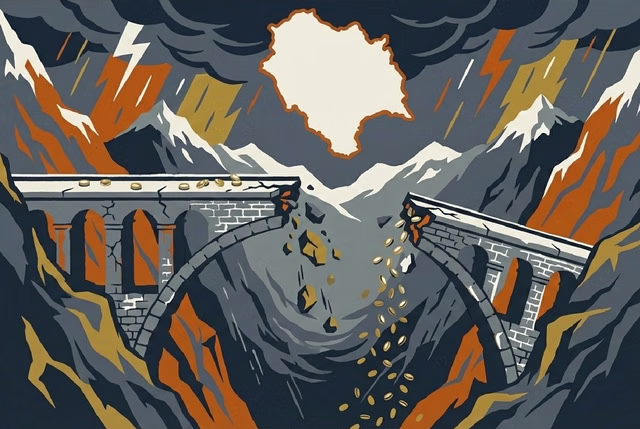
In 2017, the Comptroller and Auditor General warned that Himachal Pradesh would enter a debt trap by 2018-19. The state's financial liabilities were already 176 per cent of its revenue receipts.
Borrowings were increasingly financing not roads or schools but the repayment of previous borrowings, the textbook definition of a debt spiral. The warning was tabled in the Assembly and noted in the press. Then, with the quiet efficiency that characterises Indian fiscal governance, it was ignored.
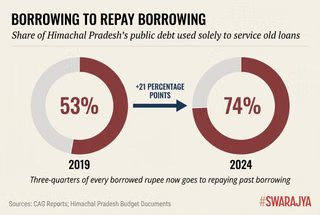
Nine years later, the prophecy has not merely come true; it has been exceeded. Debt has crossed ₹1 lakh crore. The proportion of public debt used solely to repay old loans has surged from 53 per cent in 2019 to 74 per cent in 2024.
In the coming financial year, the state must repay ₹13,000 crore in maturing obligations but can borrow only ₹10,000 crore, creating a net outflow of ₹3,000 crore before a single salary is paid, a single road asphalted, a single pension disbursed.

And now the 16th Finance Commission has discontinued the Revenue Deficit Grant. RDGs are a constitutional mechanism under Article 275(1), designed to bridge the gap between a state's revenue and its expenditure after tax devolution.
"Grants under Article 275(1) may be general-purpose, sector-specific, or State-specific. General-purpose grants, commonly known as revenue deficit grants (RDGs), bridge the gap between a State's revenues and expenditures and have been awarded by all fifteen FCs," notes the 16th Finance Commission.
They are, in theory, a transitional instrument to help fiscally weak states stand on their own feet. Himachal Pradesh received RDG from the very first Finance Commission in 1952 through the fifteenth. For seventy-three years, uninterrupted.
The political class has responded with its usual choreography. Chief Minister Sukhvinder Singh Sukhu has declared a black day, summoned all-party meetings, dispatched delegations, and projected Delhi as the villain. He has warned that an annual loss of ₹10,000 crore would paralyse development.
The BJP walked out of the all-party meeting, calling it political theatre. Leader of the Opposition Jai Ram Thakur has accused the Congress government of political gimmickry while urging harsh economic decisions. Both parties have been performing outrage with practised fluency, and both are lying by omission.
The fact is that even if the 16th Finance Commission had preserved every rupee of RDG, Himachal Pradesh would still be heading towards insolvency. The state's self-inflicted fiscal damage now exceeds the Centre's withdrawal. The hole is not what Delhi took away; it is what Shimla dug for itself.
A Constitutional Crutch That Became a Narcotic
Article 275(1) grants are meant to cover the gap between what a state earns and what it spends, and in Himachal Pradesh's case that gap has been substantial. The Fourteenth Finance Commission (2015–20) alone routed ₹40,624 crore to the state, roughly ₹8,000 crore every year. The Fifteenth Finance Commission (2021–26) has provided another ₹37,199 crore.
Add these to Himachal's share in central tax devolution and the Union government has effectively underwritten a five-year deficit of ₹80,170 crore. It is a number that sits uneasily with any claim that the state runs on a self-sustaining economic model.
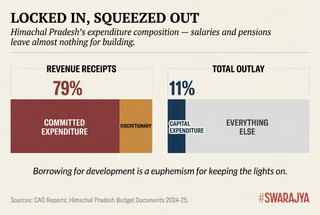
What did this money purchase? Not fiscal stability. Himachal's debt-to-GSDP ratio climbed from 35 per cent to 44.2 per cent, placing it among the three most indebted states alongside Punjab and Arunachal Pradesh. Committed expenditure consumed 79 per cent of revenue receipts. Capital expenditure shrank to 11 per cent of total outlay, so low that borrowing for development is a euphemism for keeping the lights on.

The 16th Commission ended RDG because it had become a textbook moral hazard: states being rewarded for inefficiency. States that kept running deficits received money while states that reformed received nothing.
"A fundamental problem with recurrent revenue deficit grants across successive FCs typically exemplifies the problem of time inconsistency where fiscal policies that appear optimal ex ante by the FCs are not adhered to ex post by the States once expectations of central assistance are internalised. When States anticipate that shortfalls in their revenue account will be compensated through RDGs, the incentive to undertake difficult but necessary fiscal reforms such as rationalising subsidies, improving tax administration, or curbing revenue expenditures weakens. Over time, this softens fiscal discipline and embeds dependency rather than resilience," held the report.
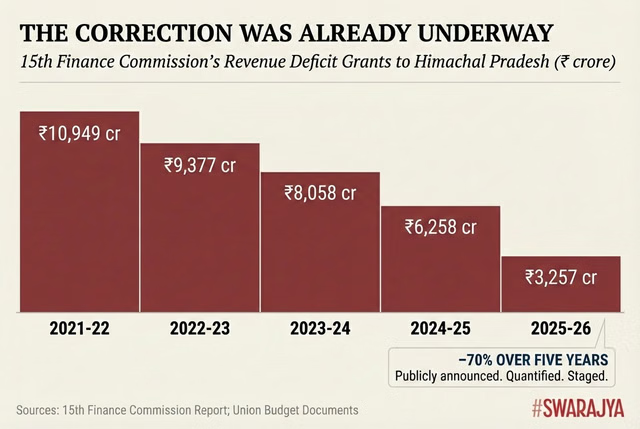
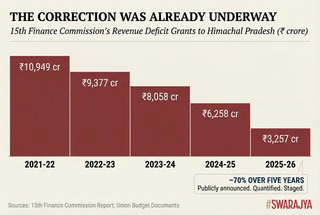
The 15th Commission had already begun the correction. RDG to Himachal was tapered in five annual steps: from ₹10,949 crore in 2021-22 to ₹9,377 crore, ₹8,058 crore, ₹6,258 crore, and finally ₹3,257 crore in 2025-26. A 70 per cent reduction over five years, publicly announced, quantified to the last crore, staged to give the state every opportunity to adjust.
The taper was not a surprise. It was a schedule.
The Pit
Between 2017 and 2022, Himachal Pradesh entered an unusually transfer-heavy phase. The closing years of the Fourteenth Finance Commission and the front-loaded awards of the Fifteenth brought record-high annual revenue-deficit grants, with more than ₹10,000 crore flowing in a single year. For a state with a narrow tax base, these transfers financed a large share of revenue expenditure, giving the government a fiscal cushion at a scale no earlier administration had operated with.
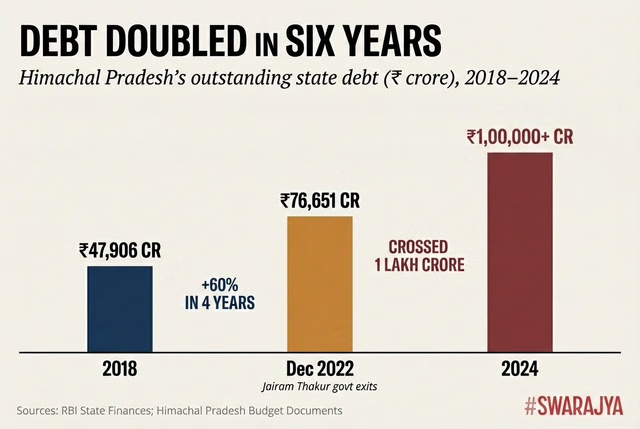
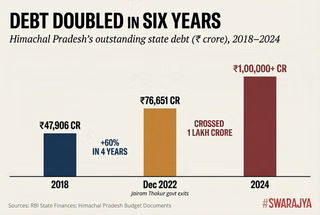
Instead of building on this windfall, the Thakur government expanded liabilities. State debt surged from ₹47,906 crore in 2018 to ₹76,651 crore by the time his cabinet left office, a 60 per cent increase in five years. The CAG documented that public debt was growing at 9.6 per cent annually, while the government was borrowing at 7.89 per cent. Every rupee borrowed was a rupee lost.
Subsidies were widened rather than reworked. Free power up to 125 units and the waiver of rural water bills delivered immediate political returns but at a steep fiscal cost, hollowing out the state's own revenue base. Pay commission awards were rolled out without any parallel restructuring of expenditure, turning what should have been a calibrated transition into a liability overhang.
The result is a backlog of nearly ₹11,000 crore owed to government employees: ₹4,430 crore in salary arrears, ₹5,226 crore in pension dues, and about ₹1,000 crore in deferred dearness allowance. These are obligations that now crowd out almost every other spending priority.
Thakur now tells the Assembly that debt under his government was ₹69,600 crore, a figure that selectively excludes several categories the CAG includes. He accuses Congress of financial mismanagement, which is accurate but incomplete. Financial mismanagement in Himachal is a bipartisan tradition with a distinguished pedigree.
INC Jumped in the Pit with Dynamite
The November 2022 election was decided, as Himachal elections always are, at the retail level. INC won 40 seats to BJP's 25, but the aggregate vote share difference was less than one per cent, barely 37,974 votes separating the two parties across 68 constituencies. On eleven to twelve seats, the margin was below 1,000 votes. One seat was won by 60 votes.
For the incumbent, this was not a transformational mandate but a continuation of Himachal's pattern of rotating incumbents out of power every five years, unbroken since 1985. That means irrational economic promises made during campaigns became a political burden.
The party's Himachal Ka Sankalp manifesto promised ₹1,500 monthly to every woman aged 18-60, 300 units of free electricity, restoration of the Old Pension Scheme, one lakh government jobs, interest-free loans for entrepreneurs, and ₹10 crore startup funds per assembly segment. The estimated annual cost was ₹4,000 crore in a state whose entire own-tax revenue was roughly ₹12,500 crore.
Priyanka Gandhi promised OPS restoration in Congress's first Cabinet meeting. It was perhaps the only promise the party kept on schedule. On the very first day, OPS was restored for 1.36 lakh employees. Sukhu estimated the annual burden at ₹800-900 crore, a figure that has since proven conservative.
The Comptroller and Auditor General, in its 2023-24 report, delivered what should have settled the argument. The Old Pension Scheme, it noted, had been restored without the creation of a dedicated pension fund, leaving the entire future liability to be met from the state's own resources, resources that are already under strain.
Any assessment of Himachal Pradesh's debt sustainability, the auditor cautioned, would have to factor in the full weight of the OPS burden. It has not been factored in. It has been denied, deferred, and draped in rhetoric about employee dignity.
The OPS restoration was not merely an expensive promise. It was one of the most catastrophic fiscal decisions any Indian state government has made in the last decade. Its costs do not peak immediately; they compound. When employees recruited after 2004 under NPS begin retiring from 2034, the pension bill will escalate beyond any current projection.
The state has created a liability whose full cost will not be visible for another decade, by which point several more governments will have come and gone, and responsibility will have been diffused to the point of anonymity.
On top of the OPS came a cascade of guarantees, each modest in isolation, together a fiscal haemorrhage. The Indira Gandhi Pyari Behna Sukh Samman Nidhi alone brought more than 2.35 lakh women into its first phase. Loan guarantees worth ₹731 crore in 2023-24 swelled the stock of contingent liabilities. Revenue expenditure climbed to 21.56 per cent of GSDP, rising at 8.97 per cent annually, even as revenue receipts grew at just 4.92 per cent.
The squeeze showed up where it always does: capital outlay for 2025-26 was cut by 55 per cent.
After meeting committed liabilities, Sukhu admitted in his own budget speech, a mere ₹24 in every ₹100 is left for development. That is a paltry sum for a state where monsoon destroys roads annually, where tourism depends on connectivity, and where infrastructure requires perpetual rebuilding.
The Cardinal Sin of Ignoring the Inevitable
The most damning fact about Himachal's crisis is not the size of the debt. It is the fact that every single actor, the BJP government, the Congress government, the Finance Department, the CAG, the 15th Finance Commission, had the information needed to prevent it, and nobody acted.
The 15th Commission's taper was public knowledge from 2021. The GST regime's impact on producing states like Himachal was quantified. The end of GST compensation after June 2022 was announced. The CAG had warned of a debt trap in 2017. And yet, INC campaigned in 2022 on promises that required ₹4,000 crore annually in a state where the entire own-tax revenue barely covers three months of salary and pension.
"No bipartisan resolution, no sharp expenditure restructuring, no early warning strategy was put in place despite knowing RDG would taper off," observed one analysis of the Finance Department's own presentation. This is not a crisis that crept up on Shimla. It is a crisis that Shimla watched approaching, year by year, commission by commission, taper by taper, and chose to ignore because the electoral cycle rewarded spending and punished restraint.
The Numbers That Matter
Chief Minister Sukhvinder Singh Sukhu has been claiming that Himachal Pradesh is staring at an annual loss of ₹10,000 crore. But the state's own Finance Department tells a more measured story.
In a Cabinet presentation, Principal Secretary (Finance) Devesh Kumar laid out the arithmetic: own tax and non-tax revenue projected at ₹18,000 crore; central tax devolution estimated at ₹13,950 crore; and borrowing space capped at ₹10,000 crore. That brings the total available resources to roughly ₹42,000 crore.
Against this stand committed liabilities of about ₹48,000 crore: salaries, pensions, interest payments, and other obligatory expenditures that cannot be deferred. The real fiscal gap, therefore, is closer to ₹6,000 crore. Severe, certainly. But not the ₹10,000 crore collapse being projected in public statements.
The higher number serves a political narrative, one that frames New Delhi as the singular villain. The harder truth lies elsewhere: an expenditure trajectory so structurally inflated that even ₹42,000 crore cannot keep pace with it.
Nor has the 16th Finance Commission abandoned Himachal. The state's share in the divisible tax pool has risen from 0.83 per cent to 0.914 per cent, a revision expected to bring in an additional ₹1,000-2,000 crore annually. Disaster-related grants amount to ₹2,682 crore, with the favourable 90:10 Centre-state cost-sharing ratio retained for relief expenditure. Nearly ₹536 crore has been earmarked specifically for mitigation. Devolution weightage for forest and ecology, critical for a hill state like Himachal, also remains intact.
Geography does explain why Himachal's costs are higher. It explains why roads cost more, why service delivery is harder, why revenue generation is structurally constrained. It does not explain the OPS. It does not explain ten unfunded guarantees. It does not explain a state where 67 per cent of the budget goes to salaries, pensions, interest, and loan repayments before a single developmental rupee is spent.
What Comes Next
The Finance Department's own internal suggestions reveal how dire the situation has become. Officials recommended disbanding all subsidies, rationalising ₹1,200 crore in power subsidies and ₹1,661 crore in social security pensions, and, most explosively, adopting the Unified Pension Scheme or reverting to NPS for future recruitment to unlock ₹1,800 crore in borrowing headroom.
Sukhu has rejected this. OPS will continue. Subsidies will stay. Development expenditure will somehow materialise. From where, exactly, remains the question nobody in Shimla is answering.
The political incentives are perverse and self-reinforcing. Himachal has not re-elected an incumbent since 1985. Congress knows it will likely lose in 2027 regardless. The BJP knows it will inherit a fiscal disaster but cannot say so without undermining its own Finance Commission.
Both are locked in a cycle where the electoral reward for populism always exceeds the fiscal penalty, because the penalty invariably lands on the next government's desk.
India can no longer subsidise states that refuse expenditure control. The Finance Commission acknowledged hill realities through devolution, disaster grants, and forest incentives. What it refused to do was continue funding a state that treats central grants not as a bridge to sustainability but as a permanent entitlement enabling permanent irresponsibility.
The RDG's end did not create Himachal's fiscal disease. It removed the anaesthetic. The patient was always terminal. Both the surgeon who operated recklessly and the one who refused to close the wound share responsibility. Until Himachal's political class, BJP and Congress alike, confronts the arithmetic it has spent two decades evading, no delegation to the Prime Minister, no all-party meeting, no Governor's address read or unread, will change the trajectory.
The structural gap will remain.
Abhishek is Staff Writer at Swarajya.
 Join our