States
India's Unlikely AI Powerhouse In The Desert Sands
Steve Rajpurohit
Jan 07, 2026, 03:19 PM | Updated 03:19 PM IST
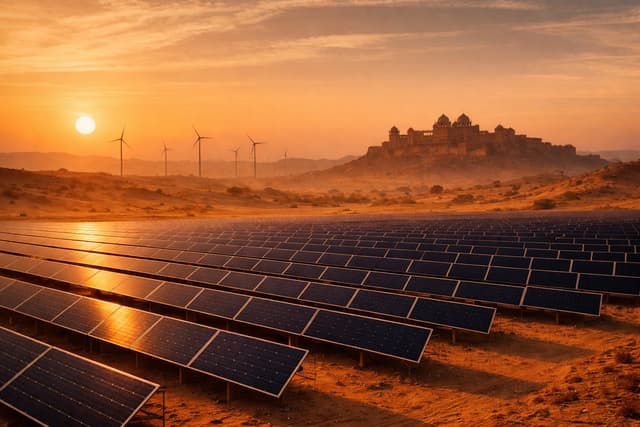
Rajasthan. The name evokes images of grand historical forts, vibrant folk culture, and a largely primary-sector and tourism-led economy. The suggestion that this state could become the bedrock of India's cutting-edge Artificial Intelligence (AI) revolution might, at first, be dismissed. It is an idea that challenges the conventional wisdom, which typically associates high-tech industries with coastal metropolises or established industrial belts.
Yet, this traditional view overlooks the single most critical, yet under-appreciated, requirement for the future of AI: massive, reliable, and clean energy. AI, driven by large language models, sophisticated algorithms, and hyperscale data centres, is fundamentally an energy-intensive industry. BloombergNEF (BNEF) forecasts US data-centre power demand will more than double by 2035, rising from almost 35 gigawatts in 2024 to 78 gigawatts. Actual energy consumption growth will be even steeper, with average hourly electricity demand nearly tripling from 16 gigawatt-hours in 2024 to 49 gigawatt-hours by 2035.
As AI infrastructure expands globally, the sheer demand for power is already beginning to stress grids in developed economies, leading to power shortages in places like the United States where data centres are proliferating.
For India to fully realise its ambition of becoming a global AI leader, it must secure an energy supply that is not just ample, but sustainable. The scale of data centres required to process India's vast data landscape from its 1.4 billion people to its exploding digital economy will drive an unprecedented surge in power consumption. In this context, Rajasthan, with its seemingly endless expanse of sun-drenched, low-density land, is not an unlikely candidate; it is the perfectly positioned powerhouse poised to fuel India's digital future. The state is uniquely positioned to trade its traditional economic strength for a new one: generating green energy at a scale unmatched by any other Indian state.
To understand Rajasthan's potential, one must first grasp the energy appetite of the AI ecosystem. Training a single large language model (LLM), such as those underpinning generative AI, can consume energy equivalent to the lifetime power consumption of several average homes. For example, training GPT-3, which has 175 billion parameters, consumed an estimated 1,287 MWh (megawatt-hours) of electricity, which is roughly equivalent to the energy consumption of an average American household over 120 years.
The operation of these models, through inference and day-to-day use, adds a continuous load. AI necessitates hyperscale data centres gigantic, centralised facilities filled with thousands of servers and cooling systems that must run 24×7×365. These centres are power vacuums, requiring megawatts of power instantly. Increasingly, civil society is demanding that the data centres be powered by 100 per cent renewable energy to meet their own Net Zero goals. India's AI capacity must, therefore, be synonymous with its green energy capacity.
As more and more data centres and AI infrastructure are planned for and established across India, the demand for power will only continue to increase exponentially. India's electricity demand is projected to triple to a staggering 4 trillion units (TWh) by 2035. This pivotal shift in industrial demand makes the renewable power sector the key strategic industry of the next decade, and Rajasthan is the leading state in it.
Rajasthan has unique geographic advantages that make it the ideal location for a clean energy boom. Firstly, the state lies perfectly near the Tropic of Cancer, guaranteeing some of the highest solar irradiation levels, averaging 6–7 kWh/m²/day. It experiences over 325 clear, sunny days a year, maximising the efficiency and output of photovoltaic (PV) systems.
As the largest state in India by area, Rajasthan offers millions of acres of barren, uncultivable land, particularly in the Thar Desert region. With one of the lowest population densities in the country, 200 people per sq km as per Census 2011, the land availability is virtually limitless. This scale is vital for developing the massive Ultra Mega Renewable Energy Power Parks (UMREPPs) and solar parks required to power gigawatt-scale data centres. The Bhadla Solar Park, the world's largest, is a testament to this potential.
The potential is already being realised. Rajasthan has cemented its position as the national leader in solar power generation, contributing over 27 per cent to India's total solar capacity. Amongst all the major states, Rajasthan has registered the highest annual growth (18.63 per cent) in the installed capacity of renewable energy.
The state leads the country in silver production, a critical input for solar cells. It is also a major producer of minerals such as feldspar and ball clay, which are essential for the glass industry and widely used in the front cover of solar panels.
Further, the Integrated Clean Energy Policy 2024 by the government of Rajasthan establishes a roadmap, setting an ambitious target of 125 GW of renewable capacity by the fiscal year 2030. This should provide investors with the long-term certainty required for multi-billion-dollar infrastructure projects. The Rajasthan Investment Promotion Scheme (RIPS) provides further tax and subsidy support, making the state attractive for large-scale energy investors.
While solar energy forms the core, Rajasthan's strategic advantage is its capacity for a diversified, low-carbon energy portfolio, offering grid stability and resilience. Western Rajasthan also possesses significant, untapped wind energy potential. The combination of solar and wind into Wind-Solar Hybrid Projects is an efficient strategy. A green energy corridor is being developed in western Rajasthan to integrate solar and wind power production.
These hybrids smooth out power generation curves making optimal use of limited land and shared transmission infrastructure. In addition, Rajasthan has a strong manufacturing base for fibreglass, resin, and plastic products. Together, these materials account for nearly 11–16 per cent of a wind turbine's mass and are vital for components such as turbine blades and the nacelle.
For continuous, high-density power, nuclear energy provides a stable, low-carbon base load. Rajasthan is already home to the Rawatbhata Atomic Power Station. With India opening up the nuclear sector to greater private participation and the global push for innovative Small Modular Reactors (SMRs), Rajasthan is well-positioned to expand its nuclear footprint, providing the non-intermittent power source essential for mission-critical AI data centres.
The final piece of the puzzle is connecting this massive energy supply to the digital demand. The deployment of power-intensive data centres is migrating from consumer-hub cities to power-generation hubs. Rajasthan, already exporting vast amounts of green power to the national grid, can naturally become a prime location for future AI and Cloud infrastructure. Eastern Rajasthan is a very suitable location for the same and the average annual temperature in the region is almost similar to that of Delhi-NCR region where most of the data centres are coming up.
The foundation for Rajasthan's path to powering India's AI revolution is robust. The state has an undeniable geographic advantage. This is a window of immense opportunity. By executing on its policy promises, especially in BESS, grid modernisation, and introducing targeted data centre incentives, it can successfully pivot. The arid lands of Rajasthan have the potential to transition from a traditional economy to the Digital Powerhouse of India.
Steve Rajpurohit posts on X at @SteveRajpurohit.
 Join our