States
Results Day: UP Is Next To Bihar; UP Is Far Away From Bihar
Arush Tandon
Nov 14, 2025, 03:07 PM | Updated 04:38 PM IST
The National Democratic Alliance has secured a gargantuan majority in Bihar. Will this enormous victory in the state have any effect on neighbouring Uttar Pradesh, where Assembly elections are due in early 2027?
That the triumph in Bihar has given the Bharatiya Janata Party a momentum is undeniable, but to be sure, there are at least 15-18 months still left for ‘UP 2027’. In between, we will have assembly elections in Assam, Kerala, Tamil Nadu and West Bengal.
The momentum of ‘Bihar 2025’ can affect ‘UP 2027’ only if it is not halted in ‘Bengal 2026’. A win in Bihar is no less valuable, but the BJP has been in power in the state—with minor interruptions—since 2005.
A victory for the BJP in Bengal holds the potential to alter the national outlook of politics, and this writer has shown in an earlier piece how the national mood shapes the electoral decisions of Uttar Pradesh.
But can the Bihar result by itself influence the outcome of the ‘UP 2027’ or help us predict it with reasonable accuracy?
No, and there are two primary points of divergence between the politics of the two states to explain why.
The first point of difference is the strength and quality of the opposition. Both SP and the RJD rely disproportionately on the support of the Muslim and the Yadav communities. Plus, tenures of both are seen as periods where the rule of law is at its weakest and criminal elements at their strongest.
Another factor of similarity has been added in recent times. The anxieties of both parties force each to rely on the Congress to secure the en bloc Muslim vote. The Congress under Rahul Gandhi has positioned itself as a political vehicle prioritising real and imagined minority interests above all.
Add to this the constant and shrill opposition to Modi. This creates an image where both the RJD and SP think that if they do not ally with the Congress, they risk losing support of the party that has ingratiated itself with the minority vote.
But as of today, that is where the similarities seem to end.
While both RJD and SP seem to get near total support from the Yadav and Muslim voting blocs, today’s results suggest the RJD gets only that and no more.
Meanwhile, in the 2024 Lok Sabha elections, Akhilesh Yadav managed to add other communities to the SP’s vote share. Keen observers of Uttar Pradesh politics had then reported that a majority of the Kurmi and a significant proportion of the SC community vote had gone to the SP-Congress alliance. Today’s results in Bihar show that Tejashwi Yadav has not been able to mirror this feat for the RJD.
The second point of difference is the situation the incumbent finds itself in.
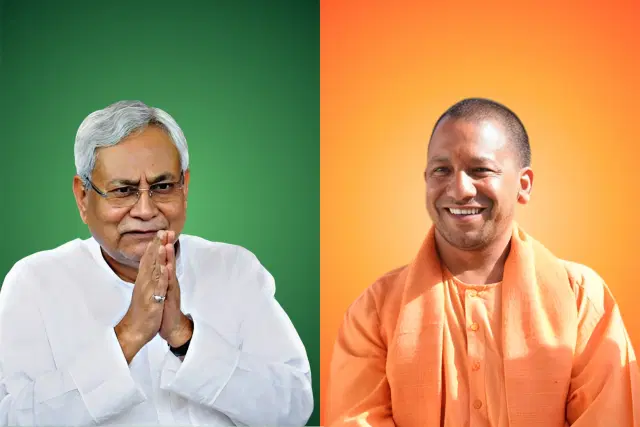
Both Nitish Kumar and Yogi Adityanath are seen as administrators who re-established the supremacy of the rule of law in their states. The parallels end there, though.
Kumar is the quintessential understated politician, getting things done quietly by systemic overhauls. In the years of better health, Kumar was reported to have even the minute details of state administration on his fingertips.
‘Understated’ is not an adjective any commentator would use to describe Yogi Adityanath. In comparison to Nitish Kumar, Yogi appears to run the administration more through the force of his persona than the gears of the administration’s machinery.
Nitish Kumar’s understated style lends him another advantage. You cannot accuse Nitish Kumar of replacing ‘Yadav raj’ with that of his own community, the Kurmis. Across the state border, though, Yogi Adityanath and his government are not untouched by charges of ‘Thakur dominance’, the community Yogi belonged to before his sanyaas.
Further on the same trail, it is the caste identities of the government head in either state that make the going easy for the BJP in Bihar and complex in Uttar Pradesh.
It was plain from the results of the 2024 Lok Sabha elections that the votes of the OBC community have deserted the BJP in significant proportions. How exactly the BJP intends to retrieve them is not clear. The announcement of the caste census was probably one step. But in a state where the OBCs comprise at least 32-35 per cent of the population, how do you convince them afresh to vote for you with a non-OBC chief minister?
Nitish Kumar, on the other hand, is the tallest OBC leader from Hindi-speaking India this century and has, over the years, carefully nurtured his OBC and EBC vote banks in Bihar.
Bihar and Uttar Pradesh are neighbours and are hyphenated in popular culture. Politics, clearly, is another matter.
 Join our