Tamil Nadu
Why Vijay's First Address After Karur Stampede Is A Strategic Gamble
K Balakumar
Nov 25, 2025, 02:03 PM | Updated Dec 01, 2025, 11:55 AM IST
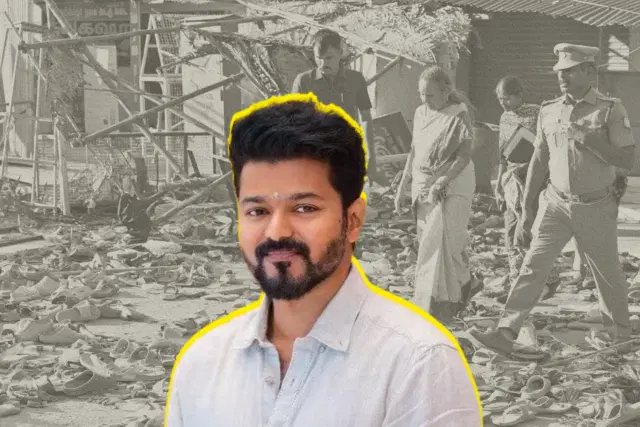
Actor-turned-politician Vijay made his long-anticipated public return yesterday in Kancheepuram, almost two months after the Karur stampede that claimed the lives of 41 innocents at his party (TVK) rally. In a sign of how seriously he now regards political risk, he spoke in the controlled confines of an auditorium rather than a mass open ground.
His first formal political speech after Karur was, however, notable for its silence on that tragedy. Not once did he mention the incident that has become the central crisis of his fledgling political career, even though the case remains in court and under CBI investigation. For a leader rebuilding his image, the decision to speak around the tragedy rather than of it seems a high-stakes bet.
The omission of any reference to Karur has, inevitably, triggered sharp debate. Critics have labelled his silence disappointing. For middle-class observers, the lack of even a brief acknowledgement or expression of remorse may appear emotionally tone-deaf, especially when 41 of his supporters died.
But from a political rebranding standpoint, the move carries a certain logic. Speaking publicly about Karur could have reopened raw wounds, shifted the conversation back to crisis, and reinforced narratives of disorganisation.
Damage control by design
The setting (an indoor People's Meeting at a private engineering college near Kancheepuram with QR-coded passes and a cap of about 2,000 attendees) was an obvious response to the chaotic Karur mobilisation model. By insisting this was not a mass rally but a controlled interaction, TVK signalled that safety, crowd discipline and image management now trump spectacle.
Politically, Kancheepuram was not a random choice. It is Annadurai’s birthplace and a sentimental node in the Dravidian movement's map, which the DMK has traditionally treated as ideological home turf. By restarting his outreach here and explicitly invoking Anna and MGR, Vijay's plan is all too apparent. He too is now laying claim to that legacy (whatever that is).
Vijay's rhetorical framing in his speech confirmed that. He reminded the audience that MGR kept Annadurai's image on the AIADMK flag, then contrasted that reverence with what he called a ruling party that had turned loot into ideology and behaved like a syndicate of dacoits.
By accusing the DMK of abandoning Annadurai's ideals, Vijay is driving home his point that the Dravidian party has now hollowed out its own doctrine. He also placed his own political journey in a timeline beginning with Parandur's anti-airport protests and restarting at Anna’s birthplace after a tragedy, even if he never named Karur.
Answering the no ideology taunt
A key objective of Vijay's speech was to rebut the DMK’s sustained narrative that TVK lacks ideological clarity or intellectual heft. Vijay answered this directly and elaborated on his party's stand on various issues, and flipped DMK's own rhetoric with wordplay, from kolkai (principles) to kollai (loot). His response allowed him to frame TVK as rights-conscious and state-autonomy oriented.
One of the speech's sharpest political instincts lay in tackling the derisive tharkuri label, the Tamil social-media stereotype of Vijay fans as illiterate and politically unserious. Vijay attacked this stigma head-on, showing that he is indeed clued in on what is unspooling at the lower level. He not only refuted the slur but dramatically repurposed it into a battle cry for change. "We are not tharkuri," he declared to roaring applause. "We are acharyakuri the exclamation mark, and maatrathirkaana arikuri (a sign of change) in Tamil Nadu politics."
He also reminded the audience that MGR's supporters were similarly dismissed as circus performers when he first launched the AIADMK. Such a framing helps Vijay deepen emotional bonding with his base, telling them that being dismissed by established parties is not a bug but a historical pattern that precedes political success.
Local anger, local promises
Vijay's speech was also tightly localised around Kancheepuram, tying macro-critique of DMK to micro-grievances in the region. He foregrounded alleged illegal sand mining on the Palar river, quoting figures running into thousands of crores (Rs 4,730 crore as per court records he cited) and accusing the ruling party of monetising a lifeline.
He linked this to the conditions of Kancheepuram’s famed weavers (still stuck with low wages and poor infrastructure) and even something as mundane as the failure to modernise the old bus stand. Reiterating support for Parandur farmers fighting the proposed airport allowed him to signal continuity with his earlier activist image.
The speech marked a shift from vague populism to pointed critique. Also, for the first time, Vijay hinted at a policy direction, outlining welfare measures that TVK might include in its 2026 manifesto. Though the economic impact of such populism can be difficult to handle, Vijay's list included permanent housing for all families, a motorcycle for every household, support to eventually buy cars, at least one earning member and one graduate per family, stronger government hospitals and stricter law and order, particularly around sexual violence cases.
Politically, this will help him speak simultaneously to the poor, the aspirational young and women voters, while reinforcing the narrative that DMK’s corruption and neglect have stalled such mobility.
Partial reset, not full reboot
The DMK response was swift and on expected lines. Its spokesperson T K S Elangovan accused Vijay of ignorance about Annadurai's history. He also tried to drag the focus back to Karur, blaming Vijay's late arrival for the deaths and demanding that he first answer why he was delayed. A second flank of attack painted Vijay as effectively reading from a BJP script, questioning why he had not raised issues like alleged voter roll manipulation if his critique was truly independent.
But make no mistake about it, Vijay's Kancheepuram speech is not a full-fledged campaign launch. As an exercise in political recalibration, its aim may have been at shifting the conversation from Vijay the leader who presided over a tragedy to Vijay the Dravidian claimant taking on the DMK's moral vacuum.
Whether this rebranding will stick depends on how he navigates the months ahead. Will he eventually address Karur with the gravity it deserves? Will he flesh out his welfare agenda beyond slogans? Will he build a cadre that goes beyond fan clubs?
In politics, as in cinema, timing is everything. For now, Vijay has bought himself time. Time to regroup, reframe and re-engage.
 Join our