Tamil Nadu
The Last Superstar-Politician? Can Cinema Still Script Power In Tamil Nadu?
K Balakumar
Jan 06, 2026, 09:57 AM | Updated 09:57 AM IST
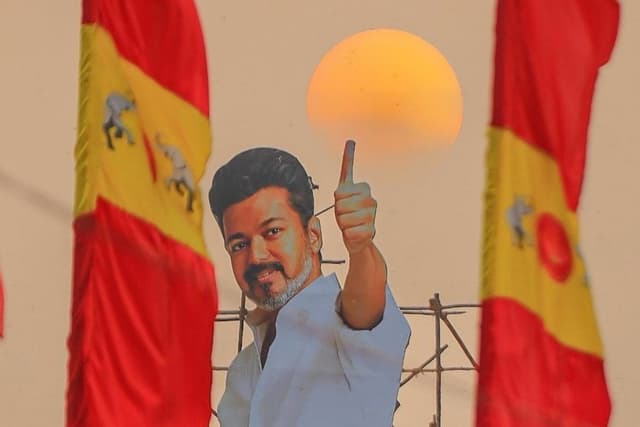
On January 10, when Jana Nayagan hits theatres, Tamil cinema will not merely be releasing another star vehicle. It will be performing a ritual farewell. Actor Vijay has announced that this will be his last film. So what will follow is not a sabbatical, but a decisive crossing over from star to full-time politician.
Tamil Nadu, of course, has seen this script before. In fact, it pioneered the genre.
No other Indian state has witnessed such a sustained, intimate, and institutionally successful overlap between cinema and politics. Here, films have not merely reflected political moods. They have in fact shaped them, sharpened them, and often weaponised them. Cinema in Tamil Nadu has served as sermon, manifesto, mobilisation tool, and mass hypnotist. It has produced Chief Ministers, broken parties and altered social hierarchies.
And yet, Vijay's entry arrives at a paradoxical moment. He inherits the most fertile legacy of cinematic politics in India, and also confronts perhaps the least forgiving political climate for it.
To understand why, one must go back not merely to MGR or Jayalalithaa, but further to the ideological roots of Tamil cinema itself.
Cinema as a weapon against empire
Tamil cinema's political DNA predates the Dravidian movement. In the 1930s and 40s, filmmakers discovered that the screen could be a way to smuggle political messages past colonial censors. K Subramanyam, one of Tamil cinema's earliest auteurs, used films like Thyaga Bhoomi (1939) to propagate Gandhian ideals. The British banned it, which only amplified its legend.
And then there were mythological films, seemingly harmless, but which carried coded messages about liberation. Stories from the Ramayana and Mahabharata were repurposed as allegories of resistance, injustice, and moral authority. Those early filmmakers proved that cinema could be a political classroom.
There was also the singer-actor KB Sundarambal, who was influenced by the Indian independence movement and recorded several gramophone discs in support of the freedom struggle. After Independence, she campaigned in support of Congress party candidates at various elections. As it happened, Sundarambal made it to the Legislative Council of Madras State in 1951 on a Congress ticket, and was the first Indian film artist to enter an Indian legislature.
What made Tamil Nadu uniquely receptive to cinema-led politics was not merely star worship, but a deeper cultural continuity between performance and persuasion. Long before the arrival of the camera, Tamil public life, more than other regions, was shaped by orality. By the power of speech, song, spectacle and staged argument. Therukoothu, Harikatha, stage drama and public oration were not entertainment divorced from civic life. In that sense, cinema did not rupture this tradition. It firmed it up.
Black and red in cinema
The Dravidian movement instinctively understood this. Its leaders were not suspicious of popular culture. They embraced it as a legitimate arena of political struggle. Unlike the Congress elite, which often viewed cinema (through the Gandhian prism) as frivolous or morally suspect, the Dravidian leadership recognised that mass politics in a modernising society required mass media. Ergo, film dialogues did the work of pamphlets. Songs replaced slogans. The hero's monologue became a substitute for the street-corner speech.
CN Annadurai and M Karunanidhi, wordsmiths of rhetoric, used the screen as an amplifier of ideology. Their film dialogues, alliterative and unapologetically political, reached millions who could never attend a political meeting or read a party pamphlet. Their words exalted Tamil identity, and articulated their avowed ideals with a flourish that made ideology entertaining.
Films like Velaikkari and Parasakthi were not accidental political works. They were carefully constructed ideological interventions. The screen became the classroom, the theatre the rally, and the hero (whoever played it) the preacher.
Yet, crucially, Anna and Karunanidhi did not attempt to become stars themselves. Their authority flowed from oratory and organisation. Cinema served the movement, not the man.
That equation would change dramatically with the arrival of one man.
MGR: the alchemy of image, ideology, and instinct
If Annadurai and Karunanidhi turned cinema into a political instrument, MG Ramachandran turned it into a political identity.
MGR's genius lay in his preternatural understanding of mass psychology and image management. He grasped something that few politicians, before or after, fully comprehended. He realised cinema conditions people.
On screen, MGR crafted a persona of moral purity and social righteousness with meticulous consistency. He did not smoke, drink, swear, or seduce. He fought only for the weak, stood against exploitation, and steadfastly upheld justice. His message songs blurred the line between film character and common man. This created a feedback loop. Voters no longer simply liked MGR's films, they believed the man on screen and the man in real life were the same moral crusader.
This was, again, not accidental. MGR exerted unprecedented control over his scripts, roles, and image. Every film became an instalment in a long political narrative. When he finally entered politics formally, he did not need to introduce himself. The electorate felt they already knew him.
And when he had a falling out with Karunanidhi and walked out of the DMK in 1972 to form the AIADMK, it was this belief that 'our' MGR would not betray 'us' that carried him.
He rode that horse of constructed goodness all the way to the Chief Minister's chair, winning three consecutive terms and turning the MGR archetype (benevolent, paternal, incorruptible in intent if not always in outcome) into the gold standard for any aspirant from the studios.
To this day, MGR remains the most sophisticated example of cinema being used as a political training ground for a leader.
Jayalalithaa was her own empress
It may be tempting to describe J Jayalalithaa as an MGR clone. She was his favoured co-star, chosen mentee, and the inheritor of his party base. But she was cast in a different mould.
Unlike MGR, who painstakingly sculpted a cinematic persona that he then imported into politics, Jayalalithaa used her film star image as a bridge, not a blueprint. While her film fame gave her initial visibility, her political power stemmed from her imposing and even intimidating personality.
Then again, unlike MGR, who cultivated affection, Jayalalithaa demanded allegiance. Her charisma was not populist warmth but regal authority. She spoke not as one among the people but as one above the fray. It was an approach that might have failed in many democracies but worked spectacularly in Tamil Nadu's political culture.
The electorate forgave her excesses, especially in her first term, not because they were blind to them, but because they perceived her as decisive, uncompromising, and fiercely protective of Tamil pride. Jayalalithaa was less a benevolent hero, more commanding matriarch. She retooled the AIADMK's welfare populism in her own image with all things 'Amma'. Her repeated victories over Karunanidhi, four times at the hustings, punctured the myth of DMK's unbeatable strategic genius.
To sum up, yes, the MGR connection gave her initial entry into the party and its mass base. But the climb from an initially humiliated, contested figure after MGR's death to an indisputable supremo was not scripted in the studios. It was forged in factional combat, statecraft and an almost steely, sometimes excessive, assertion of will.
Sivaji Ganesan: when screen greatness failed to translate
If MGR represented cinema's greatest political triumph, his arch rival Sivaji Ganesan symbolised its most poignant failure. Arguably the greatest actor of Tamil cinema, Sivaji's histrionic and linguistic talents did not convert into political traction. He remained marginal, first as a Dravidian politico, then as a Congressman and later as founder of the short-lived Tamilaga Munnetra Munnani.
Several factors may have undercut his prospects. His screen persona, intense and versatile, never settled into a single, easily politicised moral type. He played kings, anti-heroes, tragic lovers, freedom fighters and villains with equal conviction. Unlike MGR's one-note saintly heroism, Sivaji's greatest roles often foregrounded inner conflict and ambiguity. Those cinematic strengths later became electoral liabilities in a political culture hungry for certainty.
Add to this the fact that by the time he took the plunge, MGR was already fairly ahead in the political race.
Anyway, Sivaji's political journey illustrates that superstardom is necessary but not sufficient, and what matters is the compatibility of persona and moment.
Vijayakanth: almost there, but not quite
Sivaji did not reach where MGR could. But, much later, Vijayakanth came closer.
Drawing heavily from MGR's populist grammar, he positioned himself as a protector of the poor and an alternative to entrenched Dravidian elites. A popular action hero with a 'mass' image and a reputation for benevolence, Vijayakanth launched the Desiya Murpokku Dravida Kazhagam (DMDK) in 2005, consciously echoing MGR's outsider-to-saviour arc.
For a while, it worked. DMDK rapidly became a significant vote-share player, especially in 2006 and 2011, when alliances turned Vijayakanth into a kingmaker of sorts. His personal leadership style (blunt and occasionally abrasive, but seen as straightforward) resonated with voters tired of the DMK-AIADMK duopoly.
But the 'MGR formula' plateaued, as Vijayakanth did not have the same decades-long, ideologically loaded film persona. His roles were heroic, but not woven into a coherent political myth. Also politically speaking, his party's organisational depth never quite caught up with electoral needs. The DMDK depended too heavily on his personal energy and fell away with his health and reduced activity.
His middling success, enough to matter, not enough to dominate, underlines the brutal truth that charisma plus screen stardom might get you to 10-12 per cent. But turning that into a ruling mandate requires structure, ideology, and a long grind that film fandom alone cannot supply.
Rajinikanth: the non-starter
If Sivaji was the star who entered too late, Rajinikanth was one who never quite entered at all. For decades, speculation about 'Rajini's party' was a cottage industry in Tamil political commentary, fuelled by films loaded with anti-corruption and anti-establishment undertones, and by the actor's occasional political comments.
After keeping all guessing, Rajinikanth actually announced his decision to enter politics in 2017 with promises of 'spiritual politics', only to withdraw in 2020 citing health concerns. The thing is fan networks and public anticipation existed, but coherent organisational work, cadre-building, and ideological clarity never followed at scale.
Rajinikanth's case showed the limits of myth without movement. His films constructed a rebel-against-the-system persona, but his own misgivings and wishy-washy approach meant that myth was never anchored in consistent political action. His spiritual anxieties, strategic ambiguities, and reluctance to confront political realities rendered his ambitions inert. In the end, he became the eternal 'what if'. A superstar whose political era existed only as a trailer, never a full-length feature.
Kamal Haasan: a successful failure
Kamal Haasan was long considered the least likely actor to enter politics. His cinema was cerebral, experimental, and ideologically eclectic. Yet he surprised everyone by launching his party. And he even went to the extent of saying that he was quitting movies once and for all. It is a promise that he has reneged on, and that, in a nutshell, also epitomises his politics: full of convenient turns for personal reasons.
He launched Makkal Needhi Maiam (MNM) in 2018 as a 'centrist' alternative to both the Dravidian majors and the BJP. The experiment seemed bold on paper, and Kamal promised governance-focused politics, urban reform and anti-corruption, more in the mould of technocratic outfits. MNM may also have attracted some urban middle-class enthusiasm initially.
But at the polls, MNM underperformed, and the party was caught in an identity crisis. It needed someone who could stay strong at the top. But Kamal capitulated unheroically. He aligned himself with the DMK, and this meant that the party's original claim to be a distinct, anti-establishment option withered. In the public eye, the so-called rebel who once railed against the Dravidian duopoly is now a shameless supporting act for it.
His retreat underlines a structural problem. Tamil politics rewards those who either embody a grand ideological current (Anna, Karunanidhi), or crystallise a mass emotional yearning (MGR, Jayalalithaa). Kamal tried to ride a policy-heavy, 'good governance' plank with no real anchoring. He has got himself a Rajya Sabha seat for his 'efforts'. That can count as a win. But, for all practical purposes, his party and politics are a failure.
The also-rans and asides
Beyond a couple of big names, Tamil Nadu's political landscape is littered with actor-led formations that never quite became mass movements. These also-rans help understand the boundaries of what screen power can and cannot do.
Sarathkumar rode his stardom into both the DMK and the AIADMK. He was once a Rajya Sabha MP for the former and an MLA (from Tenkasi) for the latter. He has been in and out of both the parties, and also launched his own All India Samathuva Makkal Katchi. But it never broke any major ground and has since merged with the BJP.
Then there was Ramarajan, a rural star with deep B- and C-centre following in his heyday. He flirted with politics and even represented AIADMK in Parliament, but never developed an independent base as he had no real personality to create his own political equity. Much earlier, there was SS Rajendran, an actor and 'politician', who was cast in the same mould: no real conviction to their political approach. There was also T Rajendhar and K Bhagyaraj with their own political outfits and their own political stories. But nothing really beyond being footnotes.
Several TV and supporting actors have also contested on major party tickets, their celebrity appeal or caste connections (like in the case of Karunas) helping in actually winning the party tickets to contest. The actual win in the elections may have been more due to the party infrastructure and poll arithmetic.
There are also side stories with lasting institutional consequences, like that of actress Venniraadai Nirmala (in a parallel universe, she would have taken Jayalalithaa's place in AIADMK). She was controversially appointed by the MGR regime to the Tamil Nadu Legislative Council, and it was widely seen as emblematic of misuse of nominations. The subsequent abolition of the Council by MGR may have an indirect connection to her nomination running into rough weather over her personal finances. Anyway, her name is still invoked as shorthand for the era's excesses.
These episodes reiterate that star power is an accelerant or a catalyst, not a substitute, for social base and organisational depth. And without a broader movement, most actor-politicians end up as influencers in someone else's coalition rather than architects of their own.
A detour to Andhra
If MGR is the canonical Tamil example, NT Rama Rao is the Andhra (Telangana) echo, albeit with a sharper ideological stroke. Like MGR, NTR built his fame playing gods, most famously Krishna and Rama, and larger-than-life heroes on screen. He became a near-deity to vast swathes of Telugu audiences.
Riding on that groundswell of support, he founded the Telugu Desam Party (TDP) in 1982 with a clear plank of Telugu self-respect and anti-Congress federal assertion. Within nine months, he stormed to power in Andhra Pradesh, demonstrating how film-enabled charisma plus a coherent regional-national message can overturn entrenched national parties.
The NTR story showed that the 'actor-leader' model travels across borders when tied to a strong linguistic-regional assertion. It underscored how quickly such charisma can be institutionalised if organisational work is done right, something many Tamil aspirants after MGR did not fully manage.
In other words, NTR vindicated the MGR instinct: cinema can be an engine for state-level political revolutions, but only if it is hitched to a robust, rooted political project.
Vijay in 2026: his hardest exam
Which brings the story back to Vijay and Jana Nayagan. In Malaysia, at the film's grand audio launch, billed as Thalapathy Thiruvizha, he all but signed his separation papers with the industry, telling over a lakh fans that he was 'giving up cinema' for those who had built him a 'koattai' (fort). The choice of word was deliberate. In Tamil political vocabulary, 'koattai' is a clear wink at Fort St George and the seat of power it represents.
By now, Tamilaga Vettri Kazhagam is more than a teaser line in his speeches. The party has a name, a flag, a symbol and a solemn pledge read out in public. On screen, Vijay seems to have been road-testing this pivot for years. Films like Thuppakki, Mersal, Sarkar and Varisu are studded with calibrated political cues against corruption, for welfare, and for Tamil assertion. They were pitched squarely at a younger electorate that consumes politics and pop culture in the same breath.
And yet, the exam Vijay walks into in 2026 is tougher than any faced by the actor-politicians he may have grown up watching. The old Dravidian imagination is already crowded and also been exposed. The state has seen the ideologue-writers in Anna and Karunanidhi, the messianic welfare hero in MGR, the iron matriarch in Jayalalithaa, the permanently hesitant superstar in Rajinikanth, and the shambolic politics of Kamal Haasan.
Vijay's first task is to convince voters he is not a remix of these templates. His filmography casts him as the guardian of the poor and the scourge of crooked systems. But that grammar has been extensively used, and arguably exhausted, since the heyday of MGR and, later, Vijayakanth. Unlike Anna or Karunanidhi, he does not arrive with an ideological oeuvre. Unlike Jayalalithaa, he does not inherit a battle-tested party machine that can be switched from 'MGR mode' to 'Amma mode' overnight.
The electorate he faces is also far more splintered, and far more jaded, than the Tamil Nadu of the 1970s or early 1990s. MGR and early Jayalalithaa lived in an era of broadcast politics. Vijay, on the other hand, is stepping into social media outrage cycles, streaming platforms, 24x7 news shows, meme pages and political satire channels all slicing and remixing his every word in real time. Every gesture is frame-grabbed, captioned, spun through partisan ecosystems.
The aura of mystery that once insulated MGR, and even long shielded Rajinikanth, is now almost impossible to sustain. Voter loyalties, meanwhile, are cut along finer lines of caste blocs, regional sub-identities and hyper-local grievances. This makes it that much harder for a single, emotive 'Thalapathy wave' to wash across the map.
Cinema may still matter, but it no longer monopolises imagination. WhatsApp groups, micro-influencers, caste associations and resident-welfare leaders compete for narrative control. Vijay's face and name may guarantee attention, but nothing is guaranteed after that.
Also, the post-liberalisation Tamil voter is less captive, less patient, and far more transactional. Welfare schemes are expected, not worshipped. Rajinikanth and Kamal Haasan, in different ways, underestimated this change. Rajinikanth believed moral symbolism could substitute for political risk. Kamal believed intellectual seriousness could substitute for emotional anchoring. Both misread a polity that had grown sharper, not softer.
TN's new political experiment
The biggest hurdle for Vijay, however, lies off-screen, in the unglamorous grind of organisation and ideology. MGR and Jayalalithaa, and across the border NTR, either built or seized control of powerful party structures with dense booth-level networks, cadre loyalty and a well-understood welfare-identity package. Vijay begins with something looser and more volatile: amorphous fan clubs and urban youth fandom whose contributions are mostly emotional rather than institutional.
The point is social media virality is not the same as organisational loyalty. A million retweets do not translate automatically into a thousand booth agents on polling day. There is also the unresolved question of ideology. Tamil Nadu's electorate has historically rewarded clarity, even when it disagrees with it. Anna's rationalism, Karunanidhi's Dravidian rhetoric, MGR's welfare populism, Jayalalithaa's authoritarian maternalism: each was legible, even to critics. Vijay's politics so far gestures at justice, anti-corruption and Tamil pride. But he has avoided sharp and specific commitments or comments on the raging issues of our times. This ambiguity may protect him in the short term, but it will be tested relentlessly once elections draw near.
The questions now are brutally simple. Can TVK turn fan clubs into disciplined cadres who will do the un-filmy work of door-to-door canvassing, voter roll clean-up and poll-day mobilisation? Can Vijay move beyond generic anti-corruption rhetoric and youth-friendly soundbites to articulate a clear stance on the big arguments of the day? Can he stitch alliances without looking like just another satellite orbiting existing power centres, the fate that shrank Kamal's MNM and several other star-led experiments into footnotes?
But there may be one factor working quietly in his favour. Vijay is not merely another actor entering politics. He is possibly the last of a particular kind: the era of the undisputed mass hero, whose films open simultaneously in cities and villages, and one who commands first-day-first-show reverence across caste and class. This kind itself is nearing sunset. Younger stars are segmented, niche-driven, algorithmically boxed. Vijay stands at the tail-end of a lineage that still remembers what mass unanimity feels like.
That makes his gamble unusually consequential. If he succeeds, he may become the last great superstar-politician of Tamil Nadu. If he falters, he will join the ranks of quite a few that Tamil Nadu is no real stranger to.
Either way, Jana Nayagan may mark not just the end of Vijay's film career, but the beginning of Tamil Nadu's next big experiment: a test of whether cinema can still script power, or whether that plot has finally run out.
 Join our