Tamil Nadu
Why DMK Admin Blocking Thiruparankundram Deepam Wounds Both The Constitution And Civilisation
Shubhendu Anand and Abhishek Dwivedi
Dec 06, 2025, 06:55 PM | Updated 07:02 PM IST
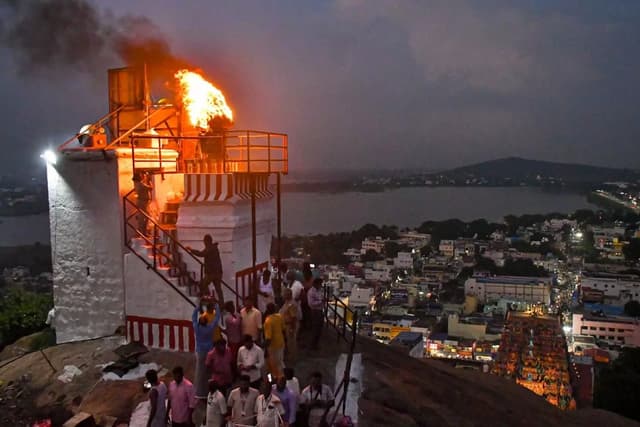
A rocky hill on the outskirts of the Madurai district of Tamil Nadu became the unlikely stage of a dramatic conflict between a constitutional institution and the executive power backed by the DMK government in Tamil Nadu.
Thiruparankundram hill hosts important religious sites, the sacred Subramaniya Swamy temple (one of the six abodes of Murugan), the ancient Jain caves, and the 14th-century dargah of Sikkander Badusha, the last barbaric ruler of the Madurai (Malabar) Sultanate.
What began as a dispute over the lighting of the Karthigai Deepam (ceremonial lamp lighting) at Deepathoon (an ancient stone lamp pillar) located at Thiruparankundram hill soon turned into direct conflict, when the TN government wilfully and deliberately defied compliance with a binding order of the Madras High Court.
Justice G.R. Swaminathan of the Madras High Court's Madurai Bench categorically directed the temple authorities to light the Karthigai Deepam at Deepathoon "from this year onwards". The court also emphasised that lighting a symbolic lamp "cannot offend anyone's sensibilities".
Despite the clear order of the Hon'ble Court, the DMK government deliberately ignored the court order and imposed a prohibitory order under Section 163 of the Bharatiya Nyaya Sanhita, 2023, which mirrors Section 144 of the Code of Criminal Procedure, 1973, across Thiruparankundram, to freeze the execution of the court order on the ground.
The confrontation persisted until the division bench of the Madras High Court upheld Justice Swaminathan's order and called the state's appeal "a ruse to circumvent timely compliance".
To many observers, the struggle over the lighting of the Deepam may appear to be no more than a mere quarrel about a ritual on a hill. However, the arc of history is much longer, and it tells many unsettling stories of the collision of temple spaces and religious traditions.
Nowhere was this collision more barbaric than during the brief but brutal rule of the Madurai Sultanate in the 14th century.
In order to understand the significance of today's dispute, one must place it on the pedestal of time when there were no courts to intervene, no constitutional safeguards to protect religious practice, and no judges like Justice Swaminathan who stood between the faith of the native Hindus and the force of the barbaric invaders.
The emergence of Madurai Sultanate followed the decline of Delhi Sultanate in the southern provinces when the ruler of Ma'bar, Jalaluddin Ahsan Khan, declared independence around 1335 CE from the Delhi Sultanate and set up the Madurai Sultanate.
The sultanate had 8 different rulers over a span of 43 years before it was defeated by the Vijayanagara Empire. What makes this Sultanate stand out in the historical record is not simply its instability but the way it governed the native Hindus and how systematic violence, temple desecration, and religious atrocities were used against the "infidels".
The Madurai Sultanate did not invent these tactics, rather they inherited both the territories and the temperament from the Delhi Sultans, whose regime was full of temple raids, plunder, and mass killings of Hindus.
The new rulers in Madurai adopted and intensified these practices, embedding them into the machinery of governance rather than limiting them to episodic military expeditions.
Ibn Battuta, the Moroccan Muslim explorer who was married in the ruling family of Madurai Sultanate mentions in his visit to Ghiyas-ud-Din Muhammad Damghani's court, one of the most notorious sultanates of Madurai, the atrocious behaviour of the Sultan towards the local population.
His army, under his personal orders, had the habit of frequently rounding up the local Hindu villagers, indiscriminately impaling them on sharpened wooden spikes and leaving them to die.
In his travelogue Rihla, Ibn Battuta describes Ghiyasuddin Dhamgani's actions as:
...the Hindu prisoners were divided into four sections and taken to each of the four gates of the great catcar. There, on the stakes they had carried, the prisoners were impaled. Afterwards their wives were killed and tied by their hair to these pales. Little children were massacred on the bosoms of their mothers and their corpses left there. Then, the camp was razed, and they started cutting down the trees of another forest. In the same manner did they treat their later Hindu prisoners. This is shameful conduct such as I have not known any other sovereign guilty of. It is for this that God hastened the death of Ghiyasuddin.
In another episode, Battuta recounts:
One day whilst the Quzi and I were having our food with (Ghiyasuddin), the Qazi to his right and I to his left, an infidel was brought before him accompanied by his wife and son aged seven years. The Sultan made a sign with his hand to the executioners to cut off the head of this man; then he said to them in Arabic: 'and the son and the wife.' They cut off their heads and I turned my eyes away. When I looked again, I saw their heads lying on the ground.
Ibn Battuta further describes the plight of common Hindus during the time of Madurai Sultanate. He writes:
I was another time with the Sultan Ghiyasuddin when a Hindu was brought into his presence. He uttered words I did not understand, and immediately several of his followers drew their daggers. I rose hurriedly, and he said to me; 'Where are you going'? I replied: 'I am going to say my afternoon (4 o'clock) prayers.' He understood my reason, smiled, and ordered the hands and feet of the idolater to be cut off. On my return I found the unfortunate swimming in his blood.
A parallel testimony comes from Gangadevi, the 14th-century princess-poet of the Vijayanagara Empire. Gangadevi describes the Madurai Sultanate's rule in her poems as:
I very much lament for what has happened to the groves in Madurai. The coconut trees have all been cut and in their place are to be seen rows of iron spikes with human skulls dangling at the points. In the highways which were once charming with the sounds of anklets of beautiful women, are now heard the ear-piercing noises of Brahmanas being dragged, bound in iron fetters and then beheaded. The waters of Tambraparni which were once white with sandal paste rubbed away from the breasts of charming girls are now flowing red with the blood of cattle slaughtered by the Turushka miscreants.
These two consistent stories tell how the Madurai Sultanate used religious persecution and barbarity as the state policy.
When a state today tries to alter or prohibit religious practice within an ancient religious space, it provokes the civilisational reaction of the communities, whose collective memory includes invasion, forced conversion, desecrations of places of worship, exiles of deities, and massacres of devotees.
The symbolism of a lamp lit at the correct location is reclaiming a space long contested, by invaders then, and by administration now.
The authors, Shubhendu Anand & Abhishek Dwivedi, are advocates practicing in the Supreme Court of India.
 Join our