Tamil Nadu
Why Tamil Nadu's 'Pullingo' Debate Is Really About Violence, Not Just Subculture And Slang
K Balakumar
Dec 31, 2025, 07:30 AM | Updated Dec 30, 2025, 07:30 PM IST
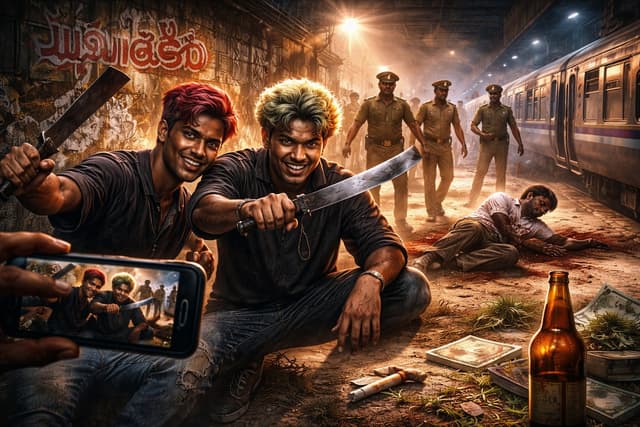
The word Pullingo has once again exploded into Tamil Nadu's public discourse, dragged there by an act of chilling violence. On a train, and later at Tiruttani railway station, four minors brazenly attacked a 34-year-old migrant worker from Madhya Pradesh, Siraj, with sickles, reportedly because he objected to them filming an Instagram reel flaunting weapons.
The youths recorded the assault, posed with victory signs, and circulated the video. The brutality of the act, and the casual performativity surrounding it, has shaken the State.
Reactions to it have been swift. Congress MP Karti Chidambaram urged the police to ‘crush the Pullingo menace with an iron hand.’ Others have echoed the same sentiment, warning of a growing culture of drugs, weapons and lawlessness among sections of youth in Tamil Nadu.
Predictably, the backlash followed just as quickly. Accusations of casteism, profiling and moral panic have been thrown back at those criticising Pullingo culture.
Who are these Pullingos?
The term Pullingo (originally a Tamil term of endearment broadly meaning ‘kids and younger brothers’) was popularised years ago by the viral Gana song Gumbalaga Suthuvom. Crooned by Gaana Stephan, it attracted several million views on social media in a short span.
The digital footprint of this subculture has expanded exponentially, manifesting through a sprawling network of social media identities. In the physical world, the hallmarks of Pullingo are neon-coloured hair, modified bikes, and skinny jeans.
Pullingo, to some, refers loosely to reckless bike riders, public nuisances or loudmouthed social media braggarts. To others, particularly from North Chennai, it has come to function as a classist or caste-coded slur, used to stigmatise underprivileged youth in job interviews, colleges and public spaces.
In general, North Chennai is often portrayed in cinema as a ‘sin city’ or a ‘gangster’s den’, and it is here that the unique Madras Bashai dialect was born.
This elaborate backgrounder is needed to understand why the Pullingo phenomenon is being debated so fiercely from opposite sides.
Booze and ganja at the core of the problem
As noted earlier, the Tiruttani incident was not a case of youthful exuberance gone wrong. It involved, reportedly, weed, sickles, organised intimidation and the filming of violence as content for social media.
This combination of drugs, weapons and digital validation is what has the general public in the State worried.
To collapse this angst into a question of ‘elitist prejudice’ is to miss the point and evade responsibility. The truth is that the current anxiety around Pullingo is not about slang, style or subculture. It is about crime, criminal intimidation and the steady normalisation of violence.
Make no mistake about it, ganja sits at the heart of this ecosystem. Over the past decade, the availability of cheap, potent cannabis has increased sharply in several urban pockets of Tamil Nadu. Law enforcement officials privately admit that ganja has become the gateway substance for many young offenders, lowering inhibitions and feeding bravado.
Dealers operate with alarming ease, while users flaunt consumption online through songs, reels and coded slang. The result is a numbing of consequences. Violence feels theatrical, even heroic, when filtered through a phone camera.
That brings us to the parallel universe of Pullingo handles that thrive on Instagram and YouTube, churning out brashly worded songs and videos that glorify knives, alcohol, drugs and defiance of authority. These are not sociological expressions of marginalised pain.
They are often crude celebrations of menace. Likes, shares and followers function as applause, pushing young men to escalate their edgy, disagreeable behaviour for digital clout.
Kollywood, a culprit too
Tamil cinema, too, cannot entirely wash its hands of the problem. While films have explored subaltern anger and resistance with nuance, a recent spate of movies has flattened this complexity into swagger.
The anti-hero is no longer conflicted or even tragic. He is cool, violent and rewarded. The visual grammar of slow-motion walks, weapon flourishes and background scores that cheer aggression bleeds seamlessly into social media mimicry.
When cinema stops interrogating violence and starts aestheticising it, the line between representation and endorsement collapses.
Calling out this cultural shift is immediately branded as elitism or caste hatred. But there is nothing progressive about romanticising thuggery. Celebrating indigenous subcultures is entirely legitimate. Ennobling drug-fuelled aggression is not.
One can oppose profiling and police excesses while still insisting that crime be confronted firmly.
Earlier this year, reports emerged of police profiling young men based on appearance under the Pullingo label. To be sure, such actions weaken the State’s moral authority and hand ammunition to those who argue that the entire discourse is about oppression rather than public safety.
But to respond to police misconduct by denying the existence of a real problem is to abandon victims like Siraj. A migrant worker travelling by train should not have to fear being attacked for objecting to a reel.
It is not boomer outrage
Tamil Nadu needs a crackdown on crime and drugs, irrespective of where it emanates from. This requires intelligence-led policing, serious action against ganja networks, and accountability for digital platforms that profit from inflammatory content.
Equally, it demands cultural introspection. Filmmakers, musicians and influencers cannot forever claim neutrality while feeding a market that thrives on glorified lawlessness. Freedom of expression does not mean freedom from consequence.
When violence is endlessly aestheticised, it eventually spills off screen.
There is nothing elitist in older people, parents or community elders calling this out. Dismissing such concerns as ‘boomer outrage’ or ‘middle-class morality’ is both lazy and wrong.
Societies have always relied on some form of inter-generational common sense to draw boundaries between rebellion and outright harm. Celebrating local language, humour and style can and should coexist with a firm rejection of blades, booze, ganja and the casual terrorising of public spaces.
The word Pullingo will likely remain contested. Perhaps it should. But the violence, drugs and performative cruelty associated with its most extreme manifestations should not be debated away.
Tamil Nadu’s unease is not imagined. It is rooted in blood on a train floor, in sickles raised for a reel, and in a culture that too often mistakes brutality for some assumed rebellion.
 Join our